Bronze Age International Trade and Credit (2000–1200 BCE)
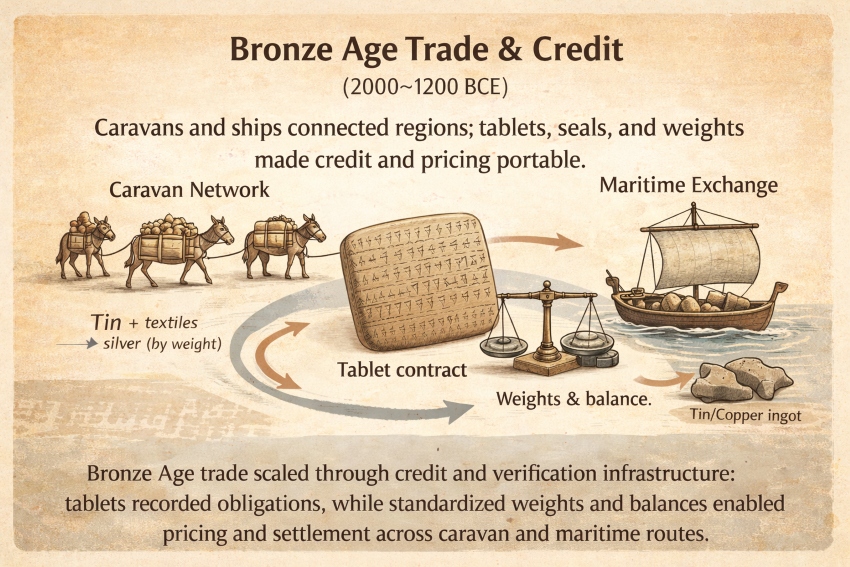
“Bronze Age trade and credit: caravans and ships moved tin and textiles for silver; tablets and weights supported pricing and settlement.”
Summary of events during the period
Between roughly 2000 and 1200 BCE, long-distance exchange scaled beyond occasional barter into repeatable, finance-enabled networks. The clearest window is the Old Assyrian merchant diaspora in Anatolia (the kārum system), where private archives show organized caravan trade, agency relationships, and credit instruments recorded on clay tablets. Later in the Late Bronze Age, maritime exchange tied the Eastern Mediterranean together; shipwreck evidence and diplomatic correspondence indicate large multi-commodity shipments, standardized weights, and high-trust “elite” exchange that blurred gift, trade, and political obligation.
Payment media (what people used to pay)
- Silver by weight remained a key settlement medium and unit of account in many interregional transactions (especially in merchant contexts). Old Assyrian texts explicitly describe merchants importing tin and textiles and selling them for silver and gold in Anatolia.
- Commodity bundles (tin, copper, textiles, grain, oils, resins) were both the traded “goods” and, in many cases, the practical settlement medium (repayment in kind, deliveries against obligations). The Uluburun wreck shows bulk metals alongside diverse high-value items in a single commercial movement.
- Standard weights and balances were core infrastructure for value verification and pricing across markets and cultures; the Uluburun assemblage includes balance weights, consistent with weight-based valuation and settlement.
How prices were set (negotiated vs administered vs regulated)
Negotiated pricing (merchant-to-merchant and merchant-to-buyer)
- Old Assyrian archives describe commission sale and agency and contain letters and records tied to caravan trade—an environment where price, timing, and credit terms are actively managed rather than simply imposed.
Administered/elite exchange (diplomatic gifting with economic content)
- Late Bronze Age “Great Kings” diplomacy used structured gift exchange that functioned as a strategic allocation system (to secure loyalty, provision allies/vassals, and signal status). The Amarna corpus provides explicit evidence of requested and granted transfers—including provisions and precious metals—embedded in political relationships.
Dual price regime
- This epoch is best explained as a dual price regime: (1) merchant pricing shaped by negotiation, risk, and credit; and (2) elite/state-directed transfers that are economically real but politically governed.
How payments cleared (the “rails”)
- Clay-tablet credit and settlement: A concrete example is an Old Assyrian loan tablet documenting a sizeable silver debt with a staged repayment schedule and interest if not repaid on time, validated by witnesses and seals—i.e., a formal credit instrument with enforcement signals.
- Network clearing through agents and colonies: The kārum Kanesh functioned as an administrative and commercial hub within a wider network of settlements and stations, enabling repeat transactions, recordkeeping, and dispute handling across distance.
- Maritime bulk shipment: Late Bronze Age sea trade moved standardized bulk cargo (notably copper and tin for bronze production) and luxury goods. The Institute of Nautical Archaeology’s Uluburun project summarizes this as a mixed cargo consistent with intense maritime exchange.
Trust and governance (why anyone accepted it)
- Private-law credibility (merchant archives): Old Assyrian archives were private, household-held records, stored in “sealed/guarded” rooms; they include contracts and claims designed to persist over years and across parties.
- Seals, witnesses, and documentation: Credit instruments explicitly list witnesses and use sealed envelopes—practical anti-fraud and enforcement technologies in a pre-modern legal environment.
- Political hierarchy in exchange: In Late Bronze Age diplomacy, transfers were governed by sovereignty and vassalage logic; the “terms” are not purely market terms, but they are enforceable through political power.
Revenue model (who made money from the system)
- Intermediation and arbitrage: Merchant profit came from moving scarce inputs (e.g., tin for bronze) and high-value textiles across regional price differentials, using agents and credit to scale throughput.
- Interest and credit discipline: Credit contracts that accrue interest and specify repayment timing represent a direct revenue channel for lenders and a risk mechanism for the network.
- State/elite rents: Diplomatic exchange and grants can be analyzed as a revenue/loyalty technology: transfers purchased compliance and stabilized control at (from the center’s perspective) an efficient cost.
Failure modes and constraints
- Logistics risk: Caravan routes and maritime routes concentrate risk in transport (seasonality, security, ship loss). Uluburun is the clearest reminder: a single wreck can represent enormous value in transit.
- Credit risk and enforcement: When settlement is delayed and interest accrues, default becomes a system-level hazard; the documentation emphasizes witnesses, seals, and durable records precisely because the risk is real.
- Political shock: Diplomatic exchange is highly sensitive to regime change and conflict; when political order collapses, the rails of elite exchange can collapse with it.
What scaled it (the scaling technology)
- Standardized weights/measures + balances: essential for pricing and settlement across languages and jurisdictions.
- Portable, durable documentation: clay tablets, sealed envelopes, and archiving practices allowed credit relationships to persist across distance and time.
- Institutional hubs and routes: kārum networks and high-intensity maritime corridors turned trade into repeatable infrastructure rather than episodic contact.
Sources
- Veenhof, K.R. “The Archives of Old Assyrian Traders: their Nature, Functions and Use” (PDF). https://www.openstarts.units.it/bitstream/10077/8658/1/Veenhof_Archives.pdf
- The Metropolitan Museum of Art (Public Domain): “Cuneiform tablet: loan of silver” (Old Assyrian Trading Colony). https://www.metmuseum.org/art/collection/search/325858
- Institute of Nautical Archaeology: “Uluburun Late Bronze Age Shipwreck Excavation” (summary page). https://nauticalarch.org/projects/uluburun-late-bronze-age-shipwreck-excavation/
- Powell et al. (2022), Science Advances: “Tin from Uluburun shipwreck…” (article page). https://www.science.org/doi/10.1126/sciadv.abq3766
- Abo-Eleaz, M.E.E. (2021), Antiguo Oriente (PDF): “The Reward of the Pharaohs… Gifts in the Amarna Letters.” https://archaeopresspublishing.com/ojs/index.php/AntOr/article/download/1941/1516
- Erol, H. (2019), Belleten: “Old Assyrian Metal Trade, its Volume and Interactions” (article page). https://belleten.gov.tr/tam-metin/398/eng