Part 1 — Coriander (Cilantro): the plant, the terms, and the lifecycle
Coriander is a fast-growing annual herb with two distinct products:
- Leaves = “cilantro” (fresh herb)
- Seeds = “coriander” (dried spice)
Biologically, the plant is programmed to transition quickly from vegetative growth (leaves) into reproductive growth (flowering → seed). This transition is called bolting (rapid stem elongation followed by flowering). For leaf growers, bolting is the enemy. For seed growers, bolting is the objective.
What triggers bolting (and why it matters for seed)
Coriander’s switch into reproductive mode is strongly influenced by:
- Warmer temperatures (faster development)
- Longer photoperiod (often accelerates flowering depending on variety and conditions)
- High light + warmth (rapid maturation)
- Stress events (notably drought cycles; can accelerate bolting but may reduce seed quality if severe)
For seed production, you typically want:
- A healthy vegetative base first (enough plant mass to support flowering)
- Then conditions that encourage bolting and flowering, without causing severe stress that aborts flowers or seeds.
What “successful seed production” looks like
- Strong central stems with multiple umbels (the flower clusters)
- A flowering phase with consistent pollen movement (airflow helps)
- Gradual browning and drying of seed heads
- Timely harvest before seeds shatter and fall
Part 2 — How to grow coriander for seeds (coriander spice) in soil/pots
1) Choose “seed mode” targets (this is intentionally different from leaf mode)
Environmental targets by stage (seed-focused)
| Stage | Air temp (°C) | RH (%) | VPD (kPa) | Light PPFD (µmol·m⁻²·s⁻¹) | Photoperiod (h) | DLI (mol·m⁻²·d⁻¹) | Water strategy | Nutrition strategy |
|---|---|---|---|---|---|---|---|---|
| Germination (0–10 d) | 16–20 | 60–75 | 0.4–0.8 | 50–150 | 12–14 | 2–8 | Evenly moist; avoid saturation | None to very light |
| Establishment (7–21 d) | 16–20 | 50–70 | 0.6–1.0 | 150–250 | 12–14 | 6–12 | Moist, not wet; prevent damping-off | Light balanced feed |
| Vegetative build (14–35 d) | 18–22 | 45–65 | 0.8–1.2 | 250–400 | 13–16 | 12–20 | Regular watering; avoid hard drydowns | Moderate N early (balanced) |
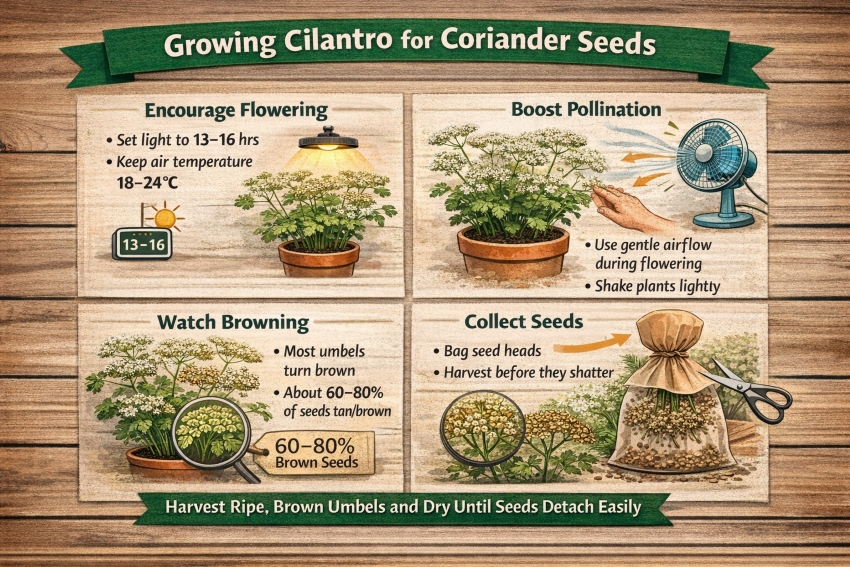
| Flowering/seed set (30–70 d) | 18–24 | 40–60 | 0.9–1.4 | 300–450 | 13–16 | 14–22 | Steady moisture; allow mild dryback but no wilting | Shift to lower N, adequate K + micros |
| Seed drying/ripening (60–90 d) | 18–24 | 35–55 | 1.0–1.6 | 250–400 | 12–14 | 10–18 | Reduce watering gradually as heads brown | Minimal feeding; avoid salt buildup |
Key seed-mode principle: encourage bolting via moderately warm temps + long-ish days, but keep the plant stable and well-watered so flowers and seeds don’t abort.
2) Pot, soil, spacing: set up for flowering (not dense leaf harvest)
- Pot size: 2–5 L per plant is a practical seed-production size indoors. Larger is fine if you can accommodate it.
- Spacing: give plants room. For seed, avoid dense sowing; crowding reduces branching and umbel formation.
- Soil: well-draining potting mix (add perlite if needed). Seed production benefits from consistent root aeration.
- Support: flowering stems can get tall and top-heavy; a small stake can prevent lodging.
3) Pollination indoors: airflow is your “insect substitute”
Coriander flowers are small and typically benefit from insects outdoors. Indoors, you can still get good seed set by ensuring pollen moves:
- Run a gentle oscillating fan during flowering.
- Optionally tap/shake flowering stems lightly once a day.
- Keep RH moderate (very high RH can reduce pollen performance and increases mold risk).
4) Watering strategy for seed quality (avoid the two extremes)
Avoid:
- Constantly saturated soil (root issues, mold)
- Severe drought/wilting cycles (flower abortion, poor seed fill)
Best practice:
- Use pot weight (or consistent watering routine) to keep moisture stable.
- During flowering and seed fill, prioritize consistency over “dryback.”
If you use a pot scale:
- Define Field Capacity Mass (fully watered, drained).
- Define a No-Wilt Floor (lowest safe mass before stress).
- Irrigate before reaching the floor; this is especially important in flowering/seed fill.
5) Nutrition for seeds: build first, then shift
- Vegetative build: balanced fertilizer with moderate nitrogen (enough to build canopy and stems).
- At first signs of bolting/flower stalks: reduce nitrogen intensity and keep nutrients steady.
- Flowering/seed fill: ensure potassium and micronutrients are not limiting; avoid over-fertilization that increases salts and stress.
Practical approach indoors:
- Light, consistent feeding is safer than occasional heavy feeding.
- If you see tip burn plus high fertilizer frequency, back off and flush once.
6) Minimal instrumentation that materially improves seed success
Tier 1 (high ROI)
- Air T/RH sensor (I²C) at canopy height, shaded from direct LED
- Light sensor (I²C BH1750, lux) at canopy height for stability/trend
- Pot weight (load cell + HX711) to prevent drought stress during flowering
Tier 2 (helpful during flowering)
- CO₂ sensor (SCD41, I²C) if your room is often closed (low CO₂ can limit growth)
- Second T/RH sensor to detect gradients near window/heater
Placement rules (important):
- Keep sensors at canopy height, out of direct lamp radiation and not in a strong fan jet.
- Keep the light sensor position consistent relative to canopy.
7) Calibration and validation (only what you actually need)
- Pot scale: calibrate with known weights (2–3 points); verify zero drift weekly.
- Lux → PPFD: optional. For seed production you mainly need consistency, not absolute PPFD. If you can borrow a PAR meter briefly, do a one-time calibration.
- Soil moisture probe: treat as a trend/threshold tool; validate against pot weight.
8) Minimal data schema and sampling rates (seed-focused)
Fields
tsair_temp_C,air_rh_pct,vpd_kPa(derived)light_lux(and optionally estimatedppfd)photoperiod_on(0/1)pot_mass_g+pot_mass_rate_g_per_h(derived)irrigation_event_mlstageordays_since_sow- Optional:
co2_ppm
Sampling
- T/RH/light: every 30–60 s
- Pot mass: every 1–2 min
- Derived daily summaries: DLI, daily min/mean/max temp, total irrigation
9) If–then diagnostics (seed production)
IF flowering is sparse (few umbels)
AND light is low (lux trend low) or photoperiod short
- Likely: insufficient DLI / photoperiod for reproductive push
- Action: increase PPFD modestly and/or set photoperiod to 13–16 h
IF flowers appear but seed set is poor
AND there is little airflow
- Likely: poor pollen transfer indoors
- Action: gentle fan during flowering; light daily shaking/tapping
IF flowers abort / seeds don’t fill
AND pot mass shows repeated dips below your “no-stress floor”
- Likely: drought stress during seed fill
- Action: tighten irrigation control; water before stress threshold
IF mold appears on umbels
AND RH is high (>65–70%) or airflow is weak
- Likely: microclimate humidity around flowers
- Action: increase airflow, reduce RH, avoid wetting flowers during watering
IF plants flop over during flowering
- Likely: weak stems (too low light) or top-heavy growth
- Action: increase light during vegetative build; stake stems before full flowering
10) Harvesting and drying seeds (practical indoor method)
When to harvest
- Harvest when most umbels are brown and seeds are tan/brown, but before they shatter easily.
- A common approach: when roughly 60–80% of seed heads have browned.
How to harvest
- Cut stems/umbels into a paper bag (or bag the heads first), because coriander seeds drop easily.
Drying
- Dry in a warm, ventilated spot out of direct sun until seeds detach easily (often 1–2 weeks).
- Thresh by rubbing umbels gently; remove chaff; store airtight.
Optional combined approach (leaves first, then seeds)
If you want both products from the same plant:
- Harvest leaves lightly during vegetative build (don’t strip the plant).
- Once bolting starts, stop heavy leaf harvest and focus on stable water + airflow for flowers/seed fill.