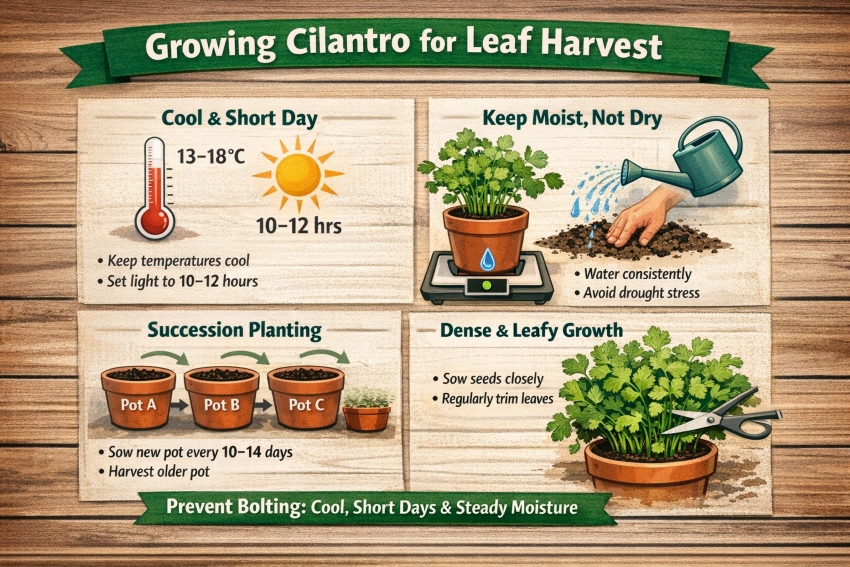
Part 1 — Coriander (Cilantro): what it is and why it “runs away” indoors
Coriander / cilantro (Coriandrum sativum) is a fast, cool-season herb. We usually grow it for the fresh leaves (“cilantro”), while the seeds are harvested later as “coriander.” Indoors it can be extremely productive—if you accept one key fact: cilantro is genetically biased to bolt (switch from leaf production to flowering) when conditions signal “summer.”
Leaf vs seed mode (what the plant is optimizing for)
- Leaf mode: compact growth, broad leaves, frequent harvest, short lifecycle.
- Reproductive mode (bolting): stem elongation → flowers → seed set. Leaves become finer and less abundant.
Cilantro doesn’t bolt randomly. It bolts because it interprets environmental inputs as a seasonal cue:
- Warm temperatures accelerate development.
- Long days (photoperiod) push the plant toward flowering in many varieties.
- Stress events (especially drought cycles: dry → re-wet) can speed up the transition.
- Very strong light + warmth can “push it fast” into maturity.
This is why cilantro often disappoints indoors: many indoor setups are warmer and run long photoperiods (14–16 h) designed for fruiting crops. That is nearly the opposite of what cilantro wants when the goal is leaves.
The practical implication
If you want a steady leaf supply, the most reliable strategy is:
- run cilantro in a cool, short-day regime to delay bolting, and
- succession-sow small batches so you’re never dependent on one pot that will eventually bolt.
Part 2 — How to grow coriander for leaves (long leaf window, minimal bolting)
This section is optimized for leaf harvest in soil/pots in a Swedish apartment with limited space.
1) Target “leaf-mode” environment (the anti-bolting operating envelope)
If you only remember one set of numbers, make it these:
- Air temperature: 13–18°C (cool is your friend)
- Photoperiod: 10–12 hours (avoid long-day schedules)
- Light intensity: moderate (enough for growth, not so high it accelerates maturity)
- Moisture: stable (avoid drought cycles)
A good indoor leaf-mode target band by stage:
Germination (0–10 days)
- Temp: 16–20°C
- RH: 60–75%
- Light: low–moderate (50–150 PPFD if you have PPFD; otherwise just keep lights gentle)
- Water: evenly moist, never waterlogged
Seedling (7–21 days)
- Temp: 15–19°C
- RH: 55–70%
- Light: moderate (150–250 PPFD)
- Water: “moist, not wet,” avoid saturated soil
Vegetative leaf harvest (14–45 days)
- Temp: 13–18°C
- RH: 50–70%
- Light: moderate (200–350 PPFD)
- Photoperiod: 10–12 h
- Water: steady moisture; no hard dry-down
Pre-bolt risk management (whenever stems start elongating)
- Temp: keep ≤18°C if possible
- Photoperiod: 10–11 h
- Light: reduce slightly if growth is getting “too fast”
- Water: tighten control; never let it droop
2) Soil, pot, and sowing density (what actually works in small space)
For leaf production you can sow cilantro denser than you would for single large plants.
- Pot depth: 12–18 cm is typically enough for leaf production.
- Soil: airy potting mix with good drainage (avoid heavy, water-retentive mixes that stay saturated).
- Sowing: crush/split coriander “seeds” (they’re actually fruit) gently to improve germination uniformity.
- Density: dense sowing is fine; thin lightly only if airflow is poor.
A simple pattern for continuous leaves:
- Use 2–4 small pots rather than one big pot.
- Stagger sowing so one pot is always coming into harvest while another is finishing.
3) Watering strategy designed to prevent bolting
Cilantro hates two extremes: constant saturation and hard drought cycles. The bolting accelerator is often the drought cycle.
A practical rule:
- Keep the root zone consistently moist.
- Let the surface dry slightly between waterings, but do not let the plant droop.
If you measure pot weight (highly recommended):
- Define a “fully watered” pot mass (after watering and draining).
- Define a minimum mass threshold that you never cross (your “no-stress floor”).
- Irrigate when you approach that floor, not after symptoms appear.
4) Nutrition: enough to grow, not enough to force
Leaf cilantro needs nutrients, but overfeeding can create overly rapid growth and can increase stress when combined with warmth.
- Use light, consistent feeding (e.g., ¼–½ strength balanced fertilizer weekly).
- Avoid large spikes of fertilizer, especially when temperatures are elevated.
- If leaves are pale and growth is slow under adequate light, increase nitrogen gently.
5) The two most common reasons indoor cilantro fails (and how to fix them)
Failure mode A: Bolts quickly
- Typical data pattern: warm average temps (>18–20°C) + long photoperiod (≥13–14 h)
- Fix:
- Reduce photoperiod to 10–12 h
- Reduce canopy temperature (fan, move away from heaters, raise/dim light)
- Keep moisture stable
Failure mode B: Seedlings damp-off or mold
- Typical pattern: saturated soil + high RH + low airflow
- Fix:
- Increase airflow
- Improve drainage
- Water less often, avoid keeping the surface constantly wet
- Sow slightly less dense
6) Measurement-informed succession sowing (the “always have leaves” system)
Even with ideal conditions, cilantro eventually transitions. The professional approach is succession.
Base cadence:
- Sow every 10–14 days for continuous leaves.
Adjust using your measurements:
- If temps are higher and growth is fast, sow every 7–10 days.
- If temps are cool and growth is slow, sow every 14–21 days.
A simple home schedule:
- Pot A: sow today
- Pot B: sow in 10–14 days
- Pot C: sow in 10–14 days after that
You harvest from the oldest pot while the next pot matures.
7) A minimal “smart growing” setup (optional but powerful)
If you want to control cilantro precisely and extend the harvest window, the most valuable sensors are:
- Air temperature + RH at canopy height (to manage heat stress and VPD)
- Light (lux) at canopy height (trend monitoring; helps keep DLI consistent)
- Pot weight (best irrigation control method)
- Optional: soil moisture probe (trend + alarm, not as a single source of truth)
Placement matters:
- Keep sensors at canopy height, shaded from direct LED glare, not in a strong fan jet.
Optional combined approach (leaves first, then seeds)
If you want both products from the same plant:
- Harvest leaves lightly during vegetative build (don’t strip the plant).
- Once bolting starts, stop heavy leaf harvest and focus on stable water + airflow for flowers/seed fill.