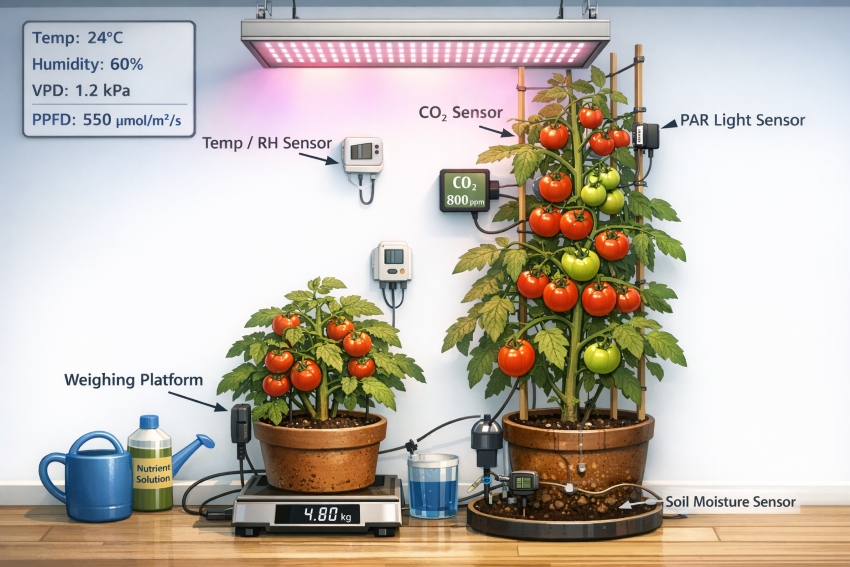
Part 1 — Tomato (Solanum lycopersicum): What it is and why it behaves the way it does indoors
Tomatoes are among the most rewarding fruiting crops to grow indoors, but they are also unforgiving if light, watering stability, and canopy management are inconsistent. In a Swedish apartment setting—limited area, variable seasonal daylight, and often dry indoor air in winter—tomato success is largely an engineering problem: delivering enough photons (DLI), keeping transpiration in a healthy band (VPD), and avoiding “wet–dry shock” in the root zone that drives disorders like blossom-end rot.
Determinate vs indeterminate: the key indoor decision
Indoor tomato strategy changes dramatically depending on growth habit:
Determinate (compact/patio/dwarf types)
- Typically stop elongating after setting a certain number of flower clusters.
- Fruit set tends to be more synchronized.
- Plant height often stays around 0.5–1.2 m (varies by cultivar).
- Requires less pruning and simpler support.
- Best if you want controlled size within ~1 m² and simpler operation.
Indeterminate
- Continues growing and flowering indefinitely under good conditions.
- Can exceed 2 m without topping.
- Requires regular pruning (sucker removal), training, and vertical support.
- Best if you want a long harvest window and you can manage height, airflow, and light distribution.
A practical 1 m² rule of thumb:
- One indeterminate in a 15–25 L pot with trellis/training, or
- Two compact determinates in 10–15 L pots if you have enough light coverage.
What tomatoes demand indoors (in order of impact)
1) Light (PPFD/DLI) is the limiting factor
Tomatoes are high-light plants. Without adequate daily light integral (DLI), you will see:
- leggy growth,
- delayed flowering,
- poor fruit set,
- small yields and slow ripening.
For indoor fruiting, practical targets are usually:
- ~450–600 PPFD at canopy height
- for 14–16 hours/day
- producing a DLI in the ballpark of ~23–35 mol·m⁻²·day⁻¹
The canopy must receive light evenly. This is why training (especially indeterminate) is not optional: a dense plant will self-shade, and shaded leaves contribute little to yield.
2) Watering stability prevents blossom-end rot (BER)
Blossom-end rot is commonly misdiagnosed as “calcium deficiency” alone. In most indoor cases, it is a calcium transport failure caused by unstable water availability or excessive transpiration stress. Even if calcium exists in the substrate, it cannot reach developing fruits reliably when:
- the pot goes through large wet–dry swings,
- VPD is too high (too dry/hot), increasing stress and uneven flow,
- salts accumulate (high EC in the root zone).
Indoor advantage: you can solve this with instrumentation—specifically pot mass monitoring and a tight watering control band.
3) VPD (temperature + humidity) controls transpiration and disease risk
VPD is the “control knob” for how hard the plant is pulling water through itself. Too high, and you get stress and BER risk; too low, and you increase fungal risk and physiological issues like edema.
A practical fruiting range indoors is typically:
- VPD ~1.0–1.3 kPa during flowering and fruit fill
4) Pollination needs a little help indoors
Tomato flowers self-pollinate, but the pollen must be released. Outdoors, wind and insects handle this. Indoors, you typically need:
- gentle airflow around flowers, and/or
- daily light vibration (tap trellis or use an electric toothbrush near flower clusters).
The indoor “system” perspective
Think of tomato growing as a closed-loop control system:
- Inputs: light, temperature, humidity, water, nutrients
- Plant responses: growth rate, flowering, fruit set, fruit quality
- Feedback signals: sensor data + visible symptoms
Once you measure the right variables, the plant becomes predictable.
Part 2 — How to grow tomatoes indoors in soil/pot (Sweden, ~1 m²): targets, sensors, and control plan
This section is a practical blueprint to run tomatoes indoors with high reliability. It emphasizes what matters most for fruiting: light (PPFD/DLI), pruning/training for canopy architecture, and watering stability to avoid blossom-end rot.
Step 1: Choose a variety that matches your space
If you want simplest operation: pick a compact determinate/patio/dwarf type.
If you want continuous harvest and can train vertically: choose an indeterminate and commit to pruning + trellis.
Container sizing (typical indoor ranges):
- Determinate: 10–15 L pot
- Indeterminate: 15–25 L pot
Bigger pots buffer moisture swings, which helps reduce BER risk.
Step 2: Use a staged environment recipe (targets by growth phase)
Below is a compact set of targets for a full indoor cycle.
Environmental + light targets (overview)
- Seedling: 22–25°C day / 18–20°C night, RH 55–75%, VPD ~0.6–0.9
Light: 150–250 PPFD, 16–18 h - Vegetative: 22–26°C / 18–20°C, RH 50–70%, VPD ~0.8–1.2
Light: 300–500 PPFD, 16–18 h - Flowering + fruit set: 22–26°C / 18–20°C, RH 50–65%, VPD ~1.0–1.3
Light: 400–600 PPFD, 14–16 h - Fruit fill + ripening: 20–25°C / 17–19°C, RH 50–65%, VPD ~1.0–1.4
Light: 400–600+ PPFD, 14–16 h (manage heat)
Key point: for indoor tomatoes, lighting and watering stability matter more than chasing perfect temperature. You can do very well at typical indoor temperatures if your DLI and root-zone stability are good.
Step 3: Training and pruning (especially for indeterminate)
Indeterminate (recommended training approach indoors)
- Train to 1–2 leaders maximum.
- Remove suckers weekly (small is easy; large is stressful).
- Tie stem to trellis/string for vertical support.
- Top the plant when you hit your height limit to redirect energy into fruit.
Determinate
- Minimal pruning; focus on support (cages/stakes).
- Only remove clearly unproductive interior leaves if airflow is poor.
Why this matters: training improves light penetration and stabilizes plant water use by preventing chaotic canopy growth.
Step 4: Watering stability—your primary BER control
Best practice: pot mass control
A load cell under the pot (with HX711) gives you a direct measure of water status. Your goal is to:
- avoid large swings,
- irrigate before the plant hits drought stress,
- keep fruit development on a steady flow.
Practical approach:
- Establish a “fully watered” reference mass after drainage.
- Allow a modest, controlled drop.
- Irrigate to return near the reference repeatedly.
Secondary: soil moisture sensor (trend)
Capacitive soil sensors are useful for trends and alerts, but they must be calibrated to your substrate and are less robust than mass.
Step 5: Nutrient strategy (simple, stable, repeatable)
- Seedlings: mild balanced feed once true leaves appear.
- Vegetative: balanced nutrition, ensure Ca/Mg present.
- Flowering/fruiting: shift to “tomato” profile (typically more K), keep Ca consistent.
- Avoid strong concentration swings, especially if you ever let the pot dry down. Drying concentrates salts and worsens BER risk.
If you want to measure, prioritize:
- irrigation water EC (consistency),
- occasional runoff EC/pH (spot checks).
Step 6: Instrumentation plan (what to measure and where)
Tier 1 (high ROI minimum)
- Air T/RH (I²C, SHT3x)
Place at canopy height, shaded from direct LED. - Pot mass (load cell + HX711)
Under rigid platform supporting the pot. - Soil moisture (capacitive, analog)
Mid-root zone, not near pot wall or drip point. - Soil temperature (DS18B20)
Near moisture sensor depth. - Light (BH1750 lux, I²C)
For trends; optionally calibrate lux-to-PPFD once.
Tier 2 (for robust fruiting)
- CO₂ (SCD41, I²C) at canopy height
- True PPFD/PAR sensor for accurate DLI
- Leaf temperature (IR) for better VPD/transpiration insight
Step 7: Calibration and validation (keep it simple)
- Air T/RH: compare sensors side-by-side; optionally salt RH check.
- Load cell: calibrate with known weights; verify repeatability.
- Moisture: calibrate against pot mass steps in your actual substrate.
- Light: if using lux, calibrate against a reference PPFD measurement at several dim levels.
Step 8: Diagnostics (symptom + data pattern → action)
- BER + big pot-mass swings / high VPD → tighten watering band, reduce VPD, stabilize feed.
- Flower drop + hot days or RH extremes → target 22–26°C and 50–65% RH; add airflow/vibration.
- Leggy seedlings + low PPFD → increase light intensity and/or duration.
- Edema + very low VPD / constant wetness → increase airflow, allow mild dryback, raise VPD.
Optional add-on: “Quick start” indoor tomato checklist (1 m²)
- Choose compact determinate or train 1 indeterminate to 1–2 leaders.
- Install trellis/support from day one.
- Aim for ~450–600 PPFD at canopy for 14–16 h once established.
- Use pot mass control for watering stability.
- Keep VPD ~1.0–1.3 kPa during flowering/fruiting.
- Provide airflow and pollination vibration during flowering.