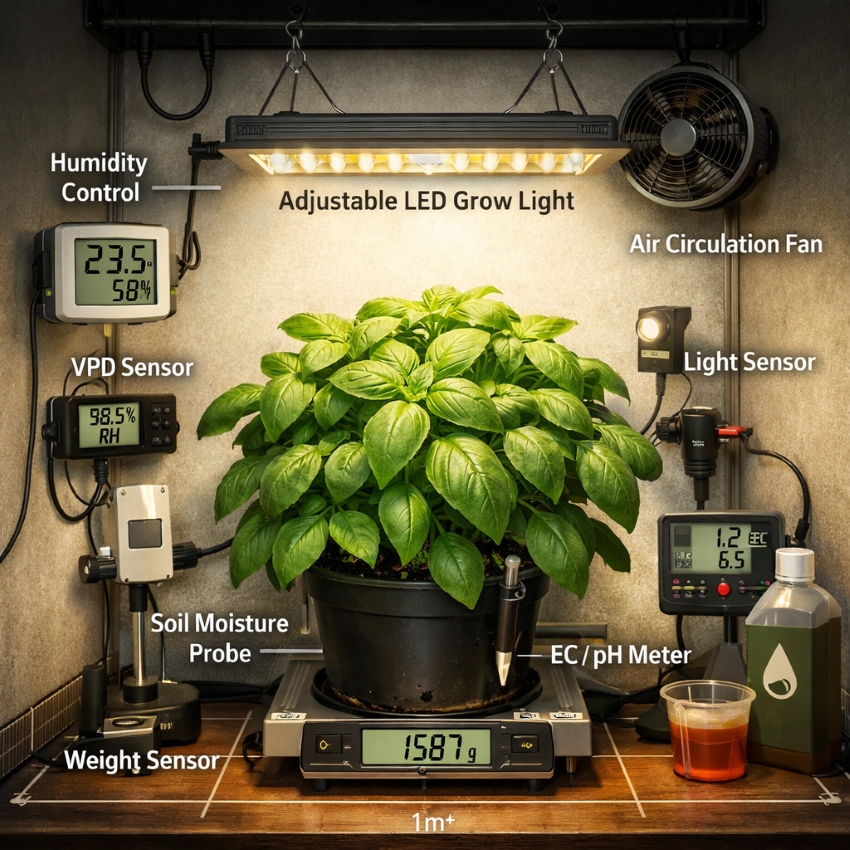
Basil (Ocimum basilicum): A Practical Profile for Indoor Growing
Basil is one of the most rewarding culinary herbs to grow indoors because it responds quickly to good light and stable climate, and it tolerates repeated harvests when managed correctly. The main failure modes in apartments are predictable: leggy growth (too warm + too dim), slow growth (low daily light), and fungal issues (high humidity, poor airflow—especially at night). If you build a simple routine around light intensity, climate stability, and consistent watering, basil can produce reliable weekly harvests year-round.
What “good basil” looks like (target phenotype)
For continuous harvest and flavor quality, you want:
- Compact plant architecture: short internodes, dense canopy
- Large, healthy leaves without bleaching or curling
- Strong aroma (volatile oil production correlates strongly with adequate light)
- No flower spikes (keep vegetative)
Growth stages (for an indoor, continuous-harvest plan)
Even if you aim to stay vegetative, basil still passes through predictable stages:
- Germination (day 0–7/10)
Seed imbibes water → emergence. Basil germinates best warm and evenly moist. - Seedling establishment (week 1–3)
Cotyledons → 2–4 true leaves. This is where legginess is “decided” by light intensity and temperature. - Vegetative growth + continuous harvest (week 3 onward)
Repeated pinching and cutting keeps it compact and productive. - Bolting/flower initiation (avoid)
Triggered by age and stress (drought cycles, heat spikes, inconsistent lighting). Once flowering starts, leaf quality and yield typically degrade.
Why basil goes wrong indoors (root causes)
- Low DLI (daily light integral): the most common limiter in Sweden for window-only setups.
- Warm room temperatures with insufficient light: classic legginess.
- High humidity pockets within the canopy: drives mildew/fungal risk.
- Overwatering: reduces root oxygenation, slows growth, invites fungus gnats.
If you treat basil like a “small leafy crop” (similar management logic to lettuce, but warmer), it becomes very consistent.
How to Grow Basil Indoors (Soil/Pot, Continuous Harvest, Sensor-Driven Control)
This section is a practical operating manual: target setpoints, sensor strategy, calibration, minimal data schema, and diagnostics. It assumes ≤1 m² space, LED grow light, and that you prefer soil/pot (not hydro).
Operating goals (explicit)
- Continuous vegetative production (no bolting)
- High flavor quality
- Avoid legginess
- Use VPD and airflow to reduce fungal risk
- Simple, measurable control variables (no over-complex systems)
1) Environmental targets by stage (temperature, RH, VPD, light)
At-a-glance “setpoints” for most apartments (recommended starting point)
- Photoperiod: 16 h on / 8 h off
- Canopy PPFD: 300–450 µmol/m²/s (vegetative/harvest)
- DLI: 14–25 mol/m²/day
- Air temperature: 20–26°C (ideal 21–24°C for quality)
- RH: 45–65%
- VPD: 0.8–1.2 kPa (especially important at night to avoid damp canopies)
- Air movement: gentle continuous fan, stronger during the dark period if RH rises
Stage targets (concise table)
| Stage | Air temp (°C) | RH (%) | VPD (kPa) | PPFD (µmol/m²/s) | Photoperiod | DLI |
|---|---|---|---|---|---|---|
| Germination | 22–26 | 70–85 | 0.3–0.6 | 0–100 (optional) | 12–16 h | 0–6 |
| Seedling | 20–24 | 55–75 | 0.5–0.9 | 120–250 | 14–16 h | 7–14 |
| Vegetative/Harvest | 20–26 | 45–65 | 0.8–1.2 | 300–450 | 14–18 h | 14–25 |
Key indoor insight: if you must choose one improvement, choose more usable light at canopy (PPFD/DLI), not longer hours with weak light.
2) Light-distance strategy (anti-leggy and pro-flavor)
The control principle
Set your lamp height and dimming to reach target PPFD at the top of the canopy, then keep it stable as the plant grows. Basil responds better to stable intensity than frequent changes.
Practical distance guidance (must be validated for your lamp)
- Seedlings: start around 35–50 cm above canopy (or dimmed), then increase intensity as true leaves develop.
- Vegetative/harvest: typically 25–40 cm (or dimmed) to maintain 300–450 PPFD at canopy.
What to watch
- Leggy growth = light too weak and/or too far (often combined with warm room temps).
- Bleaching or upward curl at the top = light too intense and/or too close (or high VPD/heat at canopy).
If you only have a lux sensor (BH1750)
Lux is not PPFD, but it becomes useful once you establish a lamp-specific conversion (see calibration). After that:
- Treat lux as your control proxy for consistency and failure detection.
3) Substrate moisture strategy (soil/pot) built for consistency
Best practice: use pot weighing as the irrigation “truth”
Cheap soil moisture probes drift and vary with soil composition. Pot mass is stable, repeatable, and directly reflects water loss.
Workflow
- Water to full saturation, allow draining to stop (field capacity). Record wet reference mass.
- Water again when pot mass falls by a defined percentage.
Recommended dry-back (vegetative basil):
- Water when mass drops ~12–20% from field capacity.
- Avoid repeated severe wilting (stress can encourage bolting and reduces leaf quality).
Disease and gnat prevention:
- Avoid keeping the top layer constantly wet.
- Prefer watering early in the light cycle so leaves/canopy dry quickly.
4) Nutrition strategy for continuous harvest (simple and safe)
Basil in pots is sensitive to “too much fertilizer + too little light,” which produces soft, weak growth.
General plan
- Seedling: begin light feeding after first true leaves (¼ strength).
- Vegetative/harvest: modest, consistent feeding (weekly light liquid feed or controlled-release plus periodic top-up).
- Avoid aggressive feeding if your DLI is low.
Optional measurements
- Runoff/slurry pH (target roughly 6.0–6.8).
- Feed EC (if using liquid nutrients): typically moderate (often ~1.0–1.6 mS/cm depending on product and plant response).
5) What to measure, what to calculate, and what to proxy
Directly measurable (hobby-grade)
- Air temperature and RH (I²C sensor like SHT31/SHT35)
- Lux (BH1750)
- Pot mass (load cell + HX711)
- Fan/light state (relay/PWM state)
Derived (calculated)
- VPD from temperature + RH
- DLI from PPFD (true or estimated) + photoperiod
- Transpiration proxy from pot mass slope (g/hour)
Not practical to measure continuously (good proxies)
- True PPFD without a quantum sensor → lux + one-time calibration or add a PAR sensor (Tier 3)
- Leaf wetness/microclimate → canopy RH at night + airflow + time-above-threshold
6) Recommended sensor stack and physical placement
Tier 1 (high ROI minimum)
- SHT31/SHT35 T/RH (I²C)
- BH1750 lux (I²C)
- Load cell + HX711 pot scale (digital)
- Simple fan control (optional but strongly recommended)
Placement
- T/RH: at canopy height, shaded from direct LED beam, in gentle airflow.
- Lux sensor: fixed at canopy level, consistent orientation.
- Load cell: under a stable platform; avoid side-loading and cable tension.
Tier 2 (better diagnostics)
- Second T/RH sensor (above canopy) for stratification and humidity pockets
- Capacitive soil moisture probe (analog) for trend only
- Soil temperature (optional)
Tier 3 (tight control)
- Quantum (PAR) sensor for true PPFD
- CO₂ sensor (optional)
- Spot-check pH/EC tools with calibration solutions
7) Calibration and validation (do this once, benefit for months)
T/RH
- Validate with a known reference meter if available.
- Simple RH check using a sealed container + salt-point (ballpark validation).
Load cell scale
- Two-point calibration with known weights.
- Repeatability test: place/remove weight multiple times.
- Mechanical check: no rubbing, rocking, or lateral force.
Lux → PPFD (the key step if you don’t buy a PAR sensor)
- Borrow/rent a PAR meter once (or use a reliable quantum sensor).
- Measure lux and PPFD pairs across several lamp heights/dimming levels.
- Fit a simple conversion: PPFD ≈ lux / K for your lamp and geometry.
- Re-check if you change the lamp or diffuser.
Soil moisture probe (if used)
- Calibrate to your soil mix using pot mass as ground truth.
- Use it for trends, not absolute thresholds.
8) Minimal data schema and sampling rates (simple but sufficient)
Fields
timestampair_temp_cair_rh_pctvpd_kpa(derived)luxppfd_est(optional derived)dli_mol_m2_day(daily)pot_mass_gpot_mass_change_g_per_hr(derived)soil_moisture_raw(optional)light_on/fan_onirrigation_event(manual or inferred from mass step)
Sampling
- Air T/RH: every 30–60 s
- Lux: every 30–60 s
- Pot mass: sample 5–10 s, log 1–2 min average
- Soil moisture: 5–10 min
- Daily DLI: computed once per day (plus a running estimate during the photoperiod)
9) If–then diagnostics (symptom + data pattern → cause → action)
Leggy basil (long internodes, floppy stems)
- Data pattern: low PPFD/lux + warm temps (>24–26°C)
- Likely causes: light too weak/far; excessive N
- Actions: increase intensity to 300–450 PPFD (or reduce distance); keep temps stable; reduce feeding slightly; add airflow
Pale leaves / slow growth
- Pattern: adequate light but slow growth OR wet pot with slow mass loss
- Causes: underfeeding OR overwatering/root hypoxia
- Actions: modest feed increase if dry-back is healthy; otherwise improve drainage and allow more dry-back
Bleaching/curling at top
- Pattern: very high light close to canopy and/or high VPD
- Cause: light/heat stress, excessive transpiration demand
- Actions: raise lamp 5–10 cm or dim 10–20%; target VPD 0.8–1.2; verify watering cadence
Fungus gnats
- Pattern: pot mass stays high; surface never dries
- Cause: chronic wet substrate surface
- Actions: longer dry-back, water earlier, top-dress, sticky traps; increase airflow
Fungal risk (mildew/leaf spots)
- Pattern: night RH >70–80% for hours; VPD <0.6; stagnant air
- Cause: humid canopy microclimate
- Actions (VPD-driven): increase airflow at night; reduce RH via ventilation/dehumidification; avoid wet foliage; thin canopy
Bolting/flower spikes
- Pattern: stress cycles (severe dry-down), heat spikes, inconsistent lighting
- Actions: stable photoperiod, avoid severe wilting, pinch flower spikes immediately, maintain regular harvest cuts
Practical harvest protocol (to stay vegetative and productive)
- Start pinching once the plant has 4–6 true leaves.
- Cut above a node to encourage branching (aim for a “bushy” structure).
- Harvest little and often rather than stripping the plant.