Part 1 Bell Pepper (Capsicum annuum) Indoors: What It Needs and Why
Quick profile
- Type: Warm-season perennial grown as an annual in containers.
- Growth habit: Compact to medium bush; can be trained and pruned to fit small spaces.
- Bottlenecks indoors: Light (DLI), root-zone stability (pot size + watering), microclimate (VPD), and pollination.
Growth stages (high level)
- Germination
- Seedling establishment
- Vegetative build
- Flowering + fruit set
- Fruit fill + ripening (continuous harvest cycles)
The indoor “success drivers”
1) Light is the primary yield lever
Indoors, peppers are almost always photon-limited. Under-lighting produces:
- Slow internode development
- Small leaves, pale or dull growth
- Delayed flowering
- Blossom drop due to chronic stress
Rule of thumb: vegetative growth needs moderate-to-high DLI; fruiting demands higher and more stable DLI.
2) Blossom drop is usually stress + microclimate
Common indoor triggers:
- Heat spikes at canopy (often from lights too close)
- High VPD (dry air) causing excessive transpiration demand
- Moisture swings (pot dries too far then gets flooded)
- Root hypoxia from poor aeration/overwatering
- Low airflow / limited pollination
3) Container size is not optional—it is a control system
In small pots, water content and nutrient concentration swing rapidly:
- Faster dry-down → drought stress episodes
- Faster salt concentration changes → nutrient uptake disruption
- Higher blossom drop risk and BER risk
For reliable fruiting, a final container 12–20 L is a major stability upgrade.
4) Nutrition: stage-specific emphasis matters
- Early: gentle feeding; avoid salt stress.
- Vegetative: sufficient N to build canopy (but not excessive).
- Flowering/fruiting: maintain K and Ca support; avoid sudden changes in strength.
5) What sensors buy you (the “why instrument?” argument)
Sensors convert ambiguous plant symptoms into measurable causes:
- Stalled growth becomes a DLI/PPFD and root-zone temperature question.
- Blossom drop becomes a canopy temperature spike, VPD, and watering volatility question.
- BER becomes a moisture swing + salinity + Ca transport question.
Part 2 — How to Grow Bell Pepper (Soil/Pot, 1 m²), Using Sensor Data
Target system boundaries (recommended setup)
- Footprint: up to ~1 m²
- One plant strategy (highest reliability): 1 bell pepper in 12–20 L pot
- Medium: aerated potting mix (avoid dense, peat-only packing)
- Light: LED capable of delivering strong canopy PPFD
- Airflow: gentle but continuous canopy movement (prevents microclimate pockets)
- Instrumentation focus: T/RH + pot weight + light proxy at minimum
Stage targets (numbers you can run)
Environment + light targets
| Stage | Temp (°C) | RH (%) | VPD (kPa) | PPFD (µmol/m²/s) | Photoperiod | DLI (mol/m²/day) |
|---|---|---|---|---|---|---|
| Germination | 26–29 | 80–95 | 0.2–0.6 | 0–150 | 14–16 h | 0–5 |
| Seedling | 23–26 / 20–22 night | 60–75 | 0.4–0.9 | 150–300 | 14–16 h | 8–14 |
| Vegetative | 22–27 / 18–21 night | 50–70 | 0.8–1.3 | 300–500 | 14–16 h | 14–22 |
| Flowering + set | 21–26 / 18–21 night | 50–65 | 1.0–1.4 | 450–650 | 12–16 h | 18–28 |
| Fruit fill + ripen | 21–27 / 18–22 night | 45–60 | 1.1–1.6 | 500–700 | 12–16 h | 20–30 |
DLI ≈ PPFD × hours × 0.0036
Watering strategy you can automate/standardize (best with pot weighing)
The most reliable indoor method: “water-to-target + controlled dry-back”
- Water to a defined endpoint (e.g., first slight runoff or a fixed added volume).
- Log the wet pot mass (this is your reference).
- Let the pot dry until it loses a controlled amount of mass, then water again.
Typical dry-back guidance (soil, bell pepper):
- Vegetative: allow ~15–30% of plant-available water to be used before rewatering
- Flowering/fruiting: tighten to ~10–20% (more stable moisture = fewer aborted flowers)
If you do not have pot weighing: use a moisture probe only as a trend indicator and validate it against “lift test” and pot mass checks on a scale.
Nutrition strategy by stage (soil/pot)
Seedling (true leaves onward)
- Feed lightly: ¼–½ strength balanced fertilizer 1×/week.
- Avoid heavy feeding early (salt stress = growth stall).
Vegetative
- Increase nutrition; keep N adequate to build canopy.
- Add Ca/Mg support if using very soft water/RO.
- Avoid overfeeding: periodic plain-water irrigation helps prevent salt buildup.
Flowering + fruit set
- Maintain nutrition consistency; avoid step-changes in strength.
- Shift emphasis: moderate N, adequate K, reliable Ca supply.
- Blossom drop risk rises with volatility—keep feeding/watering stable.
Fruit fill + ripening
- Keep K and Ca supported; keep N moderate.
- If BER appears: correct watering volatility first, then check salinity/feeding strength.
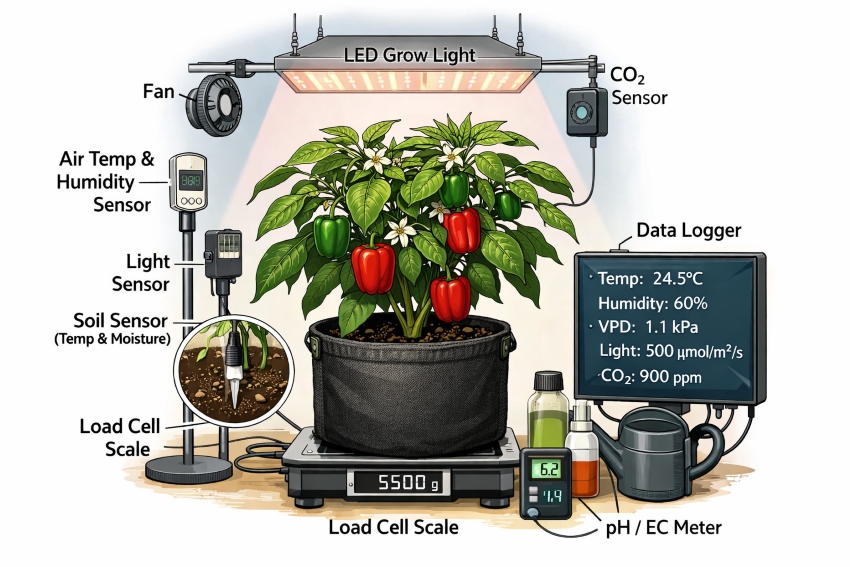
Sensor stack (recommended) and placement
Tier 1 (minimum, highest impact)
- Air T/RH (I²C, e.g., SHT31/SHT4x): canopy height, shaded from direct LED.
- Lux sensor (I²C BH1750): canopy plane, not shadowed.
- Pot weight (load cell + HX711): under pot on rigid platform.
Tier 2 (adds root-zone control)
- Substrate temp (DS18B20): 5–10 cm deep in root zone.
- Handheld pH/EC meters: for irrigation mix + occasional runoff.
Tier 3 (optimization)
- CO₂ (NDIR): canopy zone.
- Leaf temperature (IR): leaf-VPD estimation and heat-stress detection.
Calibration and validation (do this once, then quarterly)
- Pot weight: calibrate with known masses; verify 500 mL water ≈ 500 g.
- Lux→PPFD: best is a one-time borrow/rent of a quantum sensor; fit PPFD = a × lux for your LED.
- T/RH: co-locate sensors 24–48 h; optional salt RH checks.
- pH/EC: 2-point pH calibration; EC standard solution.
Minimal data logging schema + sampling
Fields
ts,air_temp_C,air_rh_pct,vpd_kPalux(orppfd),dli_mol_m2_daypot_mass_g,pot_mass_rate_g_per_h- optional:
substrate_temp_C,co2_ppm,leaf_temp_C irrigation_event_ml,feed_note(or numeric EC)
Sampling
- T/RH: every 30–60 s (store 1–5 min averages)
- Lux: 10–30 s lights-on
- Pot mass: 1–5 min
- Daily aggregates: DLI, min/max temp/RH/VPD, total water
If-then diagnostics (the quick troubleshooting layer)
Blossom drop
- If canopy temp spikes above ~29°C or nights stay too warm
Then reduce heat at canopy (raise/dim light, increase airflow), target 21–26°C day / 18–21°C night. - If VPD regularly > 1.6 kPa and pot mass shows steep dry-down
Then increase RH or lower temp to bring VPD to 1.0–1.4; water more consistently; consider larger pot. - If pot stays heavy and growth is slow
Then likely root hypoxia—improve aeration, allow deeper dry-back, stop standing water.
Slow growth
- If DLI is low (or lux trend low)
Then increase PPFD/photoperiod toward DLI 18–22 in veg; manage heat. - If substrate temp < ~18°C
Then insulate pot and avoid cold window zones.
Blossom-end rot (BER)
- If BER plus big wet/dry swings in pot mass
Then stabilize watering first; maintain Ca; avoid high salinity.
Practical “do this” checklist (condensed)
- Final pot 12–20 L, aerated mix, excellent drainage.
- Run DLI 18–22 in veg, 20–30 in fruiting if you can manage heat.
- Keep VPD ~1.0–1.4 during flowering/set.
- Use pot weight to enforce repeatable dry-back (smaller swings during flowering/fruiting).
- Avoid canopy heat spikes from LEDs; airflow is mandatory.
- Hand-pollinate assist: gentle shake daily or a fan.