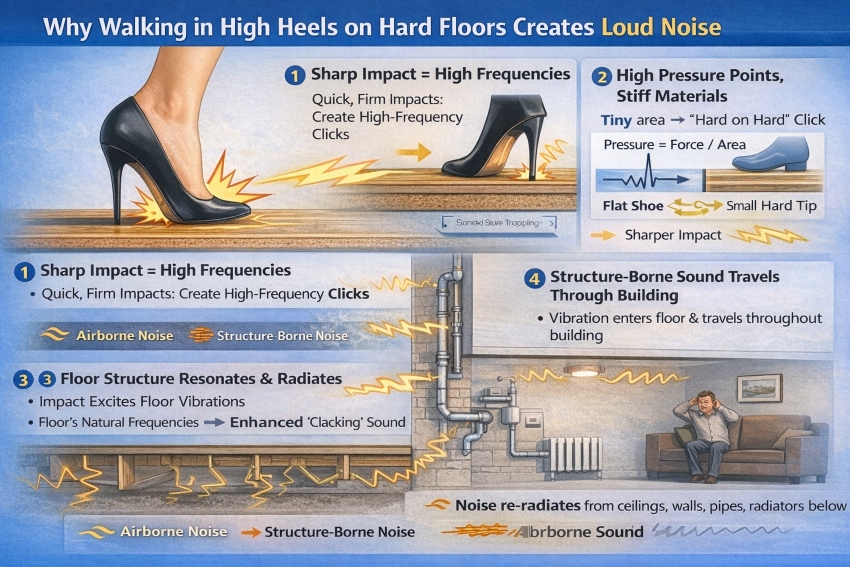
When someone walks on a hard floor with high heels, the sound is often loud and “sharp” because the impact converts a relatively slow body motion into a very fast force event that efficiently excites the floor and the air. The loudness is not mainly because the person is “heavy,” but because the contact mechanics create high-frequency energy and couple it well into the building.
1) The key idea: short impact time → high-frequency sound
A heel strike is an impact. In impacts, the force rises and falls very quickly (milliseconds or less). A fast event in time necessarily contains high-frequency components.
- Slow force change (gentle step) → mostly low-frequency vibration
- Very fast force change (heel “click”) → lots of mid/high-frequency energy (hundreds of Hz to several kHz)
This is why heel steps can sound like clicks or knocks: the waveform has sharp edges, and sharp edges require high frequencies.
2) High heels concentrate force into a tiny contact area
Pressure is force divided by area:
A high heel has a very small contact area A. For roughly the same body weight force F, the pressure becomes very high. High pressure leads to:
- Less deformation area in the shoe sole (less “cushioning”)
- A stiffer contact (hard heel tip against hard floor)
- A faster force rise (higher peak force over shorter time)
All of this makes the impact “harder” acoustically and increases the high-frequency content.
3) Stiff materials store less energy as deformation and radiate more as vibration/sound
Soft materials (rubber soles, carpet, underlays) absorb energy by deforming and damping. Hard materials (wood, tile, concrete, hard plastics) do not.
So with hard heel + hard floor:
- Less energy is dissipated in the contact
- More energy goes into floor vibration
- Vibrating surfaces then radiate sound into the air
In simple terms: hard-on-hard behaves like a mallet on a drum skin (not exactly, but the same principle of efficient excitation).
4) Floors and building structures have resonances that the impact excites
A floor is not perfectly rigid. It has resonant modes (bending modes) and connections (joists, slabs, beams). A heel strike is broadband, so it can excite many resonances at once.
Result:
- Some frequencies get amplified strongly (often mid frequencies where human hearing is sensitive)
- The sound can “ring” briefly after each step
This is also why the same heels can sound very different on different floors: you are “listening to the floor system” as much as the shoe.
5) Structure-borne transmission makes it loud elsewhere
Heel impacts often become structure-borne sound:
- Impact injects vibration into the floor.
- Vibration travels through the structure.
- Other surfaces (ceiling below, walls, radiators, pipes) re-radiate sound.
This is why a neighbor may hear loud footsteps even if the walker is not producing much airborne sound in the room itself.
6) Why it sounds especially “loud” to humans
Two perception reasons:
- The sound has strong components in 1–4 kHz, where human hearing is most sensitive.
- It is impulsive and repetitive, which draws attention more than steady noise.
Summary (one sentence)
High-heel footsteps are loud because the heel creates a stiff, small-area impact with a very short contact time, generating high-frequency energy that efficiently excites floor resonances and transmits through the building as structure-borne sound
Why a fast force change creates high frequencies (the core physics)
The time–frequency rule
High frequency means rapid variation. A signal that changes very quickly in time must contain higher-frequency components.
A simple (and very practical) rule is:
- = the “rise time” or characteristic duration of the force change.
- Shorter → larger fmax → more high-frequency content.
Example:
- If the main force change happens in , then (mostly low-frequency).
- If , then fmax (now clearly audible mid/high).
- If Δt, then (very high-frequency content).
So the reason “sharp impact” produces high frequencies is simply: the force is changing extremely fast.