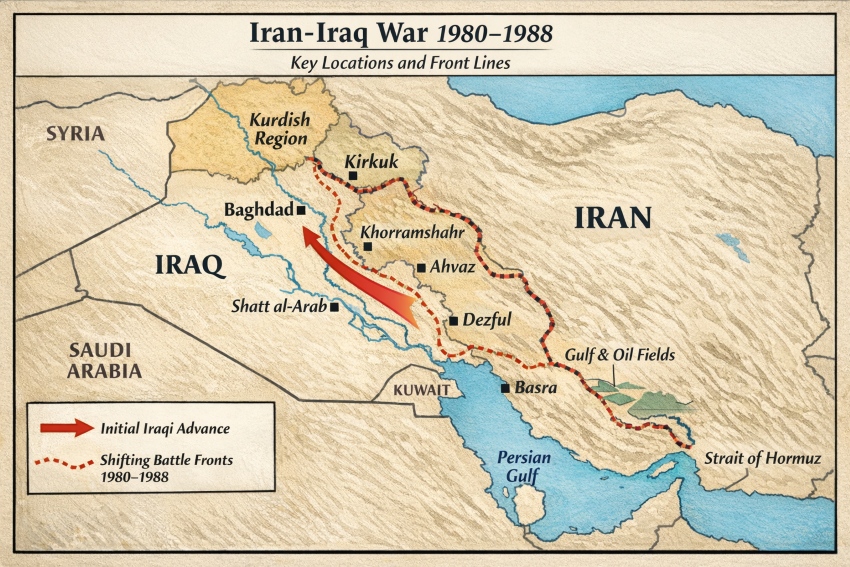
The Iran–Iraq War began as a clash between two neighboring states with a long history of border tension, and it ended as a UN-brokered ceasefire that halted major combat without delivering a clean political settlement. The war’s origins are best understood not as a single “cause,” but as a convergence of structural disputes (especially the Shatt al-Arab/Arvand Rud waterway and the land border), regime insecurity after Iran’s 1979 revolution, and escalating incidents and accusations that narrowed bargaining space. Its outcome, meanwhile, is best described as a costly stalemate: active hostilities stopped in August 1988 under UN supervision, the territorial status quo largely re-emerged, and many humanitarian and political files (POWs, missing persons, responsibility narratives) persisted for years or decades.
The pre-war setting: a border settlement that did not settle politics
A central structural issue was the Shatt al-Arab (Arvand Rud), the river formed by the confluence of the Tigris and Euphrates, which provides access to ports and oil infrastructure and is therefore disproportionately important to both Iraq and Iran. In 1975, the two states reached a settlement commonly associated with the Algiers process, and in 1976 the relevant treaty arrangements entered into force, incorporating the thalweg (deep-channel) principle for delimitation in parts of the waterway. In the late 1970s, this agreement reduced one source of open conflict, but it did not eliminate the underlying political contest: both states remained attentive to control, navigation rights, and the symbolic meaning of sovereignty at the border.
In the background, both regimes also faced internal heterogeneity and cross-border leverage opportunities. The 1975 settlement itself was linked to Iran ending support for Iraqi Kurdish rebels—an example of how internal conflicts and border diplomacy were intertwined. This mattered because, in the years that followed, accusations of interference and support for dissident groups would reappear as part of the escalation story.
The shock of 1979: revolutionary transformation and threat perceptions
Iran’s 1979 revolution changed the character of the Iranian state and its security institutions. New revolutionary bodies, including the Islamic Revolutionary Guard Corps (IRGC), emerged as parallel or reinforcing instruments of regime security. The revolution also reshaped regional politics: it created a strong ideological contrast with Iraq’s Baʿathist government and intensified mutual suspicion over whether political unrest might be encouraged across borders.
At the level of documented claims, Iraqi officials frequently framed post-revolutionary Iran as an actor that encouraged unrest in Iraq, while Iranian narratives portrayed Iraq as supporting separatism and subversion inside Iran—particularly in sensitive regions such as Khuzestan. Whether these claims were fully accurate in each instance is difficult to prove from public sources alone, but the important point for the road to war is that the claims existed, were amplified in public discourse, and created the political conditions for each side to interpret incidents as hostile intent.
Escalation before invasion: incidents, accusations, and shrinking diplomatic space
The pathway to war was not instantaneous. It was a sequence of deterioration punctuated by border violence and political moves that hardened positions. In this chat’s source base, the immediate pre-war period includes reported border attacks and clashes in 1979–1980 and a steady worsening of relations after 1979. Such events do not automatically make full-scale war inevitable—states often tolerate border friction—but they can reduce confidence in diplomacy, increase domestic pressure for assertive action, and encourage leaders to believe that delay increases risk.
Two additional escalatory dynamics mattered.
First, the border dispute returned to center stage as a bargaining focus. On 17 September 1980, Saddam Hussein publicly declared the 1975 arrangements “null and void,” explicitly reasserting Iraqi claims over the Shatt al-Arab. This was not a minor rhetorical flourish: it was a formal political step signaling that Iraq no longer accepted the existing settlement framework. Five days later, on 22 September 1980, Iraq initiated the attack that opened the war.
Second, early diplomacy after the invasion showed how quickly bargaining space collapsed once large-scale combat began. The UN Security Council adopted Resolution 479 on 28 September 1980 calling for restraint and mediation, but the combatants’ preconditions were incompatible: Iraq’s posture and Iran’s insistence on withdrawal before negotiations meant that early diplomatic pressure did not translate into de-escalation.
Why did Iraq choose war in September 1980? Competing explanations, bounded by evidence
On the question “why war?” the most rigorous approach is to separate (a) what leaders said, (b) what they did, and (c) what historians infer.
What Iraq said (documented posture): Iraq publicly framed its actions in terms of self-defense and rights related to disputed boundaries and alleged Iranian interference. This included demands around recognition of claims concerning the Shatt al-Arab and a broader non-intervention logic.
What Iraq did (observable actions): Iraq abrogated the treaty framework and then launched a broad-front attack including air strikes and a ground invasion.
Interpretations (with attribution and confidence):
- Territorial and legal-revisionist explanation (higher confidence): The tight coupling of the treaty abrogation (17 September) and invasion (22 September) makes the border/waterway dispute a high-confidence structural driver. The sequence is direct and well documented in major reference accounts.
- Opportunity/vulnerability explanation (medium confidence): Many summaries argue that Iraq perceived Iran as temporarily disorganized after the revolution and therefore more vulnerable. This is plausible and widely repeated, but the causal weight is harder to pin down precisely without deeper internal documentation.
- Regime-security explanation (medium confidence): Iraqi concerns about revolutionary agitation and domestic stability appear consistently in accounts of the period and in the rhetoric of accusations. This is strong evidence of perceived threat; it is weaker evidence that this factor was the decisive trigger rather than one element among several.
The safest synthesis, given the evidence base we have used in this chat, is that Iraq’s move to war likely combined (1) a concrete territorial-legal dispute (Shatt al-Arab and border claims), (2) heightened post-revolution mistrust and fear of destabilization, and (3) a belief that early military action could improve Iraq’s bargaining position—whether by gaining territory, forcing renegotiation of the 1975 framework, or both.
How the war was fought: stalemate, attrition, and widening targets
The war’s early phase saw Iraq achieve limited but significant gains. Khorramshahr fell in October 1980 after intense fighting, while Abadan was besieged but held. By late 1980 the Iraqi advance was largely halted and a stabilized front emerged. The next major shift came in 1981–1982, when Iran mounted successful counteroffensives; by May 1982 Iran had regained much of the occupied territory and recaptured key positions, including the liberation of Khorramshahr.
After that, the war entered a prolonged and costly phase. Iran pushed into Iraqi territory and threatened Basra, while Iraq increasingly fought defensively and sought to impose attrition. Over time, combat spread beyond the land front. The Gulf shipping “tanker war” and strikes on oil infrastructure aimed to weaken the opponent’s economic capacity and increase political pressure. Missile attacks and “city” targeting became part of the conflict’s coercive landscape, imposing civilian fear and infrastructure damage even when front lines moved slowly.
Chemical weapons also became a defining feature of the war’s conduct and its international controversy. The UN Security Council condemned the continued use of chemical weapons in Resolution 612 in May 1988, reflecting heightened international concern in the late-war period.
Termination: ceasefire first, politics later
The war ended not with decisive military conquest but via the UN framework of Resolution 598 (adopted July 1987), which demanded a ceasefire, withdrawal to internationally recognized boundaries, UN observers, and progress on POW repatriation, while also requesting work on questions of responsibility. The ceasefire did not take effect immediately upon adoption; rather, it became implementable in mid-1988, culminating in an effective ceasefire on 20 August 1988 under monitoring arrangements.
This termination design produced a characteristic pattern: stopping the fighting was possible sooner than solving the politics. Implementation disputes and sequencing arguments followed—particularly around withdrawal and POW issues—while responsibility narratives continued to be contested. Later milestones (1990 normalization steps; 1991 UN reporting referenced in scholarship and reference accounts) shaped how each side framed legitimacy and “vindication,” but those did not retroactively create a clean, unified peace settlement in 1988.
What did the war produce? Results, legacies, and unresolved files
Territory and sovereignty: The simplest outcome metric is borders. By the end of hostilities, the conflict largely returned toward recognized boundaries rather than producing a clear territorial transfer that both sides accepted as legitimate. In that sense, the war’s result resembles a restoration of the baseline rather than a durable revision.
Political survival: Both regimes survived the war. This matters because some stated aims—especially maximal aims such as regime overthrow or long-term domination—were not achieved in a way that both sides accepted. The price of survival and non-defeat, however, was severe.
Human cost: Casualty estimates vary substantially by definition, but general references cited in this chat place total casualties in a broad range of 1–2 million with perhaps around 500,000 killed, while datasets define and estimate “battle deaths” differently. The scale is clear even where precision is not.
Humanitarian aftermath (POWs and missing): The war’s humanitarian files lasted far beyond the ceasefire. The ICRC has documented that tens of thousands remained missing decades later, and it reports that the POW file was only closed after the last prisoner exchange in 2003. This is one of the most concrete indicators that the conflict’s “end” in 1988 was operational (combat stopped) rather than fully social or humanitarian (families still lacked answers).
Regional consequences: In Iraq, postwar debt and economic strain are widely documented, and major reference accounts explicitly connect the war’s exhaustion to the context in which Iraq invaded Kuwait in 1990. In Iran, major reference accounts emphasize that wartime conditions strengthened hard-line factions and contributed to the IRGC’s institutional rise. These outcomes are not “victory” in a conventional sense; they are structural legacies that shaped later domestic and regional politics.
Bottom line: why it became war, and what the war ultimately was
Using the evidentiary base in this chat, the most defensible narrative is that war emerged from a collision between a revived border dispute (Shatt al-Arab and frontier claims), post-revolution insecurity and mutual accusations, and a rapid final escalation in September 1980 that replaced bargaining with force. The result was a long, attritional conflict that neither side could end on maximal terms. It stopped through a UN ceasefire mechanism that was strong enough to halt large-scale combat but not strong enough to instantly resolve the human and political residue. The war’s “result,” therefore, is best stated in two layers: a ceasefire and near-restoration of borders in 1988, and a prolonged postwar legacy—missing persons, delayed prisoner resolution, institutional transformation, and regional instability—that continued shaping the Middle East for years.