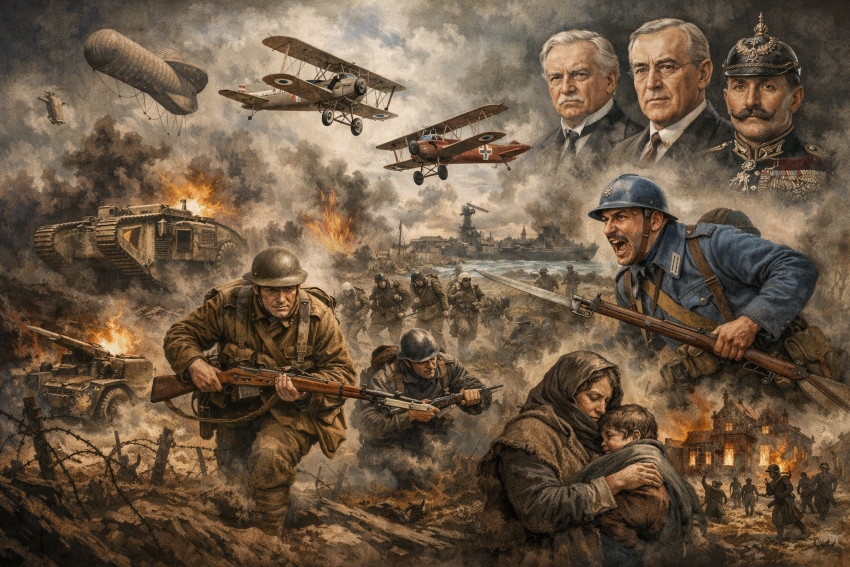
The story of World War I begins before the first shots, in a Europe that looked stable on the surface but was threaded with binding commitments, unresolved national questions, and repeated crises that trained governments to think in terms of credibility and rapid response. By the early 1910s, the continent’s great powers were linked by formal alliances and looser ententes, while several flashpoints—Morocco, Bosnia, the Balkan Wars—had already shown how a dispute on the periphery could draw in capitals far away. When leaders talked about “the balance,” they meant a system in which a local setback could ripple outward into larger danger, and in which hesitation could be interpreted as weakness. In that atmosphere, military planning increasingly assumed that speed—especially rapid mobilization and rail deployment—could determine survival in a major war. Those assumptions did not force choices, but they narrowed the room for slow diplomacy once a crisis began.
On 28 June 1914, the assassination of Archduke Franz Ferdinand in Sarajevo created the crisis that the system could not absorb. Within weeks, decision-making shifted from private calculation to public deadlines. On 23 July, Austria-Hungary presented Serbia with an ultimatum delivered at 6 p.m., with only 48 hours to answer—an intentionally compressed timeline that reduced the opportunity for consultation and mediation. Serbia’s reply accepted many points while qualifying others; Austria-Hungary broke relations and declared war on 28 July. In the days that followed, mobilizations and declarations spread the conflict: governments interpreted each other’s steps through worst-case assumptions, and what began as a Balkan confrontation became a European war. This sequence is often described as “the July Crisis,” but it was also a test of whether early-20th-century diplomacy could slow events once military timetables and alliance expectations started to move.
In August 1914 the war’s geography widened quickly. Fighting opened along multiple fronts, but the Western Front—northern France and Belgium—became the war’s most recognized image. Early maneuver campaigns gave way to entrenched lines, barbed wire, and fortified positions that made rapid breakthroughs difficult. The result was not constant motion but repeated cycles: artillery preparation, infantry assault, counterattack, consolidation, and then another assault. The war’s conduct became increasingly shaped by industrial capacity—shell production, rail throughput, food supply, and the ability to replace losses—because firepower dominated the battlefield and consumed resources at unprecedented rates.
As the months turned into years, the war’s methods and tools evolved in a grim dialogue between offense and defense. Artillery became central not just as a weapon but as the backbone of operational planning; commanders increasingly tried to solve the “breakthrough problem” by improving barrage techniques and coordinating infantry advances to timed artillery fire. New technologies entered the fight in ways that were initially limited but strategically suggestive: aircraft for reconnaissance and artillery spotting; chemical agents that forced rapid adaptation in protective equipment and doctrine; and tanks, first used in small numbers and with severe mechanical limits, but pointing toward later combined-arms methods. The public memory of the war often compresses these changes into a single image—trenches and mud—but the underlying story is one of constant tactical adjustment under severe constraints.
Meanwhile, the war’s other theaters—Eastern Europe, Italy, the Middle East, Africa, and the seas—ensured that “World War” was not rhetorical. In the east, larger distances could permit more maneuver than the west, but the fighting still included mass artillery engagements and major offensives that strained empires already under political and economic stress. In the Italian theater, geography imposed its own logic: mountain warfare, repeated offensives, and later crisis and recovery. Overseas and imperial campaigns were often smaller in scale than the Western Front, but they mattered for shipping, manpower, and postwar claims. Even when a front did not decide the war by itself, it consumed resources and shaped bargaining power when peace terms were later drafted.
At sea, the war was waged less by decisive fleet battles than by pressure on commerce and supply. The battle of Jutland demonstrated the scale of naval power, but the longer strategic contest revolved around blockade and submarine warfare. Economic survival, food imports, and the movement of troops and materials became strategic objectives. This was also where the war blurred the boundary between battlefield and home front: the ability of a coalition to keep shipping lanes open and deliver grain, fuel, and raw materials could be as consequential as a tactical victory on land. The war’s conduct therefore increasingly resembled a contest of systems—production, transport, finance, and morale—rather than a sequence of isolated battles.
For civilians, the war was not a distant spectacle but a daily reality shaped by occupation, displacement, and shortages. Large populations lived under military occupation, subject to requisitions and administrative control. Others fled: Belgium, invaded in 1914, saw mass flight—one commonly cited estimate places civilian deaths at around 13 million across the war and notes that civilian suffering came from multiple causes including starvation, exposure, disease, and military encounters, underlining why “civilian impact” cannot be reduced to a single mechanism. Displacement figures are difficult to summarize globally because counting depends on definitions (refugee vs. evacuee vs. deportee), the completeness of registration, and the fact that people often moved multiple times. What is clear is that the war produced large-scale population movement and long-term demographic disruption.
By 1917, the war’s strategic picture shifted again. The decision to intensify economic warfare at sea—particularly with renewed unrestricted submarine warfare in early 1917—interacted with neutral politics and allied logistics in ways that proved strategically consequential. Over time, the United States entered the war on the Allied side, adding major industrial and manpower potential. This did not immediately end the fighting, but it changed expectations: the prospect of sustained U.S. participation altered calculations about endurance and bargaining. At the same time, internal stress in several empires increased sharply, especially where food supply, war weariness, and political legitimacy were already fragile.
In 1918, the conflict entered its final phase. In the east, Russia exited the war through the Treaty of Brest-Litovsk in March 1918, reshaping the military balance and allowing Germany to redeploy forces westward. Germany launched major offensives in spring 1918, achieving substantial tactical gains but struggling to convert them into a decisive strategic outcome—partly because sustaining breakthroughs required moving artillery, supplies, and reserves forward faster than the battered transport system allowed. By summer and autumn, the Allied counteroffensives—often grouped under the “Hundred Days”—pushed the German army back and accelerated political crisis at home. The story of termination here is best told as interaction: battlefield reversals, resource constraints, and domestic upheaval moved together rather than in a neat sequence.
The end came through armistices that arrived in a cascade. By late autumn 1918, Germany was the last major Central Power still fighting, after separate armistices with other Central Powers. On 11 November 1918, the armistice with Germany was signed in the early morning and took effect at 11:00 a.m., a time that became a durable symbol: “the eleventh hour of the eleventh day of the eleventh month.” Yet an armistice was not the same as peace. It stopped the shooting, but it also imposed conditions and created leverage. The problem of termination shifted from military operations to political settlement: what terms would define “ending,” and what enforcement would make them stick?
Peace-making centered on the Paris Peace Conference and produced the Treaty of Versailles as the primary settlement with Germany. Versailles was signed on 28 June 1919 in the Hall of Mirrors and went into effect on 10 January 1920. The treaty imposed military restrictions, territorial adjustments, and a reparations framework; it also embedded a new international institution—the League of Nations—into the settlement architecture. The Covenant of the League of Nations was integrated into the Treaty of Versailles and the other peace settlements signed in Paris, explicitly defining the League’s purpose as promoting international cooperation and pursuing international peace and security. This was a genuine institutional innovation, but it also inherited a basic limitation: it depended on the continuing commitment and capacity of member states to enforce its principles.
The aftermath is often discussed in moral or ideological terms, but descriptively it can be approached as a ledger of security, sovereignty, and stability—gains and losses distributed unevenly within and across societies. France regained Alsace-Lorraine and sought security mechanisms along the Rhine; Britain preserved global influence but faced fiscal and imperial pressures; Italy gained territories but also endured domestic political conflict over whether the settlement matched wartime sacrifices. Germany lost territory, accepted military constraints, and confronted reparations obligations and political polarization over the legitimacy of the settlement. Across the former Habsburg and Ottoman spaces, borders were redrawn, new states emerged, and minority problems became structural features of the interwar order—difficult to solve through treaties alone.
Beneath diplomacy and borders, the human cost remained the most enduring fact of all. Britannica summarizes the scale starkly: roughly 8.5 million soldiers and about 13 million civilians died during the war, with civilian deaths attributed to multiple interlocking causes—battle, hunger, disease, and mass violence—an explanation that also clarifies why precise totals vary across sources. Those who survived carried the war forward in less visible ways: disabled veterans, bereaved families, disrupted labor markets, and societies reshaped by loss and political upheaval. In that sense, the war’s “ending” was not a single date but a transformation that continued through the 1920s as states struggled to stabilize currencies, integrate veterans, manage new borders, and reconcile public expectations with what the treaties actually delivered.
Told as a narrative, World War I is therefore not only a chronicle of battles but a story of a pre-war system that proved fragile under time pressure; of a crisis that expanded faster than diplomacy could contain; of a war conducted through industrial firepower and global logistics; and of a peace that tried to convert a ceasefire into a new order through treaties and institutions. The war’s legacy did not rest on one “cause” or one “mistake.” It rested on the interaction of institutions, perceptions, material constraints, and contingency—factors that made the conflict both deeply historical and, in its structural dilemmas, recognizably modern.