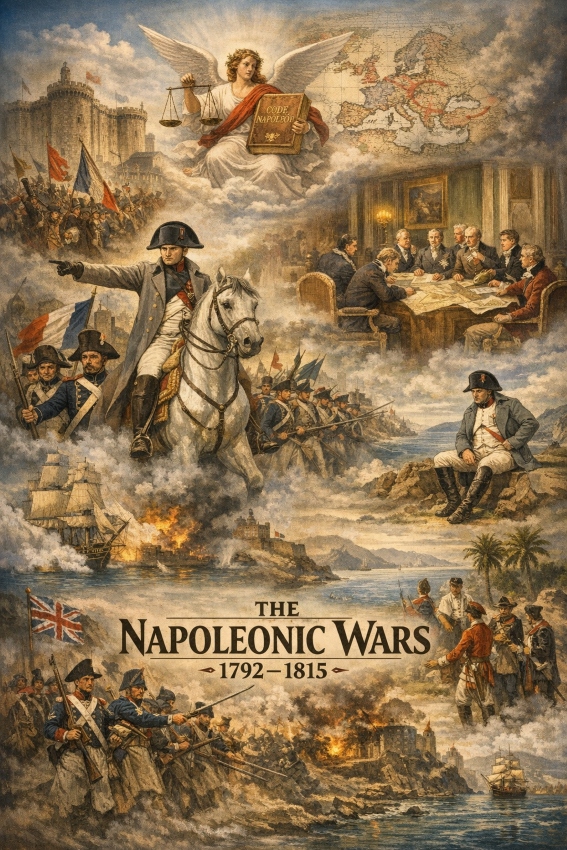
In the early 1790s, Europe’s diplomatic system was still largely organized around dynastic states, negotiated frontiers, and the expectation that war—when it came—would be limited enough to be controlled by cabinets and armies. France’s Revolution introduced a different kind of uncertainty into that system: not only a change of government, but an unstable sequence of institutional experiments that left outsiders unsure who, exactly, could commit the French state to lasting agreements.
A key rupture came in June 1791, when Louis XVI attempted to flee Paris and was captured and returned. Whatever the king’s intentions, the event became a visible indicator that the constitutional arrangement inside France was fragile. In August 1791, Austria and Prussia issued the Declaration of Pillnitz, publicly presenting the king’s situation as a matter of common interest among European sovereigns and calling for collective action under certain conditions. In the way the crisis unfolded, a signal that was conditional and carefully worded on paper was widely read in France as a hostile threat. The political temperature rose.
By April 1792, France’s Legislative Assembly voted for war. On 20 April 1792, France declared war on Austria, a decision that quickly brought in broader coalition dynamics. In France, war advocates did not speak with one voice: some argued that war would defend the Revolution, others that it would expose enemies, and still others hoped—openly or privately—that war would reshape internal politics in their favor. Across the frontier, states reacted to both France’s internal turbulence and its military posture. In practice, what followed was not a single straight-line war but a long sequence of shifting alliances, campaigns, and pauses—commonly grouped as the French Revolutionary Wars (1792–1799) and the later Napoleonic Wars (roughly 1800–1815), with a brief interruption during the Peace of Amiens.
The early months brought immediate tests of expectations. Contemporary accounts—summarized in standard references—emphasize that many actors on both sides expected quick results. Instead, war and politics fused. In July 1792, the Duke of Brunswick issued a manifesto threatening severe reprisals if the French royal family were harmed. Rather than stabilizing the situation, the threat contributed to radicalization in Paris. On 10 August 1792, the monarchy was effectively suspended after the storming of the Tuileries. The war against external powers and the struggle over France’s internal regime became increasingly entangled.
France’s war effort soon required a scale of mobilization that exceeded older norms. The levée en masse of 1793 stands out as an institutional turning point: an emergency decree that called for mass participation in war, not simply through enlistment but through the broader mobilization of society’s resources. What began as an improvised response to crisis became, over time, more systematic. Later measures such as the Jourdan law (1798) are often treated as part of the transition from emergency recruitment toward routinized conscription. The effect was to create a French capacity—administrative as much as military—to generate large armies repeatedly, even after defeats.
The political architecture in France also changed. In November 1799, the coup of 18–19 Brumaire replaced the Directory with the Consulate, bringing Napoleon Bonaparte to the center of executive authority. In 1804, he became Emperor. These shifts matter for “war conduct” not because they explain everything, but because they changed how decisions were made, how war aims were declared, and how military and administrative systems were coordinated.
A brief calm arrived with the Treaty of Amiens in March 1802, which created a short-lived peace. But Amiens proved fragile. In the breakdown described in widely used reference accounts, disputes over compliance—especially Malta—combined with deeper disagreements about commerce, dependent territories, and what “peace” should mean in a Europe where one state’s influence seemed to keep expanding through political restructuring rather than formal annexation alone. On 18 May 1803, Britain declared war again, reopening the long contest.
From that point, the wars became increasingly defined by the interaction of three systems: French land power, British sea power, and coalition politics on the continent. On land, Napoleon’s operational method—described in many summaries—relied on the corps system: large, semi-independent formations capable of moving on separate roads, living off a mix of supply and requisition, and concentrating quickly for battle. In 1805, this operational system produced one of the iconic set-piece outcomes of the era at Austerlitz (2 December 1805). At sea, the same year brought Trafalgar (October 1805), widely treated as decisive in establishing British naval supremacy and ending realistic prospects of a French invasion of Britain. From then on, Britain’s core strategic advantage lay in the ability to move goods, finance, and forces globally under naval protection, and to subsidize coalitions on the continent.
The contest expanded beyond battlefield decisions into economic warfare. Napoleon’s Continental System—initiated through decrees such as the Berlin Decree (1806) and the Milan Decree (1807)—was designed to weaken Britain by excluding its trade from the continent. Britain responded with countermeasures (often summarized under the Orders in Council). In practice, enforcement was uneven: smuggling and evasion were persistent, and the attempt to police the system stretched French resources and pushed France into deeper involvement in peripheral regions where compliance could not be taken for granted.
This dynamic is central to understanding the Iberian theater. From 1808 to 1814, the Peninsular War became a prolonged, multi-layered conflict involving regular armies and extensive irregular warfare. It is also one of the theaters where civilian harm is most clearly acknowledged—yet still difficult to quantify with precision. In the material used in this chat, Spain is treated as an illustrative case: studies summarized there offer a civilian death range for 1808–1814 in the hundreds of thousands, while also noting that famine and epidemic mortality could exceed direct wartime killings. Even here, the key point is methodological: civilian suffering was substantial, but precise totals vary depending on definitions and sources.
By 1812, the war’s center of gravity shifted dramatically east. The French invasion of Russia—dated in standard summaries from late June to early December 1812—became a case study in logistics and attrition. Reference accounts emphasize that combat losses alone do not explain the catastrophe: disease, exposure, and the breakdown of supply did much of the work. Estimates cited in this chat describe French losses on a vast scale, with most casualties attributed to non-combat causes. The campaign revealed a structural limit: operational systems designed for rapid campaigns in dense European regions could falter when distances, scorched resources, climate, and sustained resistance combined.
After 1812, coalition warfare matured into a more coordinated instrument. The Battle of Leipzig (16–19 October 1813) is widely treated as a decisive defeat for French power in central Europe. In 1814, as coalition armies pushed into France, diplomacy and battlefield pressure converged. The Treaty of Chaumont (9 March 1814) formalized coalition unity, including commitments intended to prevent separate peaces and to keep the coalition aligned until Napoleon was removed. After the fall of Paris, Napoleon abdicated in April 1814, and the First Treaty of Paris (30 May 1814) established a comparatively moderate peace: France returned to its 1792 boundaries, and the larger European settlement was deferred to a general congress.
That congress—the Congress of Vienna—opened in late 1814 and worked through profound bargaining problems, notably around Poland and Saxony. What it produced was not merely a set of borders but a framework for managing great-power relations, emphasizing a balance-of-power arrangement and strengthened buffers around France. Yet the settlement was not finalized in a stable environment. Napoleon returned from Elba in 1815, launching the Hundred Days and forcing the coalition to mobilize again. The campaign ended at Waterloo on 18 June 1815, after which Napoleon abdicated a second time.
The final closure came through a second, harsher peace. The Second Treaty of Paris (20 November 1815) imposed a large indemnity and an allied occupation force for several years. In parallel, alliance mechanisms—the consultative patterns later associated with the Concert of Europe—were intended to enforce the Vienna settlement and prevent rapid recurrence. In the years immediately after, these mechanisms were tested in various crises and interventions, revealing both the system’s capacity for coordinated action and its uneven application.
No narrative of the Napoleonic Wars is complete without acknowledging scale and uncertainty. The casualty figures discussed in this chat are presented as ranges rather than single totals for a reason: record-keeping categories differed across states, “missing” could mean many things, and civilian losses are often especially difficult to count. For France, one synthesis reported a broad range for military dead and missing on the order of roughly 800,000 to 1,000,000, while coalition military losses were summarized even more broadly—from about 1,000,000 to more than 2,500,000—reflecting uneven documentation and definitional differences. Civilian totals across all theaters remain contested; where the evidence is strongest, the story often becomes regional rather than aggregate.
In the end, the wars’ “shape” is one of escalation and adaptation. A conflict that began in 1792 amid constitutional breakdown and diplomatic signaling became, over two decades, a system of mass mobilization, coalition warfare, naval-economic struggle, and repeated attempts—some temporary, some durable—to impose a settlement. The 1814 peace proved insufficient to prevent a brief return to war; the 1815 settlement proved more enforceable, in part because it combined legal terms with occupation and alliance guarantees. Yet even as Vienna’s borders endured for decades in many places, the social and political forces that had been mobilized—mass politics, national sentiment, constitutional demands—continued to work beneath the surface, shaping the Europe that followed.