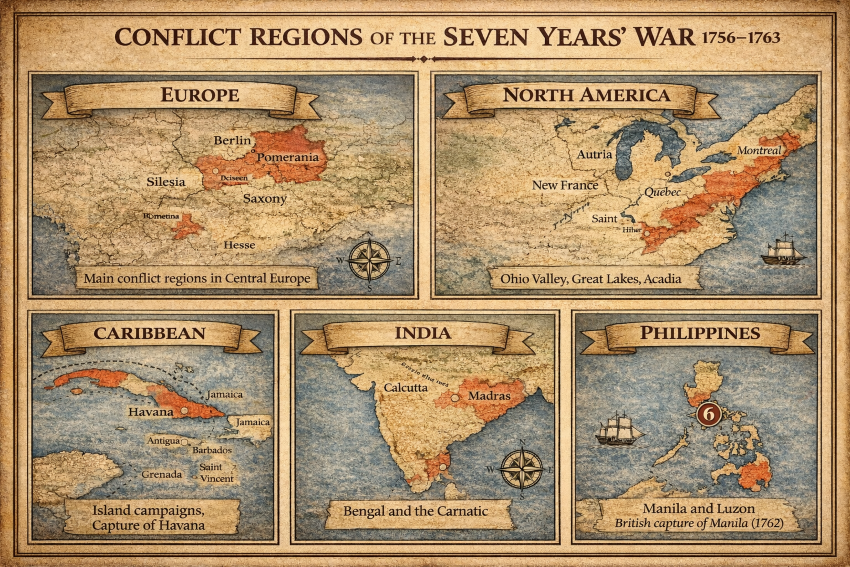
The Seven Years’ War is often described as a single conflict, but it unfolded more like a chain of interlocking wars—connected by diplomacy and resources, yet fought in distinct places under different operational constraints. By the mid-1750s, the peace that ended the War of the Austrian Succession (1748) had not settled two core problems: in Europe, Prussia’s retention of Silesia remained a live strategic dispute, while overseas Britain and France continued to compete across empires and trade networks. The result was a system primed for renewed confrontation, even before any formal declarations turned rivalry into a declared general war.
The first sparks came not in Central Europe but in the contested interior of North America. By 1754, armed clashes in the Ohio Valley were already taking place in what later English-language histories call the French and Indian War—widely treated as the North American phase of the wider Seven Years’ War. The pattern of escalation mattered. Violence began locally, then widened, and only later became a “European war” in the conventional 1756–1763 dating. Even before the paperwork of declarations caught up, events on the ground and at sea were creating irreversible commitments.
Through 1754 and 1755, North America generated a steady rhythm of blows and setbacks, including a British colonial defeat at Fort Necessity (July 1754) and the costly reverse of Braddock’s expedition at the Monongahela in July 1755. The war’s logic also appeared in decisions that blurred the boundary between peace and war. In June 1755, British naval forces captured French ships (Alcide and Lys) under orders to attack French forces even though war had not yet been formally declared. In retrospect, this “undeclared” maritime fighting helped harden positions: once ships and men were seized and blood was spilled, returning to a purely diplomatic contest became more difficult.
At the same time, the war’s human costs were not limited to soldiers. In Acadia, British operations around Fort Beauséjour (captured June 1755) formed part of the context for the Acadian deportations. Here the numbers themselves illustrate why historians insist on precision about scope. One scholarly account emphasizes that roughly 6,000–7,000 Acadians were removed in the 1755 deportation phase in the Bay of Fundy region, while broader summaries describe more than 10,000 removed across multiple years and locations. These are not necessarily contradictory claims; they often refer to different slices of the same process. The point for a reader, though, is clear: population removal and social dislocation were not peripheral side effects. They were integrated into how imperial authorities attempted to control contested spaces.
While North America burned, Europe experienced a diplomatic reconfiguration so striking that later writers called it the “diplomatic revolution.” Britain’s problem was partly continental: the British crown’s ties to Hanover meant that a war with France carried risks not just overseas but also in Germany. In January 1756, Britain–Hanover and Prussia signed the Convention of Westminster, agreeing to resist invasion of “Germany” by a foreign power. This arrangement helped reposition Prussia as Britain’s continental partner. France and Austria, in turn, moved toward cooperation: the First Treaty of Versailles (May 1756) created a defensive alliance between them, which later expanded into an offensive alignment in 1757. The treaties were written in defensive terms; nevertheless, the effect was to harden coalitions and reduce room for maneuver.
In May 1756, Britain formally declared war on France, but the conflict had already taken on a momentum of its own. Early European campaigning—such as the fighting around Minorca—signaled that the conflict was not going to remain a strictly colonial war. Then, in August 1756, Prussia invaded Saxony, a step widely treated as the opening of full-scale war in Europe. Contemporary and later debate about this move—whether it was preventive, opportunistic, or a mixture—shows how easy it is to slide from observed behavior into motive-claims. What can be stated without inference is that the invasion triggered a broader coalition war and set Prussia against multiple major powers.
Once the war was fully joined, its conduct differed sharply by theater. In Central and Eastern Europe, the conflict became a contest of maneuver, supply, and coalition coordination. Prussia won major victories in 1757 at Rossbach and Leuthen, battles that created a reputation for operational agility and battlefield effectiveness. Yet the European war was not decided by a single victory. In 1758, Zorndorf—described in reference accounts as among the bloodiest battles of the conflict—exposed the grinding character of the struggle and the immense costs of facing Russia. In 1759, the catastrophe at Kunersdorf showed how quickly fortunes could reverse. Even then, military results did not automatically convert into decisive political outcomes; supply constraints and coalition coordination often mattered as much as battlefield success.
If the European land war is remembered for its oscillations between triumph and crisis, Britain’s war is often remembered for how naval power and financial capacity could shape a global outcome. Here “war conduct” cannot be reduced to tactics. It involved moving men and supplies across oceans, sustaining fleets, and financing allies. One indicator of Britain’s approach was its subsidy relationship with Prussia: by April 1758 Britain committed an annual subsidy (stated in reference summaries as 4,000,000 talers, or about £670,000) and agreed not to make a separate peace. This was not merely a financial footnote. It was a strategic method: underwriting a continental ally while pressing France around the globe.
At sea, the war’s logic became particularly visible in 1759. The naval battle of Quiberon Bay (20–21 November 1759) is frequently presented as a decisive moment. Accounts emphasize that it followed a blockade context and helped prevent French invasion plans during the conflict, contributing to sustained British naval superiority. The immediate meaning of such a battle is operational—ships sunk, fleets scattered—but its wider significance lies in what it enabled and what it constrained. Strong naval control could restrict reinforcement flows, isolate colonies, and open possibilities for amphibious expeditions against high-value ports.
In North America, the war’s conduct emphasized forts, rivers, and sieges as much as open-field battle. The campaign sequence is telling. After earlier reverses such as the British defeat at Carillon (1758), British forces captured key positions and then struck at the political heart of New France. Quebec fell in September 1759, and by 1760 Montreal surrendered. These outcomes are often treated as decisive in ending French rule in Canada. Yet the narrative is not merely one of “better troops.” It is also about logistics, naval access, and the compounding effects of earlier losses. Once the St. Lawrence corridor was controlled, French options narrowed drastically.
In South Asia, the war’s conduct blended European rivalry with local power politics and company-state warfare. In Bengal, Plassey (June 1757) is commonly treated as a pivotal victory for the British East India Company, initiating a transformation in the Company’s political and military position. In the Carnatic, Wandiwash (January 1760) and the capture of French-held Pondicherry (1761) further eroded French capacity. Here, too, it is important to separate facts from long-run interpretations. Battles and captures can be dated and described; the claim that they “created British predominance in India” is an interpretation about longer-term consequences. Nonetheless, the broad directional shift toward greater Company power is strongly supported by the sequence of military outcomes followed by postwar political arrangements in the mid-1760s.
Even “minor” theaters mattered. In West Africa, fighting is often described as limited largely to Saint-Louis (Senegal River) and Gorée, which Britain occupied in 1758–1759. In the Philippines, Britain captured Manila in 1762. These operations were not as large as the continental campaigns, but they mattered because the war’s peace negotiations involved exchanges and restitutions across continents. A war that spreads across oceans ends not as one peace but as a package of bargains.
By 1762, the endgame accelerated. Russia’s abrupt policy reversal—following the death of Empress Elizabeth and the succession of Peter III—removed a major pressure on Prussia. Sweden also made peace with Prussia. Meanwhile, Spain entered the war, widening it at the very moment the European land war was approaching exhaustion. Britain’s amphibious capability was then demonstrated in high-impact attacks: Havana fell in August 1762, and Manila in October 1762. These captures mattered not only militarily but diplomatically. They created bargaining assets that could be exchanged at the peace table.
The war ended through two closely timed treaties in February 1763. The Treaty of Paris (10 February 1763) settled the global imperial war among Britain, France, and Spain (with Portugal included in the settlement architecture). It transferred and restored territories in North America, the Caribbean, West Africa, and India, combining cessions “in full right” with restitution of specific conquests and general clauses for territories not explicitly listed. The Peace of Hubertusburg (15 February 1763) ended the Central European war between Prussia, Austria, and Saxony and largely restored the status quo of 1748 while confirming Prussia’s possession of Silesia and Glatz. Together, these treaties illustrate a central feature of the conflict: it could not end as a single neat settlement because it was never just one war fought in one place.
Peace, however, was not an instantaneous condition. Treaty provisions required ratifications, prisoner exchanges, and phased evacuations. Distance and communication delays could make the implementation of peace slow, especially in far-flung theaters. The political consequences also outlived the treaties. In North America, the aftermath included renewed frontier violence and new British governance measures such as the Royal Proclamation of 1763, intended in part to regulate settlement and land acquisition. In South Asia, the postwar years saw further consolidation of Company power, including the decisive Battle of Buxar (1764) and the Treaty of Allahabad (1765), which granted the Company major revenue-administrative rights in Bengal. These developments were not “caused” by the peace in a simple, single-variable way, but they show that 1763 was a hinge: the legal structure of empire changed, and so did the practical challenges of ruling newly acquired or newly contested spaces.
A final way to understand the Seven Years’ War is to see it as a demonstration of how mid-18th-century warfare depended on more than battlefield outcomes. Disease and non-combat attrition could kill far more than direct combat in multiple theaters, complicating the assumption that military effectiveness was only about weapons or courage. Supply and credit systems shaped what armies could do and how long they could remain in the field. Naval superiority could constrain an opponent’s options thousands of miles away and enable late-war strikes that altered bargaining leverage. And coalition warfare meant that even dramatic victories could fail to produce decisive political results if allies disagreed, or if logistics made exploitation impossible.
The war’s “story,” then, is not simply a march from 1756 to 1763. It is a progression from unresolved settlements, to localized clashes, to globalized warfare, and finally to a peace that redistributed territory while creating new problems of governance, cost-sharing, and frontier stability. The Seven Years’ War ended with treaties, but its consequences continued in the policies and conflicts that followed—shaping imperial administration, fiscal politics, and regional power balances across the Atlantic and Indian Ocean worlds.