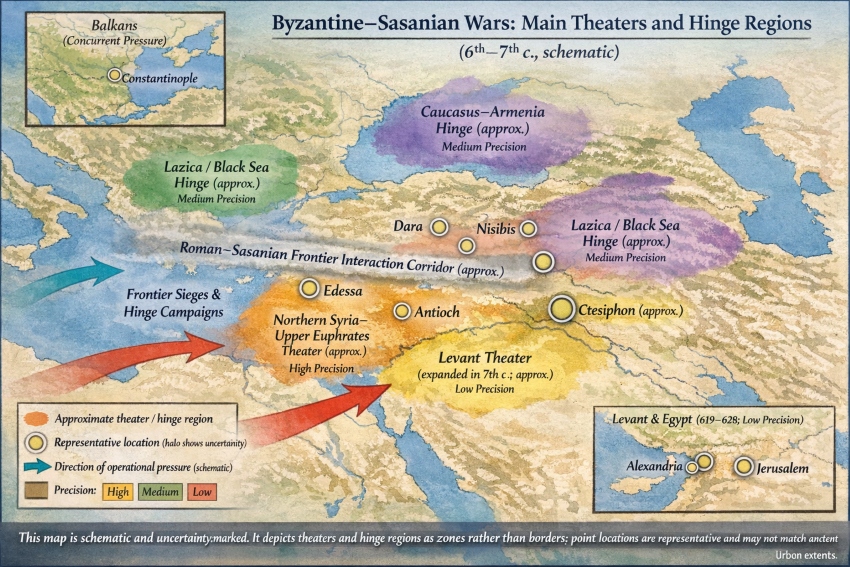
Across the dry uplands of Upper Mesopotamia and the river valleys that fed the cities of Syria and Iraq, two imperial systems faced each other for generations. Their frontier was not a thin line but a corridor: fortified towns, garrisons, tax districts, caravan routes, and the long attention of courts in Constantinople and Ctesiphon. When the corridor was quiet, diplomacy worked the gears—letters, envoys, staged encounters, gold, oaths. When it turned violent, the war most often began the same way: a fortress tested, a city invested, a campaign season opened.
In 502, the cycle broke into open war again. Modern reference synthesis describes how Kavād I approached the Roman emperor Anastasius I for financial support tied to pressures in the east—an explanation anchored in the late antique context of obligations and threats beyond the Roman frontier. When that request failed, the war moved quickly to the practical language of late antique campaigning: attacks in Roman Armenia and the siege of Amida. Even here, the pattern that would persist is visible: the objective was not a single decisive battle, but leverage—what a captured city, a broken garrison, or a threatened route could compel at the negotiating table. By 506, the fighting ended in a settlement shaped, in the same reference tradition, by payment and withdrawal: gains were relinquished, and both sides stepped back into a tense peace.
The lull did not remove the structural problem. The corridor remained crowded with fortifications, ambitions, and hinge regions—especially Armenia and the Caucasus, where local power and imperial strategy repeatedly met. When conflict resumed in the late 520s, it did so against a landscape already hardened by fortification and habit. Under Justinian I, the Romans inherited a war already in motion, and the early years of his reign were spent balancing needs at home with the demands of the eastern front. The fighting culminated in the peace of 532, widely remembered in the scholarship as an “eternal” or “perpetual” peace. In the form preserved through later reporting and synthesis, it was a bargain engineered for stability: a payment; recognition of control arrangements; and administrative gestures meant to reduce friction around sensitive nodes like Dara, which sat as both a fortress and a provocation. It was not a declaration that rivalry had ended—more a determination that, for the moment, it was too costly to continue.
Then, in 540, the cycle turned again, and it turned violently. Khosrow I moved west into Roman Syria and took Antioch. The sources summarized in modern scholarship preserve the episode not as a simple battlefield victory but as a city’s rupture: capture, ransom, and forced movement. Later compilations and reference works emphasize that this was also the period in which deportation and captive resettlement appear as a visible instrument of Sasanian state practice—moving people, skills, and wealth in ways that could reshape communities long after armies marched away. It is important to state what the evidence allows: we can say deportations occurred and are repeatedly attested; we cannot responsibly produce a single, stable number for how many were moved, because the traditions vary and the administrative ledgers that might settle it do not survive.
War after 540 did not remain only in Syria. It pulsed toward the Black Sea and the Caucasus hinge. Lazica—the eastern Black Sea littoral—became a recurring pressure point because it combined geography and allegiance: a corridor for influence, a gate for trade and supply, and a place where alignment could matter as much as conquest. By 562, diplomacy produced another major settlement—often framed as the Fifty Years’ Peace—whose known clauses, preserved through fragments and later reporting, show how both empires tried to make peace durable. It was not merely “stop fighting.” It was rules: limits on new fortresses, controlled trade routes (partly to reduce espionage), refugee return provisions, and financial arrangements presented as funding defense obligations in the Caucasus. It reads like a recognition that the frontier was not simply military; it was administrative, economic, and informational.
Yet even engineered peace could fail when its supports were withdrawn. In 572, the war resumed. Here, the narrative tradition and later synthesis underscore a familiar vulnerability: payments and compliance were politically contestable. In the reference tradition we used, Justin II’s cessation of annual payments is presented as a central proximate cause of breakdown, while other chronographic traditions differ on how blame should be allocated. The key fact is the resumption itself, and the way it re-opened the corridor. Campaigns again pressed through Mesopotamia and Armenia. As before, the objective was often leverage rather than annihilation: seize a city, compel a truce, trade a withdrawal for a concession.
The war that ended in 591 offers a distinctive picture of termination. It was not only armies, but throne politics. Khosrow II, displaced by a usurpation, appealed to the Roman emperor Maurice. Maurice’s intervention—military and financial support in return for concessions—helped restore Khosrow II and produced a period of cordiality. This is a crucial reminder that late antique war could end not because one side was exhausted in the field, but because a political settlement redefined what each side could accept. For a time, diplomacy worked.
Then came 602, a rupture in Constantinople that opened the last and largest phase of the entire rivalry. Maurice was overthrown and killed in the coup that brought Phocas to power. What followed, in the sources as later synthesized, is the kind of moment historians handle with care: motives are visible mostly through public rhetoric and later narrative framing. In that tradition, Khosrow II declared war “ostensibly” to avenge Maurice—a stated justification. The same tradition also records a ceremonial dimension: the appearance of a claimant presented as Theodosius, Maurice’s son, whom Khosrow recognized. Whether this Theodosius was genuine is debated; the safest position is to describe what the sources say (recognition, ceremony, use in diplomacy) and to acknowledge that authenticity remains uncertain.
In 603, Persian forces mobilized, and the war began in earnest. At first it might have looked like a familiar frontier contest—sieges, field actions, the pressure on key fortresses such as Dara. But the scale quickly changed. In modern reconstructions of the war’s middle phase, Persian operations expanded beyond the corridor into the Roman interior. By 614, Jerusalem was captured—an episode that survives in multiple traditions, often surrounded by contested claims about destruction and killing. It is precisely the sort of event where a narrative can be emotionally powerful yet evidentiary discipline is required: the occupation is a fact; the details of violence and responsibility vary by tradition and are still debated by modern specialists.
By the late 610s, the Persian war effort had reached a form that earlier treaties were designed to prevent: extensive occupation. Modern reconstructions describe the takeover of Palestine, raids into Asia Minor, and the conquest of Egypt by 619–620. This was no longer only pressure for concessions; it looked, for a time, like the reordering of the Roman East. But occupation is not an ending; it is a different kind of burden. It requires garrisons, supply, local deals, and the management of communities whose loyalties and survival strategies may not align with imperial narratives.
The Roman response under Heraclius evolved into something equally extraordinary. In the mid-620s, campaigns shifted away from slow frontier grinding toward maneuver and deep operations. 626 became a hinge year. The siege of Constantinople—Avar-led, with Persian forces positioned to cooperate—brought the war to the imperial center. The siege failed. Contemporary and near-contemporary texts treated the survival of the city as not only a military outcome but a legitimating event, and that textual afterlife is itself part of the war’s conduct: in late antiquity, victory also meant controlling how survival was remembered.
In the winter of 627, Heraclius drove into Mesopotamia. Modern reconstructions highlight the battle near Nineveh (12 December 627) as a pivotal operational moment. Shortly thereafter, the war’s political foundation in Persia fractured. In February 628, Khosrow II was overthrown and executed, and Kawād II came to power amid elite revolt. The termination that followed illustrates a pattern we saw earlier in 591 but under far greater strain: political rupture enabled diplomatic reversal. The post-628 peace framework, as preserved in later synthesis, centered on withdrawal and the relinquishment of wartime gains. Byzantine traditions highlight symbolic restitution as well, but the core operational result was that Persian forces gave up what they had taken.
Yet even in victory, the settlement did not translate into stability. The evidence summarized in our source base emphasizes rapid Sasanian succession crises and magnate power after 628, and it indicates that a “final” treaty is sometimes dated to 630, after protracted negotiation under unstable rulers. On the Roman side, the restoration of provinces did not mean restoration of pre-war capacity. Both empires had spent decades converting revenue into war, shifting populations, stripping regions of surplus, and turning cities into bargaining chips.
And then the strategic order changed. Within a few years, new campaigns—commonly dated in stages from 634 onward—removed Byzantium from much of Syria and Palestine and ended the Sasanian dynasty by 650/651. Historians debate how directly the last Roman–Persian war “caused” this outcome. A careful synthesis is that the war conditioned the landscape—through fiscal strain, political fragmentation, and disrupted provincial administration—while the new conquest dynamic had its own drivers and capabilities. The rivalry that had dominated the corridor for more than a century ended not with one empire permanently mastering the other, but with both empires losing the terms of their competition.
That is the story, as the sources allow it: a long contest fought in a corridor of fortresses and hinge regions, managed by treaties as much as by swords, repeatedly reignited by breakdowns in payment, alignment, or legitimacy, and finally concluded by a war so expansive that, even when it ended in withdrawal and restitution, it left behind states too strained to preserve the world they had spent generations contesting.