The Egypt–Hittite War Around Kadesh: A Narrative Built on the Surviving Record
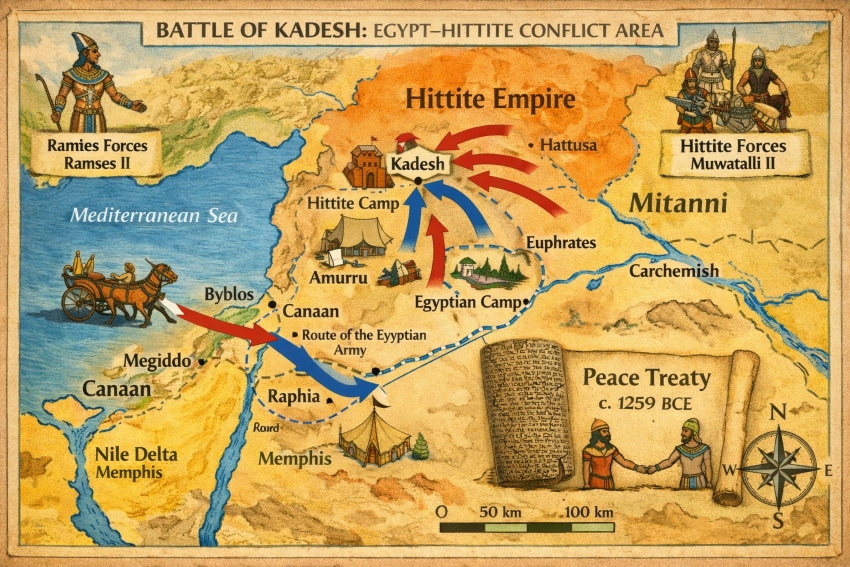
In the Late Bronze Age, power in the eastern Mediterranean was not held by a single empire. It was shared—and contested—by a small circle of “Great Kings,” courts that exchanged envoys, gifts, and marriages as readily as they organized campaigns. In that kind of system, war did not necessarily begin with a formal declaration. It could begin when a borderland shifted, when a vassal’s loyalty wavered, or when a fortress-city on a key route became the hinge upon which influence turned.
One such hinge was Kadesh, a strategic node associated by modern scholarship with the Orontes region in Syria and commonly identified with Tell Nebi Mend. Whether Kadesh was a large metropolis or a more modest center is not the core issue for understanding why it mattered. What mattered was position: Kadesh sat in a corridor where armies moved, supplies flowed, and smaller polities could be pressured to align with one great power or the other. Interpreting Kadesh as a “node” rather than merely a “city” is a high-confidence inference based on why it repeatedly appears in the conflict narrative and why powers invested so much effort in controlling it.
The road into conflict: unresolved frontiers and inherited rivalry
The Kadesh episode is usually told through the figure of Ramesses II, but the war’s logic stretches backward. Under Seti I—Ramesses’ father—Egypt had already been active in the same northern arena. Seti’s reign is commonly dated to around c. 1290–1279 BCE in modern reference chronology.
What Seti I did in Syria and how permanently it reshaped the frontier is not straightforward to pin down, because the evidence is filtered through royal display. Scholarly discussion notes that Seti I’s Karnak reliefs depict a capture of Kadesh, but the key dating text is lost—so the episode is discussed, but the exact timing and implications are uncertain.
Still, the broad shape is clear: Egypt and Hatti entered Ramesses II’s reign with overlapping claims and competing client networks in the Levant and inland Syria. The contest was not simply “Egypt versus Hittites” in an empty landscape; it was also a contest over how local rulers and territories would be integrated into a regional order.
Ramesses II moves north: stated aims and the march toward Kadesh
When Ramesses II comes to the center of the story, modern summaries are unusually direct about the stated objective. Britannica frames the campaign in geopolitical terms: Ramesses sought to recapture Kadesh and contest control in Syria/Canaan against the Hittites.
That statement can be treated as a solid starting point because it is not a psychological claim about motive. It is an externally legible aim: reclaim influence in a contested zone and seize (or neutralize) a fortified node.
But the closer we move to the battle itself, the more our narrative depends on a particular kind of evidence: Egyptian royal commemorative texts.
A major witness to that tradition is Papyrus Sallier III, described by the British Museum as preserving part of the Egyptian “Poem” account of the battle—narrative, sometimes in first person from Ramesses’ viewpoint, attributing success to the king with divine support (Amun-Ra), and known to exist in multiple monumental copies at major temples.
This matters because it tells us how the story was meant to function. It was not merely to record an event; it was to shape memory—for subjects, for elites, and for posterity.
The battle: shock, chariots, and an outcome that does not settle the war
The battle commonly called the Battle of Kadesh is typically placed in the mid-1270s BCE. Britannica’s entry gives 1275 BCE and describes it as one of the largest chariot battles remembered in the historical record. (Other chronologies can differ by about a year; that uncertainty remains important when presenting absolute dates.)
What happened on the day of battle is reported most vividly in the Egyptian tradition. A key narrative element—also summarized by Britannica—is that Ramesses received misleading information suggesting the Hittite main force was far away, only to discover the enemy was near and ready to strike.
Here, a careful narrative must hold two ideas at once:
- FACT (about the record): Egyptian texts and later summaries include a deception/intelligence failure episode as an explanation for surprise.
- INTERPRETATION (Medium confidence): The episode plausibly reflects a real operational problem—bad intelligence and timing—but it also serves a literary function: it explains danger without undermining royal competence, because the king is then portrayed as rescuing the situation through exceptional action.
As the clash unfolds, the fighting is consistently framed as a chariot-centered shock battle. Britannica highlights a distinction in chariot crew structure—often summarized as heavier Hittite chariots with three-man crews versus Egyptian two-man chariots—used in many modern retellings to explain differences in impact and tactics.
This detail should be treated as a synthesis claim rather than as a perfectly audited technical description, but it is a recurring analytical point in mainstream summaries.
Then comes the critical question: Did the battle settle the war?
On this, our sources pull in different directions—precisely because they serve different purposes.
- FACT: Egyptian commemorative accounts (as described by the British Museum) present the battle in triumphal terms, attributing success to Ramesses with divine aid and centering the king’s role.
- FACT (modern synthesis): Britannica explicitly states there was no outright victor, and another Britannica entry notes that although Ramesses claimed a great victory, the outcome was indecisive.
A conservative narrative conclusion follows:
INTERPRETATION (High confidence): Kadesh was a major engagement that neither side could convert into a decisive, war-ending victory. Egyptian sources could frame it as triumph for domestic and diplomatic prestige, while modern historians—looking at the longer strategic trajectory—commonly label it indecisive.
That longer trajectory is crucial: if Kadesh had truly ended the contest, the story would end there. Instead, it continues—toward diplomacy.
Years later: the treaty that formalizes an end to open rivalry
The strongest single anchor for “how the war ended” is not a battle report. It is a treaty—preserved in both the Egyptian and Hittite textual traditions.
FACT: The Cuneiform Digital Library Initiative describes the treaty between Ḫattušili III and Ramesses II as concluded in 1259 BCE, between kingdoms previously at odds over territory in the Levant.
FACT: A classic scholarly publication by Langdon and Gardiner treats the treaty’s versions and translation issues, forming part of the modern academic foundation for reading the text.
The treaty’s language shows what “ending the war” meant in practice. It is not simply “we stop fighting.” It is a structured agreement aimed at preventing the rivalry from re-igniting through raids, defections, internal rebellions, or third-party attacks.
From the treaty tradition as we used it here:
- Mutual defense / alliance logic: If an enemy attacks one party and assistance is requested, the other party is obligated to send support.
- Extradition and return of fugitives: The treaty includes provisions for returning people who flee from one kingdom to the other, reducing the risk that the frontier becomes a sanctuary for political defectors.
- Divine witnessing and sanctions: The treaty invokes a very large set of gods as witnesses and frames compliance through blessing/curse logic—how treaties were “enforced” in the conceptual world of the period.
In narrative terms, the treaty reads like a recognition that the rivalry had become expensive to sustain and difficult to resolve purely by campaigning. But because we do not infer motives, we should phrase it carefully:
INTERPRETATION (Medium confidence): The treaty reflects a mutually acceptable settlement framework—stabilizing relations and managing risks—rather than the total victory of one side. That interpretation is grounded in what the treaty actually does (mutual obligations and structured returns), not in assumptions about private intent.
What the result “looked like” after the treaty: diplomacy, marriage, and continued management
Treaties in this era were not only ink on a tablet; they were relationships that had to be maintained.
FACT: Post-treaty relations include continued diplomatic exchange and marriage linkages. Cataloguing of Egyptian–Hittite correspondence indicates multiple letter categories (including marriage letters and sensitive disputes such as those involving Urhi-Teššup).
FACT: A British Museum object identifies Maathorneferure as the Egyptian name of a Hittite princess married to Ramesses II (described in relation to Year 34).
These are not merely decorative details. They show what the “outcome” became: a relationship stabilized by formal obligations and reinforced by dynastic linkage, but still requiring ongoing communication about politically sensitive matters.
A necessary limitation: casualties and displacement
Readers often want numbers—dead, wounded, displaced. For this case, the responsible position is restraint.
FACT: The principal surviving sources we are using for Kadesh are commemorative and diplomatic; they are not neutral administrative casualty registries. Britannica emphasizes the battle’s scale but does not provide audited casualty totals.
INTERPRETATION (High confidence): Any precise casualty totals are not defensible from this evidentiary base. The safest statement is that losses were likely significant given the intensity and scale implied by the narrative tradition, but credible ranges cannot be derived here.
In one sentence: why war, and what was the result?
- Why it became war (fact-based summary): Egypt and Hatti contested influence and control in Syria and the Levant, with Kadesh as a strategic focal point; Ramesses II’s campaign is commonly summarized as an attempt to recapture Kadesh and reassert Egyptian influence in the contested region.
- What the result was (fact-based summary): Kadesh is widely characterized in modern synthesis as indecisive, and the rivalry culminated in a later formal treaty (commonly dated 1259 BCE) establishing peace and structured cooperation, reinforced by ongoing diplomacy and dynastic marriage.