Part 1 — Pre-War System (Actors, Institutions, Stakes, Constraints)
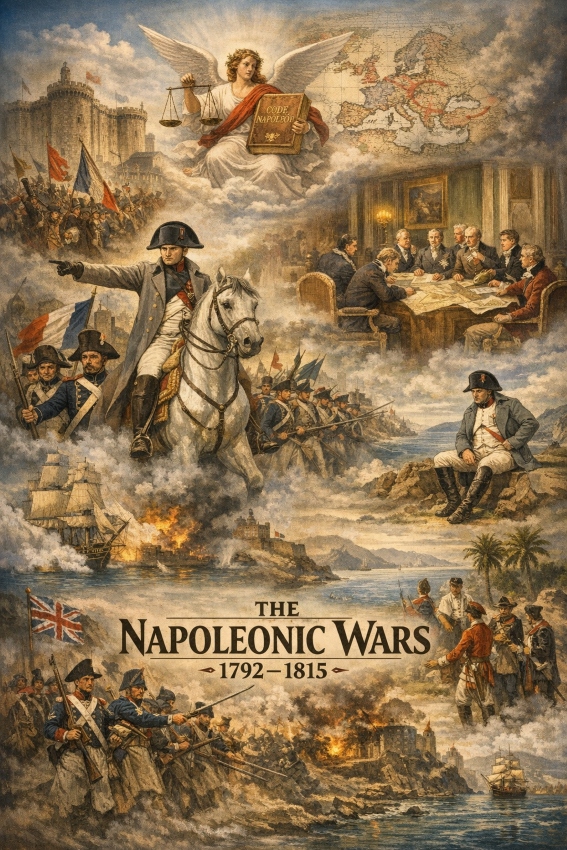
Conflict Snapshot (for series reference)
- Conflict: Napoleonic Wars (often treated as the continuation of the French Revolutionary Wars)
- Dates: 20 April 1792 (France declares war on Austria) to 18 June 1815 (Waterloo) and Napoleon’s second abdication on 22 June 1815; peace settlement formalized through May 30, 1814 and Nov. 20, 1815 Treaties of Paris and the Congress of Vienna (Sept. 1814–June 9, 1815)
- Type (descriptive classification): Interstate coalition warfare tightly intertwined with revolutionary regime change inside France and “exported” political restructuring in parts of Europe (classification note: this is a category label, not a claim about motives).
- Primary actors (core belligerents over time): France vs shifting coalitions led at different points by Austria/Prussia, later prominently including Britain, Russia, Prussia, Austria (and multiple allied/associated states).
- Theater: Predominantly Europe, with significant overseas dimensions (colonies and warfare affecting wider imperial spaces; e.g., casualty accounting that includes British losses “in the Indies”).
- Outcome label (non-normative): Coalition victory; Napoleon removed from power; postwar settlement consolidated through the Congress of Vienna and the Treaties of Paris (1814–1815).
- Casualties (ranges) and why they differ (overview):
- French military deaths (Empire-era accounting emphasized): ~900,000–1,000,000 “killed” across ~15 years (as summarized by Fondation Napoléon drawing on demographic work and military registers). This estimate explicitly grapples with “certain” deaths (e.g., deaths from combat or in hospital) versus large “uncertain losses” (prisoners, struck off, deserters) where a portion may have died but was never recorded as such.
- Non-French/coalition military deaths: estimates in the summary range from ~1,000,000 to >2,500,000, with a median around ~2,000,000 proposed in the same synthesis—reflecting uneven record-keeping across states and differences in what categories are counted.
- Civilian deaths: the same synthesis cautions that civilian losses are “almost impossible” to count across the whole conflict, then provides Spain (1808–1814) as an example with ~215,000–375,000 civilian deaths, plus ~350,000–500,000 deaths from famine or epidemics (contextualized as exceeding direct conflict deaths).
- Displacement: No standardized Europe-wide displacement total is established in the core reference set above; displacement is typically treated regionally and episodically rather than as a single aggregated estimate (flagged here as a known measurement gap rather than a zero).
- Last updated: 17 January 2026
Timeline (8–15 dated milestones)
- 27 Aug 1791 — Declaration of Pillnitz issued by Leopold II and Frederick William II (signal urging European powers to unite to restore the French monarchy; conditional and “largely symbolic” in formulation).
- 20 Apr 1792 — French Legislative Assembly ratifies war on Austria.
- 27 Jul 1792 — Brunswick manifesto threatens reprisals if the French royal family is harmed (Britannica framing: it stimulates determination to resist).
- 20 Sep 1792 — Battle of Valmy (often treated as a key early watershed in 1792 campaigning).
- 23 Aug 1793 — Levée en masse decreed by the National Convention as a response to crisis, formalizing mass mobilization.
- 9–10 Nov 1799 — Coup of 18–19 Brumaire overthrows the Directory and establishes the Consulate.
- 27 Mar 1802 — Treaty of Amiens signed; a brief European peace (about 14 months) before renewed war.
- 2 Dec 1804 — Napoleon’s coronation as Emperor.
- 9 Mar 1814 — Treaty of Chaumont (Britannica: core powers conclude a special alliance) as coalition coordination intensifies late-war.
- 30 May 1814 — First Treaty of Paris signed.
- Sept 1814 – 9 Jun 1815 — Congress of Vienna convenes and completes its “Final Act” in June 1815.
- 18 Jun 1815 — Battle of Waterloo (Britannica: Napoleon’s final defeat ending recurrent warfare).
- 20 Nov 1815 — Second Treaty of Paris signed.
Pre-War System (what the conflict “sat on top of”)
1) The European political order and its baseline assumptions (FACTS with limited inference)
By the early 1790s, Europe’s interstate system was dominated by dynastic states whose diplomacy treated war and peace as instruments of state security, territory, and status. Against that background, the French Revolution introduced a rapid succession of domestic institutional changes in France that other governments assessed—at minimum—as a source of uncertainty for regional stability. A clear factual marker of France’s internal fragility was the attempted flight of Louis XVI (20–21 June 1791) and his capture and return to Paris, occurring during an attempt to operate a monarchical constitutional regime in which powers were shared between king and assembly.
Interpretation (attributed, confidence: Medium): Many historians treat the pre-war European order as one in which interstate bargaining depended on credible signals about regime stability and control over armed force. Under that reading, France’s visible constitutional instability reduced the credibility of commitments and increased the probability that external and internal actors would gamble on coercion. (This is a framework claim; specific country motives are addressed, with attribution, in Part 2.)
2) France’s new political institutions and the “legitimacy problem” (FACTS)
Two linked institutional features mattered before major combat operations unfolded:
- Ambiguous executive authority: Britannica describes the Constituent Assembly’s attempt at a constitutional monarchy with shared legislative/executive authority, but also notes Louis XVI’s weakness and dependence on aristocratic advisers, with the attempted flight in June 1791 as a major stress test.
- Polarized domestic politics under external pressure: The Declaration of Pillnitz (27 Aug 1791) is described by Britannica as urging European powers to unite to restore the French monarchy; it was “largely symbolic” in that Austria and Prussia conditioned intervention on a broader European consensus, and Leopold II worded it so as to avoid being forced into war.
These points matter operationally because they shaped France’s civil-military decision-making: who could authorize war aims, how quickly France could mobilize, and whether foreign threats strengthened or weakened the constitutional experiment.
3) Early war aims as stated in official texts (FACTS; motives not inferred)
A notable primary-source statement of France’s declared posture appears in the French declaration of war against Austria (1792) as reproduced in Wikisource: it frames war as the defense of liberty and independence and explicitly asserts a principle of not undertaking war “with a view to conquest” (in the constitutional language reproduced).
On the opposite side, Britannica’s description of Pillnitz presents the signatories as urging unified European action to place Louis XVI “totally free” to consolidate monarchical government in France (i.e., restoration-oriented language), while also noting the declaration’s conditionality and symbolic signaling function.
Interpretation (attributed, confidence: Medium): In the historiography, these documents are often used as “opening bids” that reveal how each side sought legitimacy: France using constitutional principle language; monarchies using dynastic and sovereign-right language. The gap between stated principles and later conduct is a central issue for Parts 2–3, but the baseline is that the texts exist and were politically salient at the time.
4) Military institutions: from professional armies to mass mobilization (FACTS)
A structural discontinuity in the pre-war system is the emergence of mass mobilization mechanisms in revolutionary France:
- The levée en masse of 23 Aug 1793 is described in an academic reference (Caiani) as the Convention’s direct response to looming crisis, intended to assemble recruits and build a support framework for an unprecedented military establishment.
- The same reference notes that a durable system of annual replenishment was later introduced via the Jourdan law of 12 Jan 1798 (as described there), which replenished the ranks yearly—connecting early emergency mobilization to a more routinized manpower system.
Whatever one’s interpretation of “why” these systems were adopted, the institutional fact is that France developed a capacity to field very large forces relative to earlier norms, and opponents gradually adapted their own mobilization and military reforms in response (a topic returned to in Part 3).
5) Coalition warfare as an institution (FACTS; limited inference)
From the start, the wars were not a single dyadic conflict but a series of conflicts against changing combinations of states (coalitions), with entry, exit, and re-entry over time. Britannica’s overview treats the Napoleonic Wars as conflicts between Napoleon’s France and “shifting” alliances among other powers, and it frames the overall period (Revolutionary + Napoleonic phases) as 23 years of nearly uninterrupted war in Europe, with a brief interruption around Amiens.
Coalition coordination later culminated in formalized great-power alignment (e.g., Britain, Austria, Prussia, Russia) tied to the Treaty of Chaumont (March 1814) and then the Congress of Vienna process.
Interpretation (attributed, confidence: Medium): A common political-science reading of coalition warfare emphasizes commitment problems: partners want France constrained but also fear each other’s gains. This helps explain why coalitions could be both powerful and fragile—an analytic lens, not a single-cause claim.
6) Stakes and constraints visible before the war’s end state (FACTS, then bounded interpretation)
Stakes (FACTS):
- Regime security and sovereignty were explicitly in play in diplomatic signaling around Pillnitz and France’s interpretation of it as a sovereignty threat.
- Territorial and political reorganization of Europe becomes explicit in the eventual settlement processes: the Treaties of Paris (1814–1815) and the Congress of Vienna are described by Britannica as reorganizing Europe after the Napoleonic Wars, culminating in a comprehensive settlement.
Constraints (FACTS using casualty accounting as a proxy for state capacity limits):
The Fondation Napoléon synthesis illustrates how the human cost became a governing constraint. It describes older postwar claims of French losses so large they implied the near-total death of mobilized men as “overestimated,” and it explains why demographic methods using regimental matriculation registers produce a lower but still massive range, distinguishing certain deaths from uncertain categories (prisoners, deserters, struck off).
Interpretation (attributed, confidence: High): Even without inferring intent, sustained war at this scale tends to force states into repeated tradeoffs among manpower, legitimacy, and fiscal-administrative reach. Those tradeoffs are visible in France’s movement from constitutional experiment to emergency mobilization to routinized conscription mechanisms.
What is well-established vs. what is disputed
Well-established (high confidence)
- War begins (formal trigger): France’s declaration of war on Austria on 20 April 1792.
- Pillnitz’s existence and conditionality: issued 27 Aug 1791; framed as symbolic/conditional and interpreted in France as threatening.
- Institutional mobilization pivot: levée en masse (23 Aug 1793) and later conscription institutionalization as described in the academic reference.
- Core periodization: Revolutionary phase (1792–1799) and Napoleonic phase (about 1800–1815), with interruption around Amiens.
- Termination markers: Waterloo (18 June 1815) and the Treaties of Paris (1814–1815) as endpoints of the settlement process.
Disputed / debated (medium to low confidence, often because of measurement)
- Total military deaths (all sides): ranges vary widely (e.g., coalition totals ~1.0M to >2.5M) depending on inclusions, missing records, and definitional choices.
- How many “uncertain losses” were deaths vs survival outside state records: explicitly flagged as a core methodological problem in the French case.
- Civilian death totals across all theaters: the source base used here treats full aggregation as close to impossible, offering regional illustrations (Spain) rather than a single comprehensive number.
- A single aggregated displacement estimate: not standardized in the referenced materials; likely requires region-by-region reconstruction (an open measurement task for the series).
Key Sources Used (Part 1)
- Encyclopaedia Britannica, French Revolutionary wars (overview and “Europe during the Revolutionary years”).
- Encyclopaedia Britannica, Napoleonic Wars (overview and termination framing).
- Encyclopaedia Britannica, Declaration of Pillnitz.
- Fondation Napoléon (Thierry Lentz), “Bilan humain des guerres napoléoniennes” (casualty range logic; Spain civilian estimates example).
- Ambrogio A. Caiani, “Levée en Masse” (academic treatment; levée date; Jourdan-law note as presented there).
- Encyclopaedia Britannica, Treaties of Paris (1814–1815) and Congress of Vienna (settlement endpoints).
- Wikisource, French Declaration of War against Austria (1792) (primary-source wording as reproduced).
- Encyclopaedia Britannica, Battle of Waterloo (date and endpoint framing).
Open Questions / Uncertainties (to carry into Parts 2–5)
- Best practice for an all-sides casualty baseline: what composite method (state records + demographic back-calculation + battle studies) yields the most defensible global range without double-counting?
- Displacement measurement: can a credible “minimum displaced” range be assembled from regional refugee/evacuation studies, or is the evidence too fragmented for aggregation?
- Interstate vs domestic drivers at the margin: how do leading scholars apportion causal weight among domestic French institutional instability, external threat perceptions, and opportunistic bargaining—without collapsing into single-motive stories?
- Coalition mechanics over time: which institutional innovations most improved coalition staying power by 1813–1814 compared to earlier coalition failures (a question for Part 4, anchored by Chaumont/Vienna)?
- Civilian harm pathways: beyond Spain (where the cited synthesis provides ranges), which theaters have sufficiently robust archival-demographic studies to support comparable civilian impact ranges?