World War I — Part 1: Pre-War System (actors, institutions, stakes, constraints)
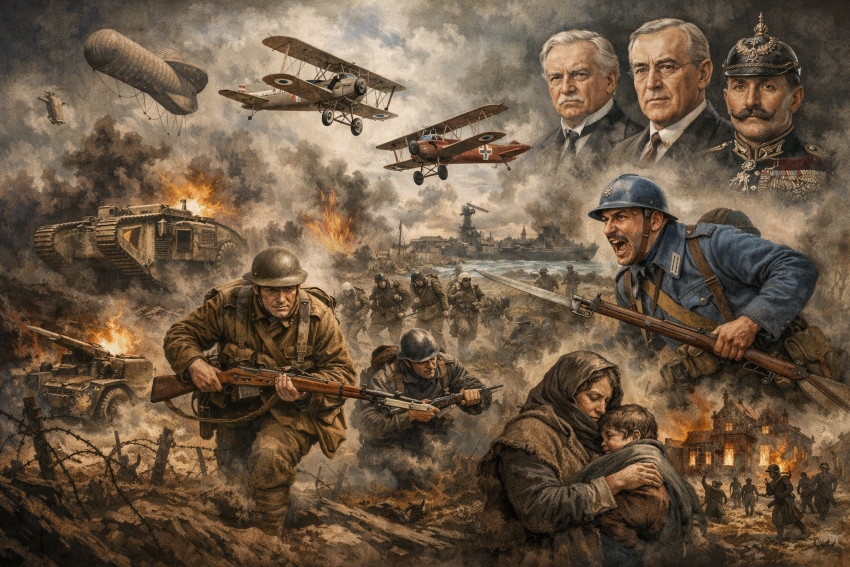
Conflict Snapshot (for reference at the start of the series)
- Dates (core fighting): Late July/August 1914 – 11 November 1918 (Armistice with Germany).
- Type: Predominantly inter-state war; escalated into a global, multi-theatre conflict.
- Primary actors (core belligerents):
- Central Powers (main): Germany, Austria-Hungary; Ottoman Empire and Bulgaria joined later among principal combatants.
- Allies (main): France, Russia, Great Britain; later Italy (1915) and the United States (1917) among others.
- Theatre: Global (Europe as main theatre with campaigns and mobilization across empires and overseas domains).
- Outcome label (minimal): Allied victory; Armistice (11 Nov 1918) followed by peace settlements including the Treaty of Versailles (28 Jun 1919).
- Casualties (ranges; why they differ):
- Military deaths: commonly cited around ~8.5 million; some public-facing institutional summaries use broader rounded figures approaching ~10 million for armed forces dead. Differences reflect counting rules (wounds vs disease), national record completeness, and rounding.
- Civilian deaths: frequently summarized around ~13 million, but attribution varies (combat, famine, disease, massacres, and what is counted as “war-related” excess mortality).
- Displacement (ranges; why they differ): No single universally accepted “global WWI displacement total.” Strong evidence exists for large regional refugee flows—e.g., Belgium saw mass flight exceeding 1.5 million in 1914, and the Eastern Front produced millions of refugees with uneven enumeration. Differences reflect definitions (refugee vs evacuee vs deportee), shifting borders, and incomplete registration.
- Last updated: 17 January 2026
Timeline (pre-war system to outbreak; 12 milestones)
- 8 April 1904: Entente Cordiale (UK–France) helps reshape alignments.
- 1905–1906: First Moroccan Crisis strains relations among major powers.
- 31 August 1907: Anglo-Russian Entente contributes to the Entente framework.
- 6 October 1908: Austria-Hungary announces annexation of Bosnia-Herzegovina (Bosnian Crisis).
- 1911: Second Moroccan Crisis (Agadir) intensifies great-power friction.
- 1898–1912 (peak years): Anglo-German naval race as a visible component of pre-war armaments competition.
- 1912–1913: Balkan Wars destabilize southeastern Europe and set conditions for further conflict.
- 28 June 1914: Assassination of Archduke Franz Ferdinand in Sarajevo begins the July Crisis.
- 23 July 1914: Austria-Hungary issues ultimatum to Serbia (July Crisis sequence).
- 28 July 1914: Austria-Hungary declares war on Serbia.
- 1–4 August 1914: Escalation to general European war; Britain declares war on Germany on 4 August (July Crisis culmination).
- 11 November 1918: Armistice with Germany ends major fighting on the Western Front.
Pre-War System: what “the system” consisted of in 1914
1) Actors and decision centers
Well-established facts
- The pre-1914 order in Europe was structured around a small number of great powers interacting through diplomacy, military planning, and (in several cases) imperial governance across overseas domains.
- Formal alliances and ententes existed in overlapping forms—some mutual defense pacts and some looser ententes—and can be studied both through narrative histories and standardized alliance datasets.
- The alliance system in 1914 did not eliminate uncertainty. Contemporary observers and later scholarship note ambiguity about (for example) the degree of British commitment in a continental war and how allies would prioritize fronts.
Interpretations in scholarship (attributed; no single “system diagnosis” is uncontested)
- Some historians emphasize leaders and small decision circles (monarchs, ministers, general staffs) as pivotal in converting crisis into war; others stress structural pressures (alliances, arms competition, imperial rivalry) that shaped the options leaders perceived. The existence of these competing frames is a core point in modern historiography on war origins.
Practical implication for your series: In Parts 1–2, treat “the actor” not as a single unified state but as a cluster: foreign ministry + military leadership + executive authority + domestic constraints (parliament, public opinion, parties), with alignment and conflict among them.
2) Institutions: alliances, diplomacy, and crisis management
Well-established facts
- By the years immediately preceding 1914, Europe was widely understood (then and now) as divided into two major groupings: Triple Alliance (Germany, Austria-Hungary, Italy) and Triple Entente (France, Russia, Britain), while recognizing that the legal and operational content of these ties differed.
- Formal alliance behavior can be examined systematically via the Correlates of War “Formal Alliances” dataset (1816–2012), which classifies mutual defense pacts, non-aggression treaties, and ententes.
- Several pre-1914 international crises (e.g., Morocco 1905/1911; Bosnia 1908; Balkan conflicts 1912–13) demonstrated that disputes on the periphery could involve major powers and influence perceptions of credibility and risk.
Interpretations in scholarship
- A recurring debate is whether alliances were primarily deterrents that failed, or commitment mechanisms that increased escalation risk by tying credibility to rapid action. Scholarship treats this as contingent on the specific crisis and the internal politics of each power, rather than as a universal law.
3) Stakes: security, territory, empire, and nationalism
Well-established facts
- Nationalism was a major political force across Europe by 1914, shaping domestic politics and claims about identity and territory; the scholarly literature traces its evolution and variability rather than treating it as a single uniform phenomenon.
- Imperial rivalries and colonial conflicts formed part of the wider pre-war environment. Even when European great powers avoided direct major war on the continent for decades, their militaries fought frequently in colonial campaigns, contributing to a broader militarized international context.
- Specific flashpoints mattered:
- Morocco (1905–11): a locus of Franco-German tension and wider alignment signaling.
- Bosnia (1908): a crisis linked to the Habsburg position in the Balkans and international responses.
- Balkan Wars (1912–13): reshaped the southeastern European balance and increased volatility in the region.
Interpretations in scholarship
- Imperialism is treated by historians as one contributing factor among others; scholarship specifically cautions that “economic rivalry,” “colonial policy,” and “imperial culture” do not map neatly onto a single causal pathway to war in 1914.
4) Constraints: why the system could be brittle in a fast-moving crisis
4.1 Military planning, mobilization, and railways
Well-established facts
- Great powers maintained detailed pre-war military plans and timetables. Germany’s planning (associated in later shorthand with the “Schlieffen Plan” tradition) aimed to address a perceived two-front problem through early operational choices, and it was embedded in mobilization and deployment planning.
- Railways were central to early-20th-century mobilization and deployment. Contemporary mobilization depended on schedules and administrative preparation rather than ad-hoc improvisation.
Interpretations in scholarship
- A prominent line of argument in the literature is that mobilization systems could create “use-it-or-lose-it” pressures during a crisis (because delay might concede initiative). Historians disagree on how determinative this was relative to diplomatic choice; treat it as a constraint with debated weight, not a mechanical cause.
4.2 Armaments competition and militarism
Well-established facts
- Pre-1914 Europe experienced significant armaments competition, with different emphases by state; the scholarship treats this as part of a wider political-strategic environment rather than a single linear “arms race story.”
- The Anglo-German naval race (1898–1912) is widely described as the most visible strand of maritime arms build-up in the period.
- Militarism as a cultural and political phenomenon was real but uneven: military symbols and organizations were widespread, yet researchers caution that visible militarization did not always translate into popular desire for aggressive war.
Interpretations in scholarship
- Debate persists over whether armaments competition primarily increased war probability, or whether it was mainly a symptom of deeper political antagonisms. Use it as a “system pressure” category, with attribution when making stronger claims.
4.3 Finance and economic interdependence
Well-established facts
- The pre-war international financial system was highly interconnected; scholarship on war finance explicitly treats the pre-1914 financial order and its global dynamics as a key background for understanding constraints once war began.
- Long-run economic history datasets show extensive global trade integration in the decades before 1914—useful as context for why “economic ties” did not automatically prevent war.
Interpretations in scholarship
- Historians differ on whether interdependence reduced incentives for war or created vulnerabilities and fears that intensified crisis behavior. Treat “interdependence prevented war” as a hypothesis that WWI challenges, not as a settled proposition.
What is well-established vs what is disputed (as it applies to the pre-war system)
Well-established
- The sequence of major pre-war crises (Morocco, Bosnia, Balkan Wars) and the July Crisis trigger sequence from Sarajevo to general war are well documented.
- Europe’s alignment structure by 1914 is clear at a broad level (Alliance/Entente groupings), though the bindingness and operational meaning varied.
- States maintained detailed mobilization and war planning systems in which railways and timetables were central.
Disputed / debated (how to weight the components)
- Relative causal weight: alliances vs arms competition vs imperial rivalry vs nationalism vs leadership choices. The historiography explicitly documents shifting scholarly emphases over time (including the Fischer controversy and later revisions).
- Agency vs structure: whether the system “pushed” leaders into war or whether leaders retained wider choice than later accounts imply.
- Militarism’s meaning: visible militarization existed, but the translation from culture to policy to war remains debated and context-dependent.
End of Part 1 — Key Sources Used
- 1914–1918 Online (International Encyclopedia of the First World War): Alliance System 1914, July Crisis 1914, Arms Race prior to 1914, Naval Race, Bosnian Crisis, Moroccan Crises, Balkan Wars, Militarism, Imperialism, and Origins historiography.
- Correlates of War Project: Formal Alliances dataset documentation (standardized alliance typology).
- Encyclopaedia Britannica: WWI overview and casualty summaries (baseline ranges and dates).
- UK National Archives (educational essay): railways and mobilization context.
- Our World in Data + CEPR volume (economic background framing for globalization/interdependence): trade integration context and economic interpretations.
Open Questions / Uncertainties (for Parts 2–5 to handle explicitly)
- How to represent “commitment” in alliances: legal texts vs practical expectations in July 1914 (confidence: Medium).
- Mobilization constraint strength: whether timetables created near-automatic escalation or remained subordinate to political choice (confidence: Medium-Low; heavily debated).
- Imperial rivalry’s causal weight relative to continental security dilemmas (confidence: Medium-Low; debated).
- Nationalism as driver vs context: identifying where nationalist movements constrained state options vs where elites instrumentalized nationalist politics (confidence: Medium-Low without case-specific evidence).
- Quantification: total displacement across the entire war remains definition-sensitive; we will use region-specific enumerations and transparently mark what cannot be aggregated (confidence: High that aggregation is difficult).