Vietnam War — Part 5: Aftermath (1975–present)
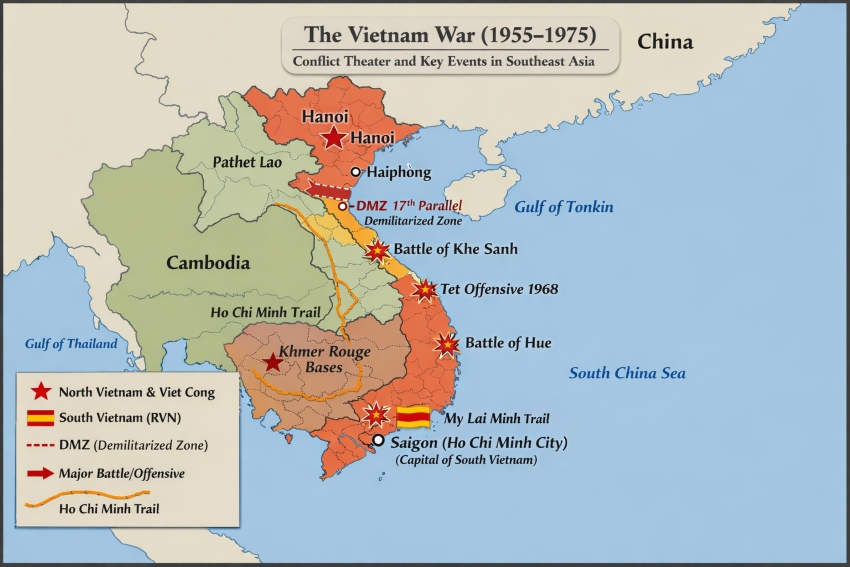
(Last updated: 17 January 2026)
How to read “aftermath”
In this series, aftermath includes (1) the immediate political and humanitarian consequences of the 1975 military outcome, (2) post-1975 regional wars and diplomatic realignments, (3) economic reconstruction and reform, (4) normalization and reconciliation processes (notably U.S.–Vietnam), and (5) long-run legacies (health, environment, unexploded ordnance, memory politics). Where the record is contested—especially on repression, migration drivers, and casualty-related legacies—I separate what is well-attested from what remains disputed and explain why evidence diverges.
Milestone timeline (selected, 1975–2007)
- 30 Apr 1975 — Fall of Saigon / end of the Republic of Vietnam as a functioning state authority in the south (military outcome achieved).
- 2 Jul 1976 — Socialist Republic of Vietnam officially proclaimed (formal reunification).
- Late 1970s — Major outward migration waves including “boat people,” commonly linked in sources to postwar economic and political changes (terminology and attribution vary by source).
- Dec 1978 — Vietnam invades Cambodia (start of a decade-scale occupation/war sequence in many accounts).
- Feb 1979 — China invades Vietnam in strength (Sino-Vietnamese War, brief high-intensity phase).
- Dec 1986 — Sixth Communist Party Congress launches/affirms Đổi Mới (“renovation”) reforms (reform timing is well-established; interpretation of drivers varies).
- 1989 — Vietnam withdraws troops from Cambodia (withdrawal date and residual presence debates exist in some narratives, but withdrawal is widely dated to 1989).
- 3 Feb 1994 — U.S. lifts the trade embargo on Vietnam.
- 11 Jul 1995 — U.S.–Vietnam diplomatic relations normalized/established.
- 28 Jul 1995 — Vietnam becomes a full member of ASEAN.
- 11 Jan 2007 — Vietnam becomes a member of the WTO.
1) Immediate postwar order and humanitarian consequences (mid-1975 to early 1980s)
FACTS
State consolidation and reunification. After the 1975 military outcome, Vietnam’s postwar political settlement culminated in the formal proclamation of the Socialist Republic of Vietnam on 2 July 1976, with Hanoi as capital.
Migration and displacement beyond 1975. Large refugee flows from Vietnam, Cambodia, and Laos continued for years after 1975. A widely used synthesis by the Migration Policy Institute describes that over the next ~20 years, about 2.5 million people found new homes elsewhere and about half a million returned, framing this as an Indochina-wide movement rather than Vietnam-only.
Encyclopedic summaries also describe a 1975 exodus followed by a later surge of “boat people,” often associated with postwar restructuring and conditions in the late 1970s.
INTERPRETATIONS (attributed; confidence-rated)
What chiefly drove the late-1970s “boat people” surge?
- Many accounts emphasize postwar economic restructuring and political-security factors as key push pressures; this is a common synthesis in reference works. (Confidence: Medium—broad agreement on correlation; precise weighting of causes varies by population group and source base.)
- Other analyses stress ethnic dynamics, including the plight of ethnic Chinese (Hoa) during a period of deteriorating regional relations, and regional war spillovers (Cambodia/China) as additional drivers. (Confidence: Medium—supported in multiple secondary syntheses, but subgroup-specific causal claims are unevenly documented.)
Re-education and postwar coercion — scale and characterization. Publicly available sources differ sharply on how to count “re-education” (brief registration vs. long detention; civilian vs. military/official categories). One educational module summarizes that about a million in the former South Vietnam were subjected to some form of re-education; however, such figures depend heavily on definitions and the underlying sources chosen. (Confidence: Low-to-Medium—directionally consistent with “large-scale” claims in many narratives, but precise totals are disputed.)
2) Regional war after the “Vietnam War”: Cambodia and China (late 1970s–early 1990s)
FACTS
Cambodia (1978 onward). Reference histories describe Vietnam’s invasion of Cambodia in December 1978 following escalating border conflict, and link the intervention to the collapse of Khmer Rouge rule in early 1979.
China (1979). Encyclopedic treatments date the Sino-Vietnamese War to February 1979, describing a short but intense conflict.
End of the Cambodia occupation phase. Vietnam’s troop withdrawal is commonly dated to 1989, while Cambodia’s comprehensive settlement process is associated with the 1991 Paris agreements and a major UN role thereafter.
INTERPRETATIONS (attributed; confidence-rated)
Why did Vietnam intervene in Cambodia?
- Vietnamese and some external narratives emphasize security threats from border conflict and self-defense rationales (often foregrounded in diplomatic histories). (Confidence: Medium—border conflict and escalation are well-attested; intent framing varies.)
- Other narratives stress the humanitarian context of Khmer Rouge mass violence, noting that Vietnam’s invasion ended Khmer Rouge rule; however, attributing “primary motive” is methodologically hard because it depends on leadership intent evidence and retrospective framing. (Confidence: Low-to-Medium—outcome is clear; prioritization of motives is disputed.)
Postwar “victory” costs and strategic tradeoffs. Many strategic summaries treat Cambodia and the China war as imposing major military, economic, and diplomatic burdens on Vietnam in the late 1970s–1980s, contributing to isolation from some neighbors and complicating external economic access. (Confidence: Medium—direction is widely argued; magnitudes differ by source and metric.)
3) Reconstruction and reform: from central planning to Đổi Mới, then global integration
FACTS
Đổi Mới timing. International financial institutions and reference materials associate the start of Đổi Mới with the Sixth Party Congress in December 1986, framing it as a major shift toward a “socialist-oriented market” approach.
Measured development outcomes (selected indicators). Post-reform Vietnam recorded large poverty reduction and growth over decades, though the specific poverty measure varies (national lines vs. international poverty lines). World Bank documentation reports Vietnam’s poverty rate falling over time and highlights the country’s poverty-reduction trajectory as notable, while also emphasizing remaining inequalities.
The IMF similarly describes Đổi Mới as a turning point and presents Vietnam’s subsequent development performance as a major transformation.
Institutional integration milestones include ASEAN membership (1995) and WTO membership (2007).
INTERPRETATIONS (attributed; confidence-rated)
Why did reform happen when it did?
- Some institutional histories present reform as a response to poor performance under strict central planning and macroeconomic crisis conditions, implying pragmatic adaptation. (Confidence: Medium—economic difficulty is broadly referenced; “crisis-to-reform” causality is plausible but still interpretive.)
- Other scholarship emphasizes political bargaining inside the party-state and gradual experimentation, cautioning against a single “turning point” story. (This is a common historiographic warning, but the strongest version requires specialist monographs beyond the scope of the citations used here.) (Confidence: Medium—widely argued, but evidence is dispersed across the literature.)
4) U.S.–Vietnam normalization and the long arc of reconciliation
FACTS
Embargo lifted, relations normalized. The U.S. lifted its trade embargo on 3 February 1994, and diplomatic relations were normalized/announced on 11 July 1995, as recorded in U.S. government documents and official histories.
War legacies as an ongoing bilateral agenda. U.S. and Vietnam cooperation has continued on legacy issues including accounting for missing personnel. DPAA reporting in 2025 cites 1,567 U.S. personnel still missing from the Vietnam War.
INTERPRETATIONS (attributed; confidence-rated)
What made normalization politically viable?
- U.S. executive-branch documents from 1994 explicitly connected embargo lifting to progress on POW/MIA accounting, indicating one stated policy rationale. (Confidence: High—direct documentary attribution.)
- Analysts also emphasize shifting geopolitical and economic incentives on both sides; however, ranking these drivers requires interpretive synthesis across multiple literatures. (Confidence: Medium.)
5) Enduring legacies: UXO/ERW, dioxin hotspots, and contested health burdens
FACTS
Explosive remnants of war (ERW/UXO). UNDP reporting cites a Government of Vietnam estimate that about 18% of Vietnam’s land area remains contaminated by explosive remnants of war.
Dioxin remediation (selected milestones). U.S. Embassy/USAID materials describe major remediation programs. An official fact sheet describes USAID and Vietnam cooperation at Bien Hoa, including multi-year funding and program structure, and situates it after earlier remediation work (commonly summarized as completed at Da Nang by 2018 in multiple public reports).
INTERPRETATIONS (attributed; confidence-rated)
Health impacts from Agent Orange/dioxin exposure. Public claims about the number of people affected vary widely across governments, NGOs, and media; causal attribution is complicated by exposure measurement gaps, migration, and baseline health data limitations. (The remediation program existence is well documented; population-wide quantified health burdens are much more disputed.) (Confidence: Medium on “serious enduring concern”; Low on specific total-affected counts without harmonized epidemiological baselines.)
Stakeholder outcomes: “winners and losers” in the short and long run (descriptive, non-moralized)
Vietnam’s governing coalition and state institutions
- Short-run gains (FACT): Territorial and administrative consolidation culminating in the 1976 proclamation of the unified state.
- Short-run costs (INTERPRETATION): Large governance burdens—reconstruction, social control, and prolonged regional warfare—are frequently cited as major constraints in late 1970s–1980s narratives. (Confidence: Medium.)
- Long-run gains (FACT): Sustained economic transformation after Đổi Mới and later integration into ASEAN/WTO frameworks.
Former South Vietnamese officials, soldiers, and connected civilian networks
- Short-run losses (FACT/LOW-CONFIDENCE RANGE): Many experienced political exclusion, property disruption, detention/re-education, and/or exile; the scale of re-education exposure is disputed and definition-dependent.
- Long-run mixed outcomes (FACT): Formation of a large diaspora and substantial resettlement—especially to the United States—became a defining legacy of the post-1975 period.
Rural households and war-affected civilians across Vietnam
- Short-run losses (FACT): War destruction plus continuing hazards from UXO/ERW and contaminated sites imposed long-lasting constraints on safety and land use.
- Long-run gains (FACT): Poverty reduction and improved living standards for many citizens are documented by the World Bank and IMF, though unevenly across regions and groups.
Cambodia, China, and Southeast Asian neighbors
- Cambodia (FACT): Khmer Rouge rule ended after Vietnam’s invasion; Cambodia then underwent a long conflict-to-settlement pathway involving Vietnamese withdrawal and UN-mediated agreements.
- China/Vietnam (FACT): A major rupture produced the 1979 war; normalization of relations later occurred, but the war left a durable imprint on security perceptions.
United States
- Short-run losses (FACT): Strategic defeat in stated objectives (as framed in Parts 2–4), deep domestic polarization, and a long legacy policy agenda centered on POW/MIA and normalization.
- Long-run mixed outcomes (FACT): Normalization (1995) and subsequent cooperation produced a durable bilateral relationship, though its emphasis and resources can fluctuate with U.S. policy priorities.
What is well-established vs. what is disputed
Well-established (high confidence)
- Formal reunification date (2 July 1976) and creation of the Socialist Republic of Vietnam.
- Vietnam’s Cambodia invasion (Dec 1978) and China’s invasion (Feb 1979) as major postwar conflicts.
- Đổi Mới reforms associated with Dec 1986 Sixth Party Congress and subsequent market-oriented transformation trajectory.
- U.S. embargo lifted (3 Feb 1994) and diplomatic normalization (11 Jul 1995).
- Persistent UXO/ERW contamination remains a national problem, with official estimates around 18% of land area contaminated.
Disputed / uncertain (medium to low confidence on specifics)
- Scale, duration, and categorization of “re-education” (who counts, how long, and under what legal-administrative status).
- Primary drivers of refugee flows (relative weight of economic policy, coercion, ethnic targeting, and regional-war dynamics differs across subgroups and sources).
- Motives hierarchy for Cambodia intervention (security vs. other rationales) — evidence supports multiple contributing factors; ranking them is contested.
- Quantified population health burdens from dioxin exposure (wide variance in claims; causal pathways are complex and data are incomplete).
- Residual Vietnamese military presence in Cambodia after 1989 — mainstream timelines date withdrawal to 1989, but some narratives debate “complete” withdrawal vs. advisory presence.
Key Sources Used
- Encyclopaedia Britannica, History of Vietnam / reunification and regional conflict context.
- World Bank materials on Vietnam’s reform-era development and poverty reduction.
- IMF country narrative on Đổi Mới and development trajectory; IMF transition literature.
- U.S. government documents on embargo lifting and normalization (1994–1995).
- UNDP Vietnam reporting on ERW/UXO contamination estimates.
- U.S. Embassy/USAID fact sheets on Bien Hoa dioxin remediation; DPAA reporting on missing personnel.
- Migration Policy Institute synthesis on Indochina refugee flows and resettlement/return magnitudes.
- Reuters reporting on contemporary commemoration/memory framing (useful for “memory politics” description, not for core quantitative claims).
Open Questions / Uncertainties
- Re-education scale and duration: What defensible lower/upper bounds can be established using declassified state records, camp rosters, or systematic demographic reconstruction rather than memoir aggregation? (Evidence base: mixed; Confidence in any single number: Low.)
- Refugee-flow causal weights: Can subgroup-specific studies (Hoa, former RVN affiliates, rural collectivization-affected households) produce clearer causal attribution across time (1975 vs. 1978–79 vs. 1980s)? (Confidence: Medium that drivers differ by subgroup; Low on precise weights.)
- Cambodia intervention intent hierarchy: How much archival access (Vietnamese, Soviet/Russian, Chinese, Cambodian) is needed to credibly rank decision drivers? (Confidence: Medium that multiple drivers mattered; Low on ranking.)
- Long-run health burden accounting (dioxin): What joint epidemiological baseline and exposure mapping would be required to narrow credible population impact ranges? (Confidence: Low on current total-impact counts; Medium that hotspots matter.)
- Residual ERW risk measurement: How do national estimates (e.g., % land contaminated) translate into province-level risk, casualty trends, and economic opportunity costs over time? (Confidence: Medium.)