Vietnam War (1955–1975) — Part 4: Termination (Negotiations, Settlement Terms, Enforcement, and End-State)
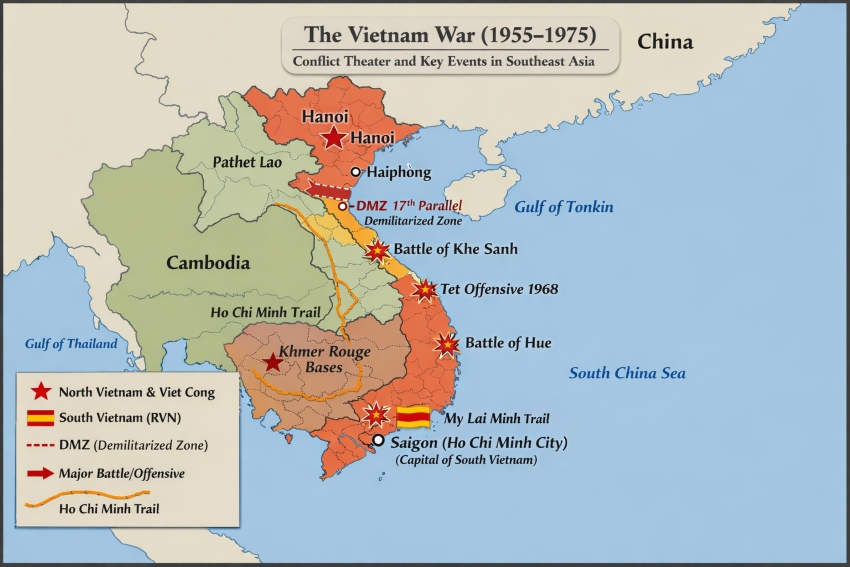
How “termination” worked in practice
For the Vietnam War, “termination” is best treated as a two-step process:
- Termination of direct U.S. combat involvement through a negotiated settlement in early 1973 (the Paris Peace Agreement/Accords). The agreement set a cease-fire time, required U.S. withdrawal within 60 days, and linked prisoner returns to that withdrawal.
- Termination of the war between Vietnamese parties by force in 1975, culminating in the fall of Saigon on April 30, 1975.
This Part 4 therefore focuses on: (a) the bargaining path to the 1973 settlement, (b) what the settlement actually required, (c) why enforcement mechanisms struggled, and (d) how those dynamics shaped the final end-state.
A. Negotiations and the bargaining sequence (1969–1973)
The bargaining problem
By the early 1970s, the negotiation problem was not only about ending U.S. involvement, but also about the post-settlement political balance inside South Vietnam—a point that repeatedly generated deadlock. The U.S. pursued negotiations while also executing “Vietnamization” (shifting combat burdens to South Vietnamese forces) and calibrating pressure through military operations and bombing campaigns.
A key inflection came in late 1972. The U.S. Office of the Historian describes President Nixon ordering major B-52 attacks (“Christmas Bombing”) to break deadlock, while also applying pressure on President Nguyễn Văn Thiệu to accept the settlement framework.
(Separately, the U.S. Air Force historical office frames Operation Linebacker II as a December 1972 campaign that contributed to Hanoi’s return to talks by late December.)
The final sprint to signature
Negotiations resumed January 8, 1973, the agreement was initialed January 23, and signed January 27, 1973; the Office of the Historian notes Thiệu “reluctantly accepted” despite misgivings.
A central point for later “termination” outcomes is that the signed terms were close to draft language already circulating by October 1972, as reflected in FRUS documents containing a draft agreement text from October 17, 1972.
B. What the 1973 settlement required (and did not require)
The “Agreement on Ending the War and Restoring Peace in Viet-Nam” is explicit on key operational and political provisions:
1) Cease-fire timing and U.S. cessation of attacks on North Vietnam
- Cease-fire in South Vietnam effective 2400 hours GMT, January 27, 1973.
- The U.S. to stop military activities against North Vietnam and end/minimize residual effects of mining (including removing/deactivating mines).
2) “In-place” forces and territorial control questions
- Armed forces of the two South Vietnamese parties “shall remain in-place”; a Two-Party Joint Military Commission was to determine areas controlled and modalities of stationing.
This matters because the agreement did not require all North Vietnamese forces to withdraw from South Vietnam; instead, it formalized a cease-fire structure with forces largely where they stood, pushing the political contest into institutions that proved difficult to activate.
3) U.S. withdrawal and base dismantlement within 60 days
- Total withdrawal from South Vietnam of U.S. troops, advisers, and associated materiel within sixty days.
- Dismantlement of U.S. (and allied) bases within sixty days.
4) Prisoners, missing, and the linkage to withdrawal
- Return of captured military personnel and foreign civilians to be completed no later than the same day as troop withdrawal.
- Parties to assist in information on missing and graves/repatriation.
Operationally, U.S. POW returns occurred under “Operation Homecoming”; the U.S. National Museum of the USAF reports 591 POWs returned (with service breakdown) and notes exchanges from multiple locations (including Loc Ninh for some held in South Vietnam).
5) Political pathway inside South Vietnam: elections and a “National Council”
A central political mechanism was the planned National Council of National Reconciliation and Concord, described as “three equal segments” operating on unanimity, tasked with promoting implementation and organizing “free and democratic general elections.”
6) Monitoring and enforcement bodies
The agreement created multiple supervisory layers:
- Four-Party Joint Military Commission (FPJMC): tasked with joint action on cease-fire enforcement, U.S. withdrawal, base dismantlement, and prisoner returns; operated on consultations and unanimity; disagreements referred to the ICCS; and crucially, its activities ended after sixty days.
- Two-Party Joint Military Commission (TPJMC): to continue cease-fire enforcement tasks between the two South Vietnamese parties, with disagreements referred to the ICCS.
- International Commission of Control and Supervision (ICCS): established immediately; composed of Canada, Hungary, Indonesia, and Poland; also operated on consultations and unanimity.
Canada’s Department of National Defence provides concrete operational detail: an ICCS of 1,160 personnel, HQ in Saigon, multiple regional headquarters and field teams, roles including monitoring cease-fire violations and monitoring restricted materiel flows, and a Paris conference (Feb 26–Mar 2, 1973) that set reporting mechanisms and rules of conduct.
Structural implication: The settlement’s enforcement architecture combined (a) a short-lived four-party mechanism (60 days), (b) a two-party mechanism dependent on political cooperation inside South Vietnam, and (c) an international body constrained by unanimity rules.
C. Why enforcement struggled (1973–1974)
1) Time-limited and unanimity-constrained enforcement
The FPJMC’s scheduled end after 60 days created a predictable handoff problem: after U.S. withdrawal and POW returns, enforcement leaned more heavily on the TPJMC and ICCS—both requiring cooperation and unanimity in key functions.
A contemporary U.S. diplomatic document in FRUS captures anxiety about this transition: a South Vietnamese official worried that if the four-party commission “disappeared in 60 days,” leaving the GVN under ICCS supervision could “leave the frontiers open.”
2) Political mechanisms did not reliably convert into a stable postwar order
The agreement’s political “bridge” was the National Council and elections pathway. The text defines it, but the record of the conflict indicates that neither Vietnamese side consistently treated the settlement as binding; the Office of the Historian bluntly notes that “Neither of the Vietnamese parties abided by the settlement” and “the war continued.”
Interpretation (attributed): Many diplomatic histories treat the Paris framework as a way to end U.S. involvement while leaving key internal political questions unresolved or unresolvable by the mechanisms created. This interpretation aligns with the agreement’s reliance on unanimity-based bodies and the “in-place” force posture. (Confidence: Medium, because the mechanism design is explicit, while causality is debated.)
3) External support and credibility constraints
In practice, the durability of South Vietnam’s position was intertwined with expected U.S. support. The Office of the Historian states Nixon obtained Thiệu’s adherence through letters promising strong U.S. reaction to violations.
However, post-1973 enforcement credibility was constrained by U.S. domestic politics and resource flows. FRUS documents from 1975 show U.S. officials estimating that a $700 million military assistance level would “drastically reduce” South Vietnam’s effectiveness—projecting major reductions in ARVN and air force capabilities and specific shortages.
Britannica describes Congress cutting military and economic aid by 30% by the summer of 1974, alongside acute internal strains in South Vietnam.
D. The end-state (1974–1975): from cease-fire to collapse and final victory
Britannica’s synthesis of the final phase is that the 1973 agreement “left North Vietnamese army units where they were in South Vietnam,” and “low-intensity fighting continued.” It then describes North Vietnam testing the U.S. response in late 1974 by taking Phuoc Long province and the absence of renewed U.S. intervention, followed by the rapid 1975 offensives and the fall of Saigon on April 30, 1975.
The result is that the negotiated “termination” of U.S. participation in 1973 did not equate to a stable termination of the Vietnamese civil/internationalized war. Instead, the war’s final termination occurred through military defeat of the Republic of Vietnam in 1975.
Timeline (Termination-focused milestones, 1969–1975)
- Aug 1969 — U.S.–DRV negotiations documented in FRUS subseries begin (Paris track).
- Oct 17, 1972 — Draft agreement text appears in U.S. documentary record (FRUS).
- Dec 1972 — “Christmas Bombing”/Linebacker II period used to break deadlock; U.S. Air Force history notes operations concluding by Dec 29, 1972.
- Jan 8, 1973 — Negotiations resume in Paris.
- Jan 23, 1973 — Agreement initialed; Nixon announces conclusion of agreement.
- Jan 27, 1973 — Agreement signed; cease-fire set for 2400 GMT that day.
- Mar 1973 — POW return and U.S. withdrawal executed within the agreement’s framework; Operation Homecoming totals 591 returned POWs (per USAF museum).
- Feb 26–Mar 2, 1973 — Paris conference establishes ICCS reporting mechanisms and rules (Canada DND history).
- Summer 1974 — Congress cuts aid by ~30% (Britannica).
- Dec 1974–Jan 1975 — Phuoc Long episode shapes Hanoi’s expectations of limited U.S. response (Britannica).
- Mar 4–Apr 30, 1975 — Final campaign culminating in the fall of Saigon (Britannica).
Victory criteria vs. results (as stated vs. realized)
Stated/embedded criteria in the settlement texts and public framing
- United States (public framing): Nixon presented the agreement as ending the war and enabling return of POWs (“peace with honor” framing).
- Democratic Republic of Vietnam / PRG (embedded in agreement): U.S. cessation of attacks, U.S. withdrawal, respect for Vietnam’s independence/unity/territorial integrity, and a political process in the South.
- Republic of Vietnam (GVN/RVN): The Office of the Historian describes Thiệu’s “misgivings” and reluctant acceptance, implying that the agreement’s political/security balance was seen as risky by Saigon’s leadership.
Results by 1975
- U.S. achieved: withdrawal within the settlement framework and POW return linked to withdrawal.
- DRV achieved: continued military and political contest after 1973, culminating in capture of Saigon and de facto unification under Hanoi’s control (Britannica’s characterization).
- RVN did not achieve: long-term survival as an independent state; it collapsed in 1975.
What is well-established vs. what is disputed
Well-established
- The agreement’s core terms: cease-fire timing, U.S. withdrawal within 60 days, and linkage of prisoner returns to withdrawal.
- Existence and design of enforcement bodies (FPJMC/TPJMC/ICCS), including unanimity features and ICCS membership.
- Sequence: negotiations resumed Jan 8, initialed Jan 23, signed Jan 27, 1973; war continued afterward; Saigon fell April 30, 1975.
Disputed / contested (termination-related)
- Whether the 1973 agreement was ever “workable” as a self-enforcing settlement versus primarily a mechanism to end U.S. involvement. (Evidence: institutional design, unanimity constraints, short-lived four-party commission; competing interpretations across historiography. Confidence: Medium.)
- Relative causal weight of (a) aid reductions, (b) South Vietnamese governance/morale issues, (c) North Vietnamese strategy/capabilities, and (d) U.S. willingness to reintervene, in explaining the speed of RVN collapse. (Evidence: contemporaneous U.S. assessments on aid levels; secondary syntheses. Confidence: Medium.)
- Compliance narratives (“who violated first / more”) after January 1973: parties and aligned sources offer conflicting accounts; the Office of the Historian states neither side abided. (Confidence: Low–Medium without a dedicated violations dataset summary in this part.)
Key Sources Used
- “Agreement on Ending the War and Restoring Peace in Viet-Nam” (full text, UN source via World and Japan Database): key articles on cease-fire, withdrawal, POW returns, commissions, ICCS membership, and political mechanisms.
- U.S. Department of State, Office of the Historian (Milestones: “Ending the Vietnam War, 1969–1973”): negotiation sequence, pressure on Thiệu, and statement that the war continued after the settlement.
- FRUS (Office of the Historian, historical documents): draft agreement text (Oct 1972) and internal assessments of South Vietnam’s military assistance needs and enforcement concerns.
- Canada Department of National Defence (WESTPLOY ICCS page): ICCS structure, staffing, roles, and the Feb–Mar 1973 conference.
- National Museum of the U.S. Air Force (Operation Homecoming fact sheet): POW totals and operation summary.
- Encyclopaedia Britannica (Fall of Saigon; fall of South Vietnam): continuation of fighting post-1973, Phuoc Long test, and 1975 end-state chronology.
- Air Force Historical Support Division fact sheet (Operation Linebacker II): late-1972 campaign framing and timing.
Open Questions / Uncertainties (for follow-up in Part 5 and the Data Appendix)
- Cease-fire violations: What do the best datasets/archival syntheses say about the frequency and geographic distribution of alleged violations (1973–1975), and how do they adjudicate competing claims? (Confidence pending targeted sourcing: Low.)
- Effect of aid reductions: How precisely did changing aid levels map onto operational shortages (fuel, munitions, aviation readiness) across 1974–1975? FRUS gives internal estimates; triangulation with Vietnamese sources and quantitative logistics studies would strengthen this. (Confidence: Medium.)
- Political mechanism failure: Why did the National Council/elections pathway not become a stabilizing institution—design flaws vs. strategic noncompliance vs. security realities? (Confidence: Medium.)
- International monitoring effectiveness: How did ICCS unanimity and team access constraints shape what it could credibly verify? (Confidence: Medium.)
- Decision calculus in Hanoi after Phuoc Long: Which internal documents most directly support claims about how strongly Phuoc Long altered expectations of U.S. response? Britannica summarizes; archival triangulation remains. (Confidence: Medium.)