Vietnam War (1955–1975) — Part 3: War Conduct
(Phases, strategy, technology, logistics/finance, civilian impacts)
1) The operational “shape” of the war (FACTS)
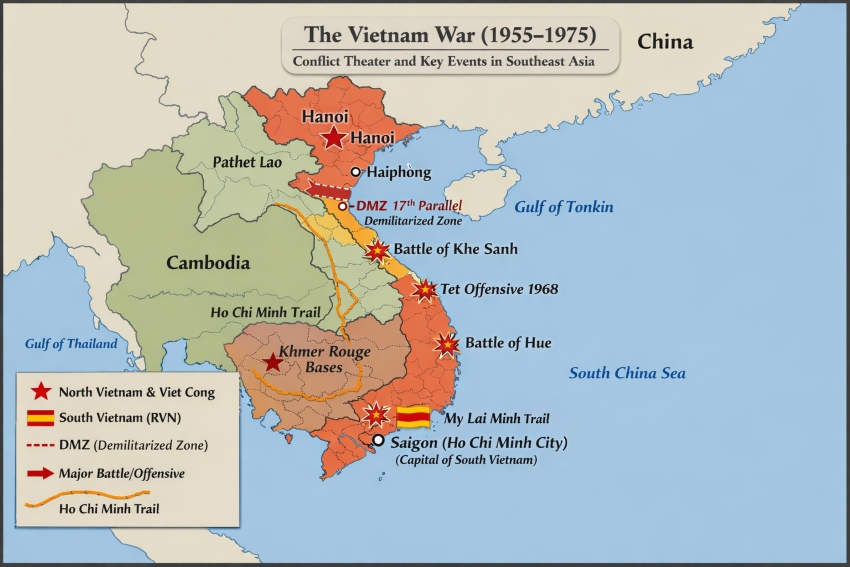
A multi-theater conflict with shifting force mixes.
Combat unfolded across South Vietnam, North Vietnam, Laos, and Cambodia, with maritime and air operations extending into the South China Sea and Gulf of Thailand. Over time, the balance shifted from predominantly guerrilla and “infrastructure” contestation (especially in the South) toward large-unit conventional campaigns, particularly by 1972 and again in 1975.
U.S./South Vietnamese conduct: from escalation to drawdown-with-support.
U.S. ground combat and advisory effort expanded sharply from 1965, with American troop strength reaching a peak around April–May 1969 (U.S. Army history pages give ~543,400 in April 1969; another U.S. Army history volume notes a peak “more than 543,000” in May 1969), followed by stepped reductions under Vietnamization.
North Vietnamese/Viet Cong conduct: protracted war plus sanctuary-enabled logistics.
North Vietnamese (PAVN) and Viet Cong (VC) forces used a mix of guerrilla tactics, main-force operations, and political/administrative control efforts, supported by infiltration and supply routes that ran heavily through Laos (and, at times, through Cambodia).
2) Major phases of combat operations (FACTS)
Phase A — Escalation and attrition-oriented operations (1965–1967)
Air war against North Vietnam: Rolling Thunder (1965–1968).
U.S. air operations against North Vietnam began in early 1965 and consolidated into the sustained campaign known as Operation Rolling Thunder, lasting until late October 1968. Official U.S. sources describe its start as 24 February 1965 with Rolling Thunder as a frequently interrupted campaign; U.S. State Department documentation also describes Rolling Thunder as “begun on 2 March 1965” (a date often used for commencement of regular missions).
Ground war in the South: large-unit sweeps, mobility, and firepower.
U.S. and allied operations leaned heavily on helicopter mobility, artillery, and air support to locate and engage enemy units. A U.S. Army official history volume on the 1966–1967 period describes a combined campaign concept emphasizing destruction of VC/PAVN main forces and base areas while also supporting pacification efforts.
Phase B — Tet and the “two-level” war (1968)
Tet Offensive (late Jan–Feb 1968) as a nationwide shock.
The Tet Offensive included widespread attacks across South Vietnam (including major urban fighting). The U.S. State Department’s historical overview treats Tet as a pivotal inflection in U.S. domestic perceptions and policy debate.
Immediate humanitarian effects: large displacement.
Encyclopaedia Britannica reports that over 670,000 people were declared refugees after Tet, raising internally displaced persons in South Vietnam to ~1.5 million—figures commonly cited but still dependent on wartime reporting and definitions (e.g., “declared refugee” vs. temporarily displaced).
Phase C — Vietnamization, intensified interdiction, and expansion into Cambodia/Laos (1969–1971)
Vietnamization and U.S. drawdown.
Vietnamization paired U.S. withdrawals with expanded reliance on ARVN (South Vietnamese forces), while U.S. airpower, artillery, and advisory roles remained central.
Cambodian Incursion (spring 1970).
The U.S. State Department chronology notes Nixon ordered a U.S.–South Vietnamese “incursion” into Cambodia on April 30, 1970, and U.S. Army campaign summaries frame the major allied incursion as beginning 1 May 1970 (a common distinction between decision/announcement and operational start).
Lam Son 719 (Laos, 1971).
U.S. State Department FRUS volume organization explicitly groups documents under “Operation Lam Son 719” for February–April 1971, while U.S. government historical materials summarize the operation as winding down by early April 1971.
Phase D — Conventional offensives and high-intensity air campaigns (1972)
The Easter Offensive (spring 1972).
FRUS editorial organization dates “The Easter Offensive” as beginning 30 March 1972, reflecting the major North Vietnamese conventional push.
U.S. air response: Linebacker-era operations (1972).
The U.S. Air Force historical fact sheet describes an interdiction campaign beginning 6 April 1972 that expanded rapidly (often discussed alongside Freedom Train/Linebacker sequencing).
Linebacker II (18–29 December 1972).
This concentrated bombing campaign targeted areas around Hanoi and Haiphong. An official U.S. Air Force base history commentary reports >20,000 tons of bombs dropped and cites North Vietnamese-reported civilian deaths of 1,624 (noting the figure as reported and therefore source-dependent).
3) Technology and logistics that mattered (FACTS)
Airmobility and dispersed ground control problems.
Helicopter-centric mobility enabled rapid insertions/extractions and supported a style of operations emphasizing contact and engagements rather than permanent occupation of all rural space. This interacted with the challenge of holding territory and protecting populations in contested hamlets—one reason pacification programs were repeatedly reorganized.
Sensors and interdiction on the Ho Chi Minh Trail: Igloo White.
The U.S. National Museum of the USAF describes Igloo White as operational in late 1967, built around air-dropped sensors along the Ho Chi Minh Trail, relay aircraft, and an analysis center to cue strikes.
The Laos air war and the scale of ordnance.
UNDP reporting states that over 2 million tons of ordnance were dropped on Laos between 1964 and 1973, alongside hundreds of thousands of bombing missions—figures widely used in contemporary UXO policy and development literature.
Herbicides and environmental/civilian exposure risks (1962–1971).
A National Academies/Institute of Medicine volume (via NCBI) summarizes U.S. military records indicating ~20 million gallons of herbicides used in Vietnam from 1962 to 1971 (including Operation Ranch Hand and additional recorded sprays). The U.S. Department of Veterans Affairs similarly states “more than 19 million gallons” of tactical herbicides were sprayed starting in 1962.
Pacification integration: CORDS (1967).
The U.S. National Archives describes CORDS as organized on May 28, 1967, under COMUSMACV, integrating civil and military support for pacification across regions.
4) Civilian impacts and contested practices (FACTS)
Displacement and urban destruction surges.
Tet-era fighting produced major displacement and housing loss in multiple cities; the reported refugee totals depend heavily on how authorities classified and counted “refugees” vs. temporarily displaced.
Atrocities and accountability: My Lai (16 March 1968).
Reuters summarizes the My Lai killings as occurring on March 16, 1968 and reports a widely cited Vietnamese death toll of 504 civilians (with other official estimates sometimes lower), noting it became emblematic of broader controversies over conduct and accountability. The official U.S. Army investigation is commonly referred to as the Peers Inquiry (primary documentation available via archival collections, including Library of Congress cataloging).
Targeted counter-infrastructure programs (Phoenix/Phung Hoang) and “neutralization” counts.
U.S.-linked and South Vietnamese efforts to disrupt the VC infrastructure produced disputed “neutralization” figures and persistent allegations about abuses. A U.S. Army University Press study notes figures commonly cited for Phoenix outcomes (tens of thousands “neutralized,” including a substantial killed subset) while also reflecting the continuing historiographic controversy around definitions, targeting quality, and attribution of deaths to Phoenix vs. conventional operations.
5) Timeline — War conduct milestones (10 items, dated)
- 24 Feb / 2 Mar 1965 — Rolling Thunder begins (official sources date the campaign’s start differently: late Feb vs. early March mission start).
- May 28, 1967 — CORDS organized to integrate pacification support.
- Late 1967 — Igloo White becomes operational (trail sensor/interdiction system).
- Late Jan–Feb 1968 — Tet Offensive; large refugee flows reported.
- 16 Mar 1968 — My Lai killings (Son My, Quang Ngai).
- Late Oct 1968 — Rolling Thunder ends (late October in USAF fact sheet; broader bombing halt announced effective early Nov).
- Apr–May 1969 — U.S. troop strength peaks (~543k range), then begins sustained drawdown.
- Apr 30 / May 1, 1970 — Cambodia incursion decision/operation start (date varies by framing).
- Feb–Apr 1971 — Operation Lam Son 719 (Laos).
- 30 Mar 1972 / 6 Apr 1972 — Easter Offensive begins; U.S. aerial interdiction escalates (USAF dates major 1972 campaign onset at 6 April).
- 18–29 Dec 1972 — Linebacker II (“Christmas bombings”).
6) What is well-established vs. what is disputed
Well-established (high confidence)
- The broad sequencing of escalation (1965), Tet (1968), Vietnamization/drawdown (1969–1972), Cambodia/Laos expansions (1970–1971), and the 1972 conventional offensive/air campaigns.
- The organization date and purpose of CORDS (May 28, 1967).
- The basic technical architecture and timing (“late 1967”) of Igloo White.
- The herbicide program’s operational timeframe (1962–1971) and approximate aggregate volume (~19–20 million gallons) as reflected in U.S. records syntheses.
- The scale of U.S. bombing in Laos (order-of-magnitude and tonnage range) as used in UNDP reporting.
Disputed / contested (medium-to-low confidence, often definitional)
- Rolling Thunder “start date” framing (late Feb vs. early March) and what is counted as the campaign’s beginning (reprisal strikes vs. scheduled missions).
- Effectiveness assessments of attrition-oriented ground operations and coercive bombing (outcomes depend on counterfactual assumptions and metrics).
- Phoenix/Phung Hoang statistics (what “neutralized” means; attribution of deaths; data quality; degree of abuse).
- Civilian casualty and displacement totals across the full war, especially in Laos/Cambodia and rural South Vietnam, where reporting, access, and definitions varied markedly over time.
- Linebacker II civilian death totals: official U.S. presentations sometimes reproduce North Vietnamese-reported counts; alternative figures exist in other accounts.
7) Interpretations (explicitly attributed)
Interpretation 1: “Attrition vs. population security.”
Some official and scholarly accounts portray MACV strategy as emphasizing destruction of main forces/base areas alongside pacification; critics argue the balance and metrics (including quantitative measures of “progress”) misfit the political nature of the conflict. A U.S. Army history volume documents the combined-campaign framing in 1967, while Marine Corps histories describe alternative “inkblot” style pacification concepts via Combined Action Platoons (CAPs). Confidence: Medium (the debate is about emphasis and causal impact, not whether both approaches existed).
Interpretation 2: “Interdiction limits under sanctuary and constraints.”
Analysts disagree on how much U.S. interdiction (bombing, sensors, and strikes) constrained PAVN infiltration. Igloo White illustrates high-technology surveillance and strike cueing, but its net effectiveness remains debated because it depends on uncertain estimates of truck flow, substitution strategies, and the ability to re-route logistics. Confidence: Medium (capabilities are clear; effects are hard to quantify).
Interpretation 3: “1972 airpower as decisive leverage vs. one factor among many.”
Some U.S. institutional narratives emphasize 1972 bombing (including Linebacker II) as pivotal leverage; other histories stress bargaining dynamics, the battlefield situation, and the role of external support and endurance. Confidence: Medium (causal weight is disputed).
Key Sources Used (Part 3)
- U.S. Air Force historical fact sheets: Rolling Thunder; Linebacker I.
- U.S. Navy NHHC overview and “Today in History” entry on Rolling Thunder.
- FRUS (U.S. State Department) volumes/press material on 1972 and Cambodia/Laos operations.
- U.S. State Department Milestones: “Ending the Vietnam War, 1969–1973.”
- U.S. Army Center of Military History: Vietnam campaign summaries; operational history PDFs.
- U.S. National Archives: CORDS organizational description.
- National Museum of the USAF fact sheet: Igloo White.
- UNDP Laos reporting (annual report/blog): scale of Laos bombing and mission counts.
- National Academies/Institute of Medicine (via NCBI) and U.S. VA: herbicide program scope and volumes.
- Encyclopaedia Britannica: Tet displacement/refugee figures.
- Reuters + Library of Congress cataloging: My Lai date, toll range context, and Peers Inquiry archival trail.
- Marine Corps University/History Division publications on CAPs.
Open Questions / Uncertainties (for Part 3)
- Quantifying “control” vs. “contestation” in rural South Vietnam across districts and years: what indicators best reflect durable security (and how biased were wartime metrics)?
- Net effect of interdiction on infiltration flows (especially via Laos): what do declassified estimates imply when reconciled with postwar Vietnamese sources?
- Phoenix/Phung Hoang measurement validity: how many “neutralizations” were truly VC infrastructure, and how many reflected poor intelligence, coercion, or misclassification?
- Civilian harm accounting across Laos/Cambodia/Vietnam: reconciling civilian death estimates with strike records and postwar survey data remains incomplete in many areas.
- 1972 bombing causality: isolating how much Linebacker II changed negotiating positions versus confirming trends already in motion.