Vietnam War (1955–1975) — Part 2: Road to War (1954–1965)
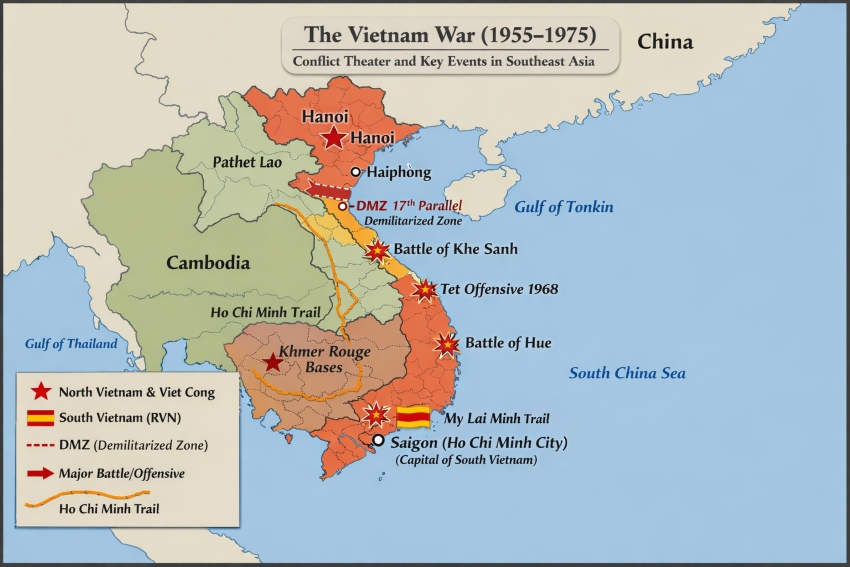
Part 2 traces how the post–First Indochina War settlement failed to produce a stable political order, and how escalation decisions—within Vietnam and among external patrons—turned a contested internal struggle into a large-scale internationalized war.
Timeline of key milestones (1954–1965)
- July 20, 1954 — Armistice in Vietnam (Geneva ceasefire agreement) establishes a temporary military demarcation line and modalities for regroupment and supervision.
- July 21, 1954 — Geneva Final Declaration calls for nationwide elections in July 1956 aimed at reunification, while acknowledging that implementation depends on the parties’ cooperation.
- July 21, 1954 — U.S. unilateral statement signals U.S. non-signature while endorsing “free elections” under international supervision as the standard for legitimacy.
- October 23, 1954 — Eisenhower letter to Ngô Đình Diệm (publicly released) sets out U.S. support conditional on governance and reform, anchoring early U.S.–Saigon alignment.
- October 23, 1955 — Diệm–Bảo Đại referendum culminates in Diệm’s consolidation of authority and the political institutionalization of a separate South Vietnamese state (as reported by U.S. Embassy observers).
- May 1959 — South Vietnam’s Law 10/59 (excerpts) authorizes severe penalties through special tribunals for security offenses, widely cited in scholarship as part of coercive counterinsurgency policy.
- January 1959 — Vietnamese Workers’ Party 15th Plenum (as described in military-historical syntheses) is commonly characterized as authorizing escalation of armed struggle in the South alongside political work.
- May 1959 — Establishment of the 559th Transportation Group (U.S. intelligence reporting) marks early institutionalization of the logistics apparatus later associated with the Ho Chi Minh Trail system.
- December 20, 1960 — National Liberation Front (NLF) formed as a political umbrella claiming to represent southern opposition; its program explicitly calls for staged reunification and political change.
- 1961–1963 — Rapid expansion of the U.S. advisory mission; U.S. internal documents discuss constraints (including Geneva-related visibility) and report personnel levels around 16,000 by 1963.
- November 1–2, 1963 — Coup in Saigon and deaths of Diệm and Ngô Đình Nhu deepens South Vietnam’s political instability and reshapes U.S.–Saigon coordination.
- August 1964 — Gulf of Tonkin incidents and Tonkin Gulf Resolution accelerate U.S. authority to use force; later official releases acknowledge major uncertainty over the reported August 4 attack.
- March 2, 1965 — Rolling Thunder begins (systematic air campaign against North Vietnam).
- March 8, 1965 — U.S. Marines arrive at Đà Nẵng as early combat troops assigned to secure key facilities.
1) The post-Geneva political track collapses
FACTS
- The 1954 ceasefire agreement created a temporary military division and an internationally supervised framework meant to stabilize the end of the First Indochina War, not to permanently partition Vietnam.
- The Geneva Final Declaration called for general elections in July 1956 as the intended mechanism for reunification.
- The United States did not sign the Geneva accords; its official statement emphasized that legitimacy would require genuinely free elections under effective international supervision.
INTERPRETATIONS (attributed)
- Why the “elections-for-unification” formula failed is debated. A common interpretation is that the arrangement lacked an enforcement mechanism and depended on mutual trust that did not exist after nearly a decade of war; this is broadly consistent with the design of the declaration itself (aspirational political language paired with hard military separation). Confidence: High (structural inference from the settlement design).
- Competing historical schools emphasize different primary causes:
- Some prioritize Cold War alignment and U.S. determination to prevent a communist victory. One contemporaneous U.S. policy framing describes Vietnam as an “outpost” where “a free government and a communist regime compete directly,” reflecting containment logic inside U.S. planning. Confidence: High (this is explicit in U.S. documents, though it is one side’s framing).
- Others emphasize Vietnamese agency and legitimacy contests inside the South—arguing that state-building strategies and coercive governance generated conditions for insurgency. Confidence: Medium (interpretive; depends on weighting of evidence across provinces and periods).
2) South Vietnam’s consolidation and the growth of armed opposition
FACTS
- South Vietnam underwent rapid political transformation in the mid-1950s. U.S. Embassy reporting on the October 23, 1955 referendum described state-directed campaigning and the practical conduct of voting, underscoring that the South’s political institutions were being constructed under conditions far from liberal contestation.
- By 1959, the South Vietnamese government promulgated Law 10/59, authorizing severe penalties through special tribunals for acts defined as threatening state security.
- U.S. government historical compilations (e.g., Pentagon Papers materials preserved by the National Archives) describe the late 1950s as a period in which communist organization in the South adapted and rebuilt, while also noting limits on direct evidence linking some local violence to Hanoi in the earliest phases.
INTERPRETATIONS (attributed)
- Bargaining failure inside the South. One strand of scholarship treats the South’s coercive security measures—combined with unresolved land, sectarian, and rural governance disputes—as expanding the insurgency’s recruiting pool. Confidence: Medium (well-supported in many studies, but the causal weight relative to northern direction varies by author).
- State survival logic. An alternative interpretation is that Saigon’s leaders, facing assassination and subversion, treated extraordinary legal instruments as necessary counterinsurgency—arguing that the real driver was the reactivation of communist networks and infiltration. Confidence: Medium (plausible and documentable as a stated justification; assessing necessity is interpretive).
3) Hanoi’s escalation decisions and the infrastructure of mobilization
FACTS
- U.S. and allied military-historical syntheses commonly describe the Workers’ Party 15th Plenum (January 1959) as authorizing an intensified armed struggle in the South alongside political action.
- Multiple U.S. government sources identify May 1959 as the creation period of the 559th Transportation Group, which U.S. reporting described as a logistics organization supporting infiltration and supply southward.
- The NLF (December 1960) publicly positioned itself as a broad southern front. Its published program calls for independence, political reorganization in the South, and peaceful reunification by stages through negotiation—a key indicator of stated political aims, regardless of later debates over command-and-control relationships.
INTERPRETATIONS (attributed)
- Degree of Hanoi control over the southern insurgency is a central historiographical dispute. Educational and documentary collections highlight that U.S. officials often asserted the NLF was directed by Hanoi, while many scholars have debated the mix of local initiative and northern guidance across time. Confidence: Medium (direction increased over time; degree and timing remain contested).
- On motives: it is safer to describe stated goals than inferred intentions. The NLF’s own program emphasizes reunification, sovereignty, and political transformation; U.S. policy documents emphasize preventing communist takeover and sustaining a “free” South. Confidence: High (these are expressed positions).
4) The conflict internationalizes: advisors, Laos, and escalation pathways
FACTS
- U.S. internal documentation acknowledges the sensitivity of adviser numbers relative to the Geneva framework; one FRUS document notes Geneva-related expectations around adviser limits and discusses how the U.S. managed the issue as the advisory effort expanded.
- By 1963, U.S. internal accounts referenced just over 16,000 U.S. military personnel in Vietnam (with additional civilians), indicating that the U.S. role had moved far beyond a small advisory presence.
- Laos became an acute Cold War crisis theater in 1960–1963, overlapping with Vietnam’s escalation dynamics and creating strategic incentives for cross-border logistics and sanctuaries.
INTERPRETATIONS (attributed)
- A common analysis is that Laos functioned as a strategic pressure valve: even if Vietnam’s political track failed, both sides faced incentives to use Laos-linked geography for supply, sanctuary, and bargaining leverage. Confidence: Medium (geographic logic is strong; exact decision sequences vary).
- Another interpretive frame sees the advisory buildup as a commitment trap: as U.S. personnel and credibility stakes rose, the perceived cost of disengagement increased, narrowing policy options. This is consistent with the escalation logic presented in later U.S. historical summaries of 1964–1968 decision-making. Confidence: Medium (widely argued; causality is complex).
5) South Vietnam’s 1963 political rupture and the turn toward open-ended war
FACTS
- In November 1963, a coup in Saigon ended with the deaths of Ngô Đình Diệm and Ngô Đình Nhu; U.S. documentary and archival collections treat this as a major pivot in the war’s political trajectory.
- The Gulf of Tonkin events (August 1964) were followed rapidly by the Tonkin Gulf Resolution, which expanded the U.S. president’s authority to use force in Southeast Asia.
- The U.S. National Archives’ public presentation notes that later declassified analysis confirmed the August 2 clash but concluded the August 4 reported attack did not occur as initially represented—an unusually clear case where later official review revised a key escalatory narrative.
- Rolling Thunder began on March 2, 1965, and U.S. Marines arrived at Đà Nẵng on March 8, 1965, marking the transition to sustained air war and the introduction of substantial U.S. ground combat forces.
INTERPRETATIONS (attributed)
- Some historians emphasize contingency: South Vietnam’s political instability after 1963 reduced Saigon’s capacity to defeat the insurgency, making direct U.S. intervention more likely. Confidence: Medium (reasonable; the counterfactual is debated).
- Others emphasize strategic choice: U.S. leaders interpreted developments through a containment lens and escalated to avoid defeat and protect credibility, a rationale echoed in policy statements and later documentary records. Confidence: Medium–High (well documented as rationale; whether it was decisive is debated).
What is well-established vs. what is disputed (Part 2 focus)
Well-established
- Geneva created a temporary military division and envisaged elections for reunification; the U.S. did not sign and conditioned legitimacy on genuinely free elections.
- South Vietnam consolidated as a separate state under Diệm; coercive security measures intensified by 1959.
- North Vietnam (and associated southern forces) built logistics and political-front structures that supported sustained insurgency (NLF program; 559th Group referenced in U.S. reporting).
- 1964–1965 saw decisive U.S. escalation: Tonkin Resolution, Rolling Thunder, and deployment of Marines.
Disputed / debated
- The extent and timing of Hanoi’s operational control over the NLF versus local southern initiative.
- How much the August 4, 1964 event (later officially challenged) functioned as a necessary precondition for escalation versus a facilitating narrative.
- Whether a durable political settlement was feasible in 1954–1956 given the security environment and competing legitimacy claims.
Key Sources Used (Part 2)
- Geneva ceasefire agreement text (1954).
- Geneva Final Declaration (elections clause).
- U.S. statement on Geneva (non-signature; election conditions).
- Eisenhower letter to Ngô Đình Diệm (DocTeach).
- FRUS reporting on the 1955 referendum and early South Vietnam politics.
- Law 10/59 excerpts (Vassar document collection).
- 15th Plenum characterization and early escalation narrative (U.S. Army / Vassar synthesis).
- CIA and U.S. military/aviation historical materials on the 559th Group and trail system.
- NLF program (Vassar primary-document translation).
- Tonkin Resolution (U.S. National Archives) and State Department milestone summary.
- FRUS reference for Rolling Thunder start date.
- U.S. Marine Corps official history on March 8, 1965 arrival at Đà Nẵng.
Open Questions / Uncertainties (for Part 2)
- Command relationship: Hanoi ↔ NLF (1960–1964) — Evidence exists for increasing northern direction, but scholars differ on how centralized control was at specific moments. Confidence: Medium.
- Counterfactual viability of 1956 elections — Geneva’s political plan lacked enforcement; whether elections could have been implemented credibly is inherently uncertain. Confidence: Low–Medium.
- Local vs. external drivers of rural insurgency growth (1957–1960) — Many accounts emphasize both coercive governance and organized communist rebuilding; weighting remains debated. Confidence: Medium.
- Tonkin as trigger vs. accelerator — Later official review undermines the August 4 attack narrative; the degree to which escalation was already locked-in remains contested. Confidence: Medium.
- Why sustained bombing and troop deployment were selected over a negotiated political track in early 1965 — public and internal rationales exist, but relative influence is debated. Confidence: Medium.