Iran–Iraq War (1980–1988) — Part 5: Aftermath (1988–long run)
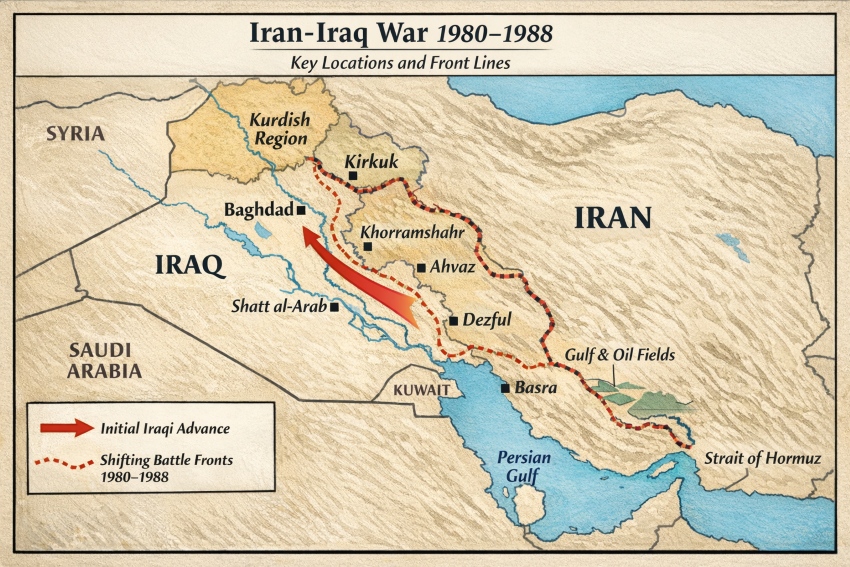
This part covers (i) what changed inside Iran and Iraq after the 1988 ceasefire, (ii) regional security effects, and (iii) long-running legacy files (POWs, missing, borders, responsibility narratives). It distinguishes FACTS from INTERPRETATIONS and avoids motive-claims without attribution.
Aftermath milestone timeline (12 dated points)
- 20 Aug 1988 — Ceasefire takes effect under the UN framework (end of large-scale combat).
- 1989 — Iran enters a reconstruction-oriented phase under President Hashemi Rafsanjani (presidency begins 1989).
- 30 Jul & 14 Aug 1990 — UN-filed Iraqi presidential letters propose settlement terms and border understandings (primary documentary record).
- 2 Aug 1990 — Iraq invades Kuwait (regional security rupture strongly connected, in many accounts, to Iraq’s postwar economic position).
- Aug 1990 — Iran and Iraq restore diplomatic relations; Iraq accepts key Iranian settlement terms and POW exchange proceeds (Britannica summary).
- 28 Feb 1991 — UNIIMOG monitoring mandate ends after extensions (termination-monitoring closure in many UN accounts).
- 9 Dec 1991 — UN Secretary-General report (UN Doc S/23273) referenced in Iranica as describing Iraq’s aggression against Iran.
- May 2003 — ICRC-supervised cooperation on repatriating remains is documented in ICRC reporting (example of ongoing postwar humanitarian work).
- Mar 2003 — Britannica notes final exchange of prisoners completed by March 2003.
- Nov 2008 — ICRC case study documents bilateral cooperation for exchanging and repatriating mortal remains.
- 10 Oct 2014 — ICRC reports “tens of thousands” still missing from the war.
- 10 Sep 2025 — ICRC FAQ reiterates POW file closure and states last prisoner exchange occurred in 2003.
1) Humanitarian legacies: POWs, missing persons, and remains
What is well-established (FACTS)
- POWs: The ceasefire did not instantly close the POW file. The ICRC states the Iran–Iraq POW file has been officially closed by both governments and that the last prisoner exchange took place in 2003 under ICRC supervision.
- Missing: The ICRC reports that the fate of tens of thousands who disappeared in connection with the 1980–1988 war has not been determined, and it documents continued efforts to exhume, identify, and repatriate remains.
- Ongoing public commemoration: Reporting as late as Nov 2025 describes ceremonies in Iran tied to the recovery and burial of soldiers’ remains, illustrating that the “missing” issue remains socially salient decades later.
Interpretation boundaries (INTERPRETATIONS)
- Many analysts treat the missing/POW file as evidence that “termination” was institutionally incomplete in 1988: combat stopped, but humanitarian accounting persisted for decades. (Confidence: High, because the ICRC timeline directly demonstrates long-duration postwar casework.)
2) Political and institutional after-effects inside Iran
Documented outcomes (FACTS)
- Institutional strengthening of hard-liners and security organs: Britannica explicitly states that the war’s existential framing and prolonged emergency elevated hard-line figures and contributed to the evolution of the IRGC from a limited militia into Iran’s most powerful armed force.
- Reconstruction politics (late 1980s–1990s): Britannica’s country coverage notes that under Rafsanjani (president 1989–97), Iran pursued policies oriented toward restoring economic relations and managing foreign policy constraints in the postwar period.
Competing interpretations (INTERPRETATIONS, attributed)
- “War as state-builder” interpretation (Confidence: Medium–High): A common scholarly view is that long wars can consolidate coercive institutions, veterans’ networks, and political narratives that endure in state practice. Britannica’s summary of IRGC institutional growth aligns with this broad interpretation, though more granular academic work may disagree on the mechanisms and timing.
- Distributional politics of reconstruction (Confidence: Medium): Economic studies of Iran’s war damage and reconstruction note that aggregate cost estimates vary widely and that reconstruction policy choices reallocated resources among sectors and constituencies. The variability itself is well-attested; attributing precise “winners and losers” requires micro-level evidence.
3) Political and economic after-effects inside Iraq
Documented outcomes (FACTS)
- Debt overhang: A London School of Economics working paper tracing Iraqi sovereign debt concludes Iraq emerged from the war with a very large external debt stock (it cites $86 billion external debt at end-1988) and emphasizes that debt levels and creditor classifications remained contested in the literature.
- Strain and spillover: Britannica explicitly links the war’s resource strain in Iraq to the context for Iraq’s later invasion of Kuwait in 1990.
Competing interpretations (INTERPRETATIONS, attributed + confidence)
- Economic-strain explanation for Kuwait 1990 (Confidence: Medium): Britannica’s Gulf War summary states Iraq invaded Kuwait in 1990 to acquire oil reserves, cancel debt, and expand regional power—an interpretation consistent with many overview accounts.
- “Debt and postwar bargaining” nuance (Confidence: Medium): Recent scholarship reviewing the invasion’s origins notes that the “$80 billion debt” argument is conventional, while emphasizing additional factors and differing views of creditor obligations. This supports a cautious posture: debt was a major structural condition, but not necessarily a complete causal explanation.
4) Interstate normalization: borders, diplomacy, and responsibility narratives
Documented outcomes (FACTS)
- Diplomatic normalization (1990): Britannica reports that in August 1990 (while Iraq was focused on Kuwait), Iran and Iraq restored diplomatic relations, and Iraq agreed to Iranian settlement terms including withdrawal, shared sovereignty arrangements in the Shatt al-Arab, and a POW exchange; it also notes completion of prisoner exchanges only by March 2003.
- UN documentary trail for 1990 commitments: The UN Digital Library hosts the official record of Iraqi presidential letters dated 30 July 1990 and 14 August 1990 transmitted to the Security Council (primary documentation of the bilateral diplomatic posture at the time).
- Responsibility framing (1991): Iranica states Iran felt vindicated by UN Secretary-General Javier Pérez de Cuéllar’s reference to Iraq’s aggression against Iran in a report to the Security Council dated 9 December 1991 (UN Doc S/23273).
Interpretation boundaries (INTERPRETATIONS)
- The postwar record supports a distinction between (a) operational ceasefire stability (achieved in 1988) and (b) political closure (partial and delayed, with major milestones in 1990–1991 and humanitarian files extending into the 2000s). (Confidence: High.)
5) Regional security and institutional responses (Gulf and beyond)
Documented outcomes (FACTS)
- Institutional regional response: The Gulf Cooperation Council (GCC) was established in May 1981; in its own institutional publication, the GCC describes the Iran–Iraq war as a major concern from its first summit and presents GCC diplomacy as oriented toward containing/terminating the conflict.
- Internationalization of Gulf security: Britannica’s Iran–Iraq War entry and related coverage describe increased foreign naval presence and intervention dynamics during the tanker war years, contributing to longer-term security patterns in the Gulf.
Interpretation boundaries (INTERPRETATIONS)
- Many analysts treat the 1980s as a formative period for the institutionalization of Gulf collective security and for the durable presence of external naval power in Gulf shipping protection. This is a reasonable inference from the GCC’s stated concerns and from the documented multinational maritime deployments, but the relative weight of the Iran–Iraq war versus other drivers (oil-market security, superpower rivalry, later crises) varies across scholarship. (Confidence: Medium.)
6) Stakeholder outcomes (winners/losers) — stated neutrally
Because “winners/losers” depends on the metric (territory, regime survival, human cost, institutional power, economic welfare), this section lists stakeholder outcomes rather than declaring a single winner.
Iran: prominent stakeholder outcomes
- State leadership / hard-line factions (FACT): Britannica reports wartime conditions elevated hard-line figures and strengthened the IRGC as an institution.
- IRGC as an institution (FACT): Britannica describes the IRGC’s transformation into a dominant armed force as part of the war’s legacy.
- Civilian families of the missing (FACT): ICRC documents long-term uncertainty for tens of thousands of missing persons’ families.
- Reconstruction constituencies (INTERPRETATION, Medium): Economic reconstruction choices after 1988 likely created uneven sectoral and regional outcomes; published economic studies focus on cost magnitudes and constraints rather than definitive welfare ranking across groups.
Iraq: prominent stakeholder outcomes
- Regime survival (FACT, but narrow): The Baʿathist state survived the war and achieved a ceasefire without formal capitulation in 1988; however, the postwar period featured severe financial strain and subsequent regional conflict.
- Economic stakeholders and creditors (FACT): Iraq’s postwar debt stock and creditor disputes are documented in debt-history scholarship; Gulf-state lending is a central component in these accounts.
- Kurdish civilians in Iraq (FACT, but numerically uncertain): Britannica includes estimates that 50,000–100,000 Kurds were killed by Iraqi forces in campaigns in 1988, and it reports around 5,000 Kurdish civilians killed at Halabjah in March 1988—figures that are widely cited but remain estimate-based and definition-sensitive.
- Families of missing persons (FACT): ICRC documentation on missing persons and remains exchange reflects the continuing burden on Iraqi families as well.
7) What is well-established vs what remains disputed
Well-established (high confidence)
- Normalization milestones: August 1990 diplomatic restoration and POW exchange pathway (Britannica), with prisoner exchanges continuing into 2003 and documented by ICRC.
- Enduring missing-persons problem: ICRC’s “tens of thousands” missing characterization and continuing bilateral/ICRC work on remains.
- Economic strain in Iraq: Large postwar debt and fiscal crisis are strongly supported in specialist debt-history research.
- Institutional effects in Iran: Britannica’s depiction of IRGC empowerment and elevation of hard-liners as a war legacy.
Disputed or analytically contested (medium-to-low confidence depending on item)
- Total economic cost of the war (Iran and Iraq): Estimates vary sharply depending on whether they include indirect losses, counterfactual GDP, base-year prices, oil revenue opportunity costs, and reconstruction. Example estimates in the literature differ by hundreds of billions of dollars.
- Causal pathway from 1988 war end to Kuwait 1990: Debt and economic strain are well supported; whether they were decisive versus other strategic/political considerations remains debated.
- Responsibility and reparations meaning of UN reporting (1991): Iranica reports a “vindication” reading; how this translated into concrete legal/financial outcomes is less clear and depends on subsequent diplomacy and regional events.
- Scale and categorization of 1988 campaigns in Iraq’s north within “war totals”: Even when specific events are well documented, casualty totals and whether they are counted “within” war casualties vary by source and definitions.
Key Sources Used (Part 5)
- Encyclopaedia Britannica, Iran–Iraq War (legacy claims; 1990 normalization; POW exchange timing; institutional impacts in Iran).
- ICRC, FAQ on ICRC work in Iraq (POW file closure; last exchange in 2003).
- ICRC, Iran–Iraq: Still missing since the 1980–1988 war (tens of thousands missing; long-run humanitarian legacy).
- ICRC IHL-in-action case study on cooperation to repatriate mortal remains (evidence of continuing bilateral/ICRC mechanisms).
- LSE working paper on Iraqi sovereign debt trajectory (external debt estimates and creditor disputes; postwar fiscal condition).
- UN Digital Library record S/21528 (1990 Iraqi presidential letters transmitted to the Security Council).
- Encyclopaedia Iranica, Gulf War and Persia (reference to UN SG report S/23273 dated 9 Dec 1991).
- Britannica, Persian Gulf War summary (Iraq–Kuwait 1990 trigger claims, including debt cancellation framing).
- Academic/economic studies on Iran war damage and opportunity costs (used for range logic, not a single “true” number).
- GCC institutional publication describing early-war context and GCC engagement (used as an official self-description, with caution).
Open Questions / Uncertainties
- Unified economic accounting: What is the most defensible harmonized estimate of direct damage vs foregone output for each country, using consistent base-year prices and explicit counterfactual assumptions?
- Missing-persons closure: How many cases have been resolved since the ICRC’s 2014 “tens of thousands” statement, and what bilateral mechanisms (DNA identification capacity, archives, exhumation access) most constrain progress?
- Border normalization durability: How fully did 1990 understandings translate into stable border administration on the ground, especially under later regional shocks (1990–91 Gulf War, 2003 Iraq war)?
- Responsibility and reparations: What concrete diplomatic or legal actions, if any, followed from the 1991 UN SG report reference to aggression, and why did reparations not emerge as a comparable mechanism to other late-20th-century conflicts?
- Institutional legacies in Iran: How much of the IRGC’s later domestic and economic role can be causally attributed to wartime expansion versus post-1988 political economy and sanctions-era governance?