Iran–Iraq War (1980–1988) — Part 3: War Conduct
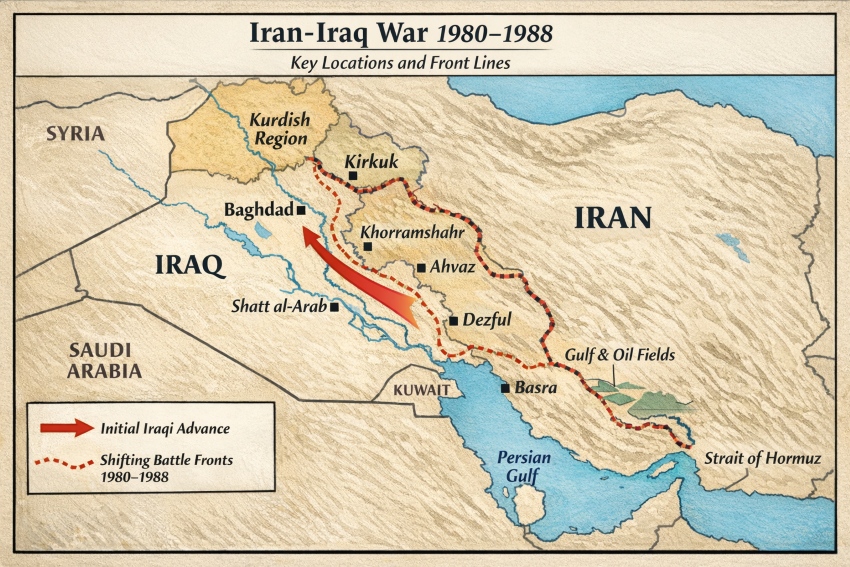
This part describes how the war was fought: major phases and turning points; the interaction of strategy, operational art, and technology (air/missile, chemical weapons, naval escalation); logistics/finance; and civilian impacts. It keeps a strict boundary between documented events and interpretations.
Milestone timeline of war conduct (12 dated points)
- 22 Sep 1980 — Iraq launches air raids on multiple Iranian airports and invades along several fronts.
- 24 Oct 1980 — Khorramshahr falls to Iraq after heavy fighting; Abadan remains besieged but holds.
- Nov 1980 — Iraqi advance is halted; front stabilizes.
- Sep 1981 — Iran begins a series of successful offensives (Britannica’s Iraq history narrative dates a shift here).
- May 1982 — Iran drives Iraq from most captured Iranian territory; Khorramshahr is liberated and siege of Abadan lifted; Iran begins incursions into Iraq’s Basra province.
- 1982–1987 — Iran threatens Basra and occupies areas including Majnūn Island and the Fāw peninsula at points during the mid-war.
- 27–28 Mar 1984 — Iraq begins a sustained pattern of tanker attacks using Super Étendard/Exocet strikes near Kharg, widely treated as the opening of the “tanker war” escalation phase.
- Oct 1982 — Iraq makes Scud operations combat-effective and begins Scud launches (with annual totals increasing later).
- Mar 1985 — Iran fires its first Scuds; missile exchanges become a recurring pressure tool during later “city” targeting.
- Feb–Mar 1986 — Fighting over the Fāw peninsula produces very heavy losses (Britannica characterization) as Iraq attempts to reverse Iranian gains.
- 9 May 1988 — UNSC Resolution 612 condemns the continued use of chemical weapons in the conflict and calls for export controls on relevant chemicals.
- Apr 1988 — Iraq recaptures the Fāw peninsula (Britannica), part of a broader 1988 Iraqi operational reversal preceding the ceasefire later that year.
1) Operational phases and battlefield conduct
Phase I — Iraqi invasion and limited gains (Sep–Dec 1980)
FACTS:
Iranica describes a broad-front invasion with Iraqi air raids and ground thrusts, identifying key targets in Khuzestan—notably Khorramshahr and Abadan—with Khorramshahr captured on 24 Oct 1980 and Abadan besieged but not taken; by December, only parts of Khuzestan were occupied.
Britannica’s Iraq narrative similarly states the Iraqi advance was halted by November 1980 and the front then stabilized.
INTERPRETATIONS (attributed):
Iranica frames early fighting as intense and notes that geography and river barriers made key cities difficult to seize, an explanation that emphasizes terrain and access constraints rather than unit “quality.” (Confidence: High, because this is grounded in the described river/bridge constraints.)
Phase II — Iranian recovery and expulsion of Iraqi forces from Iran (1981–May 1982)
FACTS:
Britannica’s Iraq narrative dates a turning point to September 1981, when Iran begins successful offensives, and states that by May 1982 Iraq had been driven from most captured territory; Khorramshahr was liberated and Abadan’s siege lifted.
INTERPRETATIONS (attributed):
Britannica presents this shift as a move from Iraqi early advantage to Iranian recovery, consistent with many general histories that treat 1981–1982 as a reversal of momentum. (Confidence: Medium–High; widely reported in reference syntheses, though operational detail varies by source.)
Phase III — Iranian penetration into Iraq; Iraqi defense and attrition (mid-1982–early 1984)
FACTS:
After May 1982, Britannica states Iran began to penetrate into Iraq’s Basra province, and that from 1982–1987 Iran threatened Basra and occupied areas including Majnūn Island and the Fāw peninsula at different times.
Iranica offers an explicit strategic characterization: by this stage, Iran pursued more mobile operations while Iraq increasingly fought a defensive war of attrition aimed at exhausting the opponent; it also observes that both sides found defense easier than offense.
INTERPRETATIONS (attributed):
- The “attrition vs maneuver” framing is Iranica’s interpretive synthesis (Confidence: Medium–High, because it matches the documented stalemate pattern and is explicitly argued by the source).
- The implication that the war became structurally hard to end—because neither side could reliably translate tactical success into decisive operational collapse—is consistent with this framing, but remains an analytical inference (Confidence: Medium).
Phase IV — Expansion beyond the front: Tanker war and widening strike campaigns (1984–1986)
This period is notable for escalation into the Gulf shipping lane and a broader “systems” struggle against oil export capacity and strategic depth.
FACTS (tanker war / maritime-economic targeting):
CSIS’s Lessons of Modern War dates a key inflection to 27 Mar 1984, when Iraq began a sustained series of Super Étendard/Exocet tanker strikes near Kharg, followed by public Iraqi announcement of Exocet use on 28 Mar 1984.
Britannica’s Iraq narrative also describes Iraq countering via a “tanker war” by striking Iranian oil terminals in the Gulf, especially Kharg Island.
FACTS (air and missile depth strikes):
CSIS describes the air and missile war evolving through multiple sub-phases, including resumption of “war of the cities” campaigns and a concentrated missile exchange in 1988.
INTERPRETATIONS (attributed):
CSIS treats tanker and city targeting as coercive tools intended to apply political pressure by stressing the opponent’s economy and civilian confidence. This is the author’s analytical framing, not a conceded intent by belligerents. (Confidence: Medium; plausible and widely used, but “intent” remains hard to prove decisively.)
Phase V — Iraqi reconstitution and late-war reversal (1987–1988)
FACTS (force generation and arms):
Britannica states that by 1987 the balance began to favor Iraq; it describes Iraq as having raised an army “of some one million,” and obtaining advanced arms from France and the Soviet Union, including large armored and artillery inventories and combat aircraft.
Britannica also notes Iraq’s chemical weapons stock and use/availability grew during the 1980s.
FACTS (1988 operational reversals):
Britannica reports that in April 1988 Iraq recaptured Fāw, and later recovered other districts (including Majnūn) and penetrated into Iran again in July, after which Iran accepted UNSCR 598 (ceasefire later effective in August).
INTERPRETATIONS (attributed):
A reasonable synthesis, consistent with Britannica and many military histories, is that Iraq’s late-war effectiveness increased via combined arms, improved force structure, and superior external resourcing, while Iran faced isolation in arms acquisition. (Confidence: Medium; “why” and relative weights differ across scholarship.)
2) Technology that mattered
2.1 Air power, strategic bombing, and the “war of the cities”
FACTS:
CSIS documents a renewed urban strike campaign and missile-intensive exchanges, including a “missile war of 1988,” and provides annual Scud launch totals by Iraq: 3 (1982), 33 (1983), 25 (1984), 82 (1985), 25 (1987), 193 (1988).
CSIS also states Iran acquired Scuds later (first fired March 1985) and gives Iranian annual totals: up to 14 (1985), 8 (1986), 18 (1987), 77 (1988).
INTERPRETATIONS (attributed):
CSIS argues these strikes were used to generate political pressure and affect morale and economic function—an interpretation of strategic logic. (Confidence: Medium; consistent with coercion theory, but motive remains inferential.)
2.2 Chemical weapons
FACTS (international documentation):
- UNSC Resolution 612 (9 May 1988) condemns the continued use of chemical weapons in the conflict and calls for tighter export controls on relevant chemical products.
- A peer-reviewed analysis in The Nonproliferation Review (Ali, 2001) surveys the CW issue as a noncompliance case study and situates UN investigations and state responses within arms-control politics.
FACTS (use and battlefield relevance in late war):
Britannica’s Iraq narrative explicitly notes Iraqi chemical weapons use in late-war operations and refers to chemical weapons inflicting heavy casualties in the north (including Kurdish civilian impacts around Halabjah in March 1988).
INTERPRETATIONS (attributed):
Ali (2001) emphasizes that CW employment affected operational outcomes and international responses, but the degree to which it “decided” specific campaigns is debated and varies by battle and defensive preparation. (Confidence: Medium; strong that CW mattered, less precise on counterfactual decisiveness.)
2.3 Naval escalation and convoy protection
FACTS:
Britannica states that in 1987 the United States agreed to reflag 11 Kuwaiti tankers and escort them through the Strait of Hormuz; it also describes U.S. attacks on Iranian ships and oil platforms in October 1987 and April 1988.
A U.S. Naval Institute Naval History article similarly frames the U.S. escort mission (Operation Earnest Will) as beginning in July 1987.
INTERPRETATIONS (attributed):
Contemporary and later naval analyses often interpret the convoy effort as intended to manage escalation risks to global energy shipping and to limit Iranian leverage in the Gulf. That is a policy interpretation, not a proven singular motive. (Confidence: Medium.)
3) Logistics, finance, and war sustainability
FACTS:
Iranica states that from the start of the war, both sides attacked each other’s oil installations, but that oil prices rose only briefly and there was not a sustained global oil-market shock during the war.
Britannica emphasizes the strain on national resources and ties the war’s cost and depletion to later Iraqi choices (as a long-run legacy observation).
Interpretations (attributed):
- Iranica’s observation about oil-market effects implies that global market buffers and alternative supply reduced immediate international pressure for a rapid settlement, compared to prior oil crises (Confidence: Medium; plausible inference from the “limited effect” statement).
- SIPRI’s discussion of the war and arms trade highlights how external supply channels helped sustain prolonged fighting; however, particular claims about leadership misperception or decision quality reflect SIPRI author interpretation and should be treated as such. (Confidence: Medium for “arms supply mattered,” lower for specific psychological claims.)
4) Civilian impacts during war conduct
4.1 Urban bombardment and missile strikes
FACTS:
CSIS documents that large-scale strikes against urban targets became more pronounced later in the war and provides detailed strike/missile totals by year, including the surge in 1988 and the earlier resumption in 1987.
4.2 Chemical weapons exposure and international condemnation
FACTS:
UNSC Resolution 612 condemns continued CW use and calls for export controls; Ali (2001) compiles the compliance and verification politics surrounding CW allegations and UN responses.
4.3 Missing persons, POW-related humanitarian burden
FACTS:
The ICRC reports that tens of thousands of people remain listed as “missing” in connection with the 1980–1988 war, decades after the ceasefire, underscoring an enduring humanitarian legacy.
What is well-established vs what is disputed (Part 3 focus)
Well-established (high confidence)
- The broad phase structure: Iraqi invasion (1980) → Iranian recovery (1981–1982) → prolonged attrition and externalized escalation (1982–1986) → Iraqi late-war reversal (1987–1988) is supported by major reference syntheses and Iranica’s narrative.
- The tanker war escalation beginning in early 1984 is documented in detailed operational studies and summarized in Britannica.
- The existence of extensive missile exchanges (Scud use by both sides, with major 1988 intensification) is documented with quantitative breakdowns in CSIS.
- The UN Security Council formally condemned chemical weapons use in 1988 (UNSCR 612).
Disputed / uncertain (medium to low confidence)
- How decisive chemical weapons were in specific battles versus broader force-quality and logistics factors (source-dependent and counterfactual).
- Civilian death totals attributable to city strikes and missiles: widely discussed, but precise attribution and consistent counting across years remain contested and definition-sensitive.
- Relative causal weight of external arms supply versus internal mobilization and tactical adaptation in explaining the 1987–1988 Iraqi advantage (debated across military histories).
Key Sources Used (Part 3)
- Encyclopaedia Iranica, “IRAQ vii. IRAN-IRAQ WAR” (operational chronology; invasion details; attrition framing; oil-market note).
- Encyclopaedia Britannica (Iran–Iraq War overview; Iraq country narrative on phases, arms, tanker war, chemical weapons, and U.S. convoy/engagement).
- CSIS, Cordesman & Wagner, The Lessons of Modern War, Vol. II: The Iran–Iraq War (Chapter 7 on tanker war escalation; Chapter 13 on air/missile war and WMD context, including missile counts).
- UN Security Council Resolution 612 (as reproduced by Refworld) on chemical weapons condemnation and export controls.
- Ali (2001), The Nonproliferation Review article on chemical weapons and noncompliance dynamics.
- ICRC reporting on the enduring missing-persons caseload related to the war.
- SIPRI background on the arms trade context (used only with attribution for interpretive claims).
- U.S. Naval Institute Naval History overview of the tanker war/convoy framing (supporting context for 1987 escort operations).
Open Questions / Uncertainties (for Part 4 linkage)
- Battlefield-to-settlement linkage: Which specific 1988 reversals most directly shifted Iran’s bargaining position—Fāw recapture, missile pressure, economic strain, or cumulative exhaustion? (Confidence now: Medium; requires triangulating military histories and primary diplomatic records.)
- Casualty accounting by phase: Can credible phase-by-phase casualty ranges be constructed without mixing “killed,” “wounded,” and “missing,” and without double-counting related campaigns? (Confidence: Low–Medium.)
- Chemical weapons’ operational decisiveness: What battles have the strongest evidentiary basis for CW as the decisive margin, as opposed to one factor among many? (Confidence: Medium.)
- External naval involvement: To what extent did convoy protection and Gulf engagements affect either side’s war termination calculations versus simply managing spillover? (Confidence: Medium–Low.)