Seven Years’ War — Part 5: Aftermath (1763 and beyond)
1) The “peace” as an implementation problem (what changed hands, and what did not)
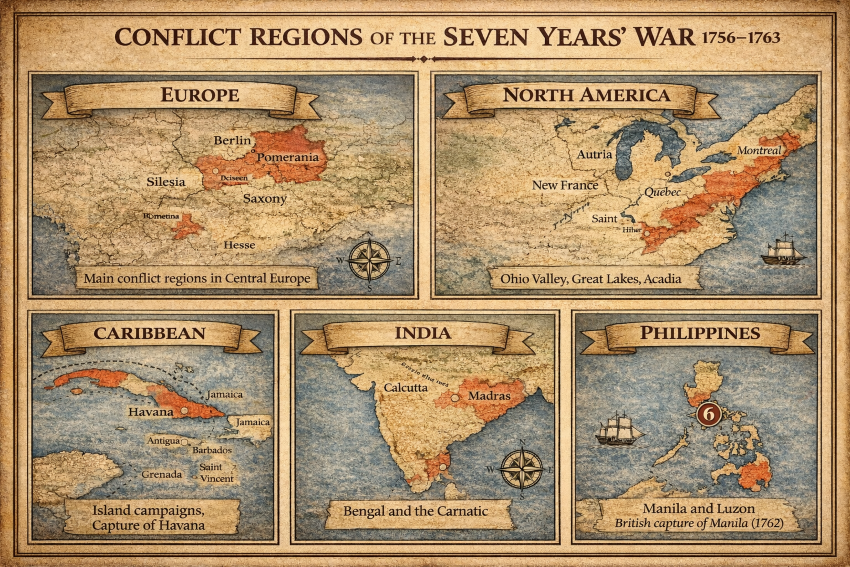
FACTS. The Seven Years’ War ended through two principal peace instruments in February 1763: the Treaty of Paris (10 February 1763) and the Peace of Hubertusburg (15 February 1763). The Treaty of Paris reallocated overseas possessions on a large scale—Britain gained extensive North American territory east of the Mississippi (with specified exclusions), while various Caribbean, African, and Indian arrangements were restored, exchanged, or constrained; Spain recovered Havana and Manila but ceded Florida to Britain and received Louisiana from France as compensation. The Peace of Hubertusburg largely restored the prewar territorial situation in Central Europe but confirmed Prussia’s retention of Silesia and (in contemporary diplomatic terms) reinforced Prussia’s status among major European powers.
INTERPRETATION (attributed). Many historians treat 1763 less as a clean “ending” than as a restructuring of risk: the treaties resolved the formal great-power war while leaving unresolved issues of frontier governance, fiscal burden-sharing, and imperial defense commitments—problems that quickly manifested in new conflicts and political crises. (This is a synthesis rather than a single-author claim; the specific mechanisms are treated below with source-based caution.)
2) Immediate postwar violence and frontier governance in North America (1763–1766)
FACTS. In North America, the early postwar settlement intersected with a major Indigenous-led uprising commonly known as Pontiac’s War (often dated 1763–1764, with subsequent negotiations into the mid-1760s). Britannica characterizes the uprising as a stimulus for policy action in London and links it to the imposition of new frontier restrictions.
FACTS. On 7 October 1763, the Crown issued the Royal Proclamation of 1763, a document that (among other provisions) established rules intended to regulate westward settlement and the acquisition of Indigenous lands, channeling land purchases through Crown processes. The text is preserved in full in a widely used primary-source transcription. For modern Canadian constitutional and historical framing, the Government of Canada describes the Proclamation as foundational to Crown–First Nations relations and as part of Canada’s territorial evolution. Britannica summarizes the Proclamation as aiming primarily to conciliate Native Americans by restricting settler encroachment.
INTERPRETATION (attributed, confidence: Medium). A common interpretation in scholarship is that the Proclamation and related boundary governance were dual-use instruments: (1) risk management to reduce frontier warfare costs and stabilize diplomacy/trade, and (2) imperial assertion of administrative control over colonial land speculation and westward expansion. The first rationale is explicit in many summaries (including Britannica’s emphasis on conciliation), while the second is often inferred from the institutional design (Crown-controlled land purchases and governance rules).
3) Fiscal aftershocks and imperial politics in Britain and the colonies
FACTS. Britain emerged from the war with major territorial gains and major fiscal burdens. A peer-reviewed economic history article reviewing debt debates reports figures from J. J. Grellier’s early-19th-century history of the British national debt: £76,480,886 (5 January 1757) rising to £135,691,313 (5 January 1763)—an increase of roughly £59.2 million over that interval—while noting that published debt series can differ depending on sources and accounting choices.
FACTS. Britain’s postwar policy agenda included raising revenue and managing the costs of imperial defense, including garrisons and frontier administration in North America. Contemporary colonial responses to the Stamp Act (1765) record that Parliament framed the measure in part as funding the maintenance of British troops in the colonies after the French and Indian War (the North American theater of the larger Seven Years’ War).
INTERPRETATION (attributed, confidence: Medium). Many historians present the post-1763 fiscal program—new taxes, stricter customs enforcement, and administrative consolidation—as a bargaining failure over the distribution of the war’s costs across the empire. This interpretation is consistent with documentary evidence of Parliamentary debates about revenue and colonial objections about representation and constitutional authority, but the relative causal weight of “debt pressure” versus “sovereignty and governance” remains debated in the literature.
4) South Asia: the Company-state’s acceleration (1764–1765 as hinge years)
FACTS. Although the European war ended in 1763, conflict and state-building dynamics continued in South Asia. Britannica dates the Battle of Buxar to 22 October 1764 and links its outcome to the Treaty of Allahabad (1765), in which the Mughal emperor granted the East India Company major political-fiscal rights in Bengal.
FACTS (primary-source support). A Government of India/Archaeological Survey publication includes a facsimile and notes the Treaty of Allahabad dated 16 August 1765, by which Shah Alam II made over to the Company the diwani (revenue administration rights) of Bengal (subahs specified in the document).
FACTS. Under the 1763 settlement, France’s position in India was constrained relative to the prewar competition; Britannica’s summary of the Treaty of Paris includes the provision that France renounced “conquests made since 1749 in India or in the East Indies,” and more generally the treaty structure restored or limited overseas holdings in ways that affected the balance among European trading powers.
INTERPRETATION (attributed, confidence: Medium). A standard interpretation is that 1763–1765 marks a transition from a predominantly “trade-post competition with military episodes” toward more sustained territorial-revenue governance by the East India Company in eastern India. This interpretation is strongly supported by the move from battlefield outcomes (Buxar) to explicit fiscal sovereignty arrangements (diwani), but there remains debate over whether 1765 should be treated as a qualitative “regime change” or one milestone within a longer state-formation trajectory.
5) France, Spain, and postwar imperial reform agendas (naval reconstruction and administrative reform)
FACTS. The Treaty of Paris returned several valuable Caribbean islands to France (e.g., Guadeloupe and Martinique) while Britain retained others (e.g., Grenada, Tobago, Dominica, St. Vincent) and acquired Florida from Spain; it also returned Gorée to France while Britain held Senegal (per Britannica’s summary of treaty terms).
FACTS. A specialized naval history journal article notes Choiseul’s determination after 1763 to rebuild France’s navy and links this to heightened attention to Atlantic resources (including fisheries seen as a “nursery for seamen”), illustrating how maritime competition continued after territorial losses in North America. France’s post-1763 strategic and institutional refocusing on naval capacity is also noted in scholarly discussions accessible via academic platforms (even when full texts are access-controlled).
FACTS. For Spain, modern scholarship emphasizes that the Seven Years’ War highlighted vulnerabilities in imperial defense and administration, with reform programs (often grouped under “Bourbon reforms”) targeting fiscal extraction, military reorganization, and administrative centralization in various regions. A peer-reviewed article in the Hispanic American Historical Review (PDF) discusses military reform underway in the early 1760s and its relationship to broader imperial reorganization. A recent Oxford University Press edited volume chapter similarly frames the Seven Years’ War as a catalyst for reforms in the Spanish and Portuguese empires.
INTERPRETATION (attributed, confidence: Medium). A mainstream interpretation is that France and Spain treated 1763 as a “lessons learned” moment—France emphasizing naval reconstruction and alliance management, Spain emphasizing military and administrative modernization of imperial defenses. The specific counterfactual claim (“they would not have reformed without 1763”) is harder to prove; what is well supported is that reform agendas intensified in the postwar context and were explicitly linked by policymakers and later analysts to wartime vulnerabilities.
6) Central Europe: recovery, state capacity, and reputational effects
FACTS. The Peace of Hubertusburg confirmed Prussian possession of Silesia and (per Britannica) confirmed Prussia’s stature as a major European power. Postwar Prussia faced reconstruction needs; Britannica’s biography of Frederick II emphasizes sustained efforts in the 1760s–1770s to attract immigrants and settle depopulated land as part of “making good” the losses of the war.
FACTS / INTERPRETATION boundary. It is well grounded to say that Prussia’s survival and retention of Silesia shaped subsequent European diplomacy. It is more interpretive to specify how much this “caused” later conflicts; historians differ on whether 1763 should be treated as the decisive inflection point or one of several in a longer Habsburg–Prussian rivalry.
7) Stakeholder “winners/losers” (short-run vs long-run; both sides)
Below is a descriptive accounting of benefits and costs, without implying moral valuation.
Britain (metropole)
- Potential winners (short-run): Expanded territorial claims and commercial access; strategic prestige after 1763 settlement.
- Potential losers (short-run): Substantial debt increase and administrative costs of a larger empire.
- Ambiguous (long-run): Debt-financed imperial governance may have underwritten later power projection, but also created political conflicts over revenue and authority.
British North American colonists
- Potential winners: Reduced French imperial presence on the mainland east of the Mississippi (as structured by the Treaty of Paris).
- Potential losers: New taxes and tighter imperial governance; restrictions on westward settlement framed through the Proclamation system.
Indigenous polities in the Great Lakes/Ohio Valley
- Potential winners: Some policy concessions and recognition of regulated land purchase mechanisms in the Royal Proclamation framework (as a formal constraint on settler encroachment, though enforcement varied).
- Potential losers: Intensified frontier conflict (e.g., Pontiac’s War) and the longer-run challenge of enforcing boundaries against settler pressure.
France
- Potential winners: Retention/restoration of some valuable Caribbean holdings and fishing-related arrangements (as described in treaty summaries and regional historical treatments).
- Potential losers: Loss of extensive mainland North American possessions east of the Mississippi and constraints on wartime gains in India.
- Long-run strategic pivot: Documented focus on naval reconstruction and Atlantic strategic issues after 1763.
Spain
- Potential winners: Recovery of Havana and Manila; acquisition of Louisiana from France as compensation (within the 1763 settlement architecture).
- Potential losers: Cession of Florida to Britain; postwar emphasis on reform partly reflects perceived vulnerabilities revealed during the war.
Prussia and Austria
- Prussia winners: Retained Silesia; enhanced status as a major European power (per Britannica).
- Prussia losers: Severe wartime strain requiring demographic/economic recovery measures.
- Austria winners/losers: Regained peace but failed to recover Silesia—often treated as a central strategic disappointment; the war also contributed to reform pressures, though the specific content varies by author and periodization.
South Asia (Company and regional polities)
- East India Company winners: Post-1764 military outcomes and 1765 treaty arrangements yielded major revenue-administrative rights in Bengal.
- Regional polities losers (variable): Certain rulers and confederations lost bargaining leverage and fiscal autonomy in affected regions; however, local outcomes varied and cannot be collapsed into a single “winner/loser” story without region-specific treatment.
8) What is well-established vs what remains disputed
Well-established
- Dates and core terms of the 1763 treaties (Paris; Hubertusburg) and major territorial exchanges described in authoritative summaries.
- Issuance date and key governance features of the Royal Proclamation (7 Oct 1763; regulated settlement/land purchase rules).
- The debt increase figures (as reported from historical debt series) and that postwar revenue measures were framed as funding imperial defense.
- Buxar (1764) and the Treaty of Allahabad (1765) as hinge events in East India Company revenue power in Bengal.
Disputed / debated
- The relative causal weight of “war debt” versus constitutional/sovereignty disputes in driving the later British–colonial rupture (often treated as multi-causal; confidence in any single-cause story is Low).
- Whether 1763 is best seen as the decisive “origin” of later Atlantic revolutions or as one accelerant among many (confidence Low–Medium, depending on the claim’s specificity).
- The extent to which the Proclamation functioned as a protective constraint for Indigenous land rights in practice versus a governance tool frequently overridden by settlement dynamics (confidence Medium, with strong regional variation).
- The degree to which French and Spanish reforms should be attributed primarily to 1763 rather than longer-term fiscal-military state trends (confidence Medium).
Key Sources Used (Part 5)
- Encyclopaedia Britannica: Treaty of Paris (1763); Peace of Hubertusburg; Pontiac’s War; Proclamation of 1763; Battle of Buxar; Seven Years’ War peace context.
- Primary texts: Royal Proclamation of 1763 (Avalon Project, Yale Law School); Treaty of Allahabad facsimile/reference (Archaeological Survey of India/Govt. of India-hosted PDF).
- Fiscal history (peer-reviewed): Eloranta & Land (2011) discussion of debt debates and historical series comparisons (including Grellier’s figures).
- Diplomatic framing: U.S. Office of the Historian milestone on Treaty of Paris negotiations.
- Reform and naval reconstruction: Janzen (International Journal of Naval History PDF) on post-1763 French naval rebuilding; Kuethe (HAHR PDF) and OUP chapter on Iberian imperial reforms.
- Government of Canada contextual framing of the Royal Proclamation.
Open Questions / Uncertainties (for future research)
- Debt accounting comparability: How different published British debt series (Parliamentary papers vs contemporary compilations) change the magnitude/timing of “debt shock” narratives. (Confidence: Medium that differences matter; Low on direction without harmonization.)
- Enforcement reality of the Proclamation line: Region-by-region evidence on compliance, enforcement capacity, and settler circumvention in the 1760s. (Confidence: Medium.)
- Indigenous coalition dynamics in Pontiac’s War: The extent to which “Pontiac” as a label compresses multi-polity decision-making and distinct local objectives. (Confidence: Medium.)
- India as “postwar continuation”: How far the 1764–1765 hinge should be interpreted as downstream from the European settlement versus a largely autonomous regional power shift. (Confidence: Medium.)
- Reform causality in France/Spain: Policymaker documents that explicitly link specific reforms to wartime lessons versus longer-run state capacity trends. (Confidence: Medium.)