Part 2 — Road to War (1748–1756)
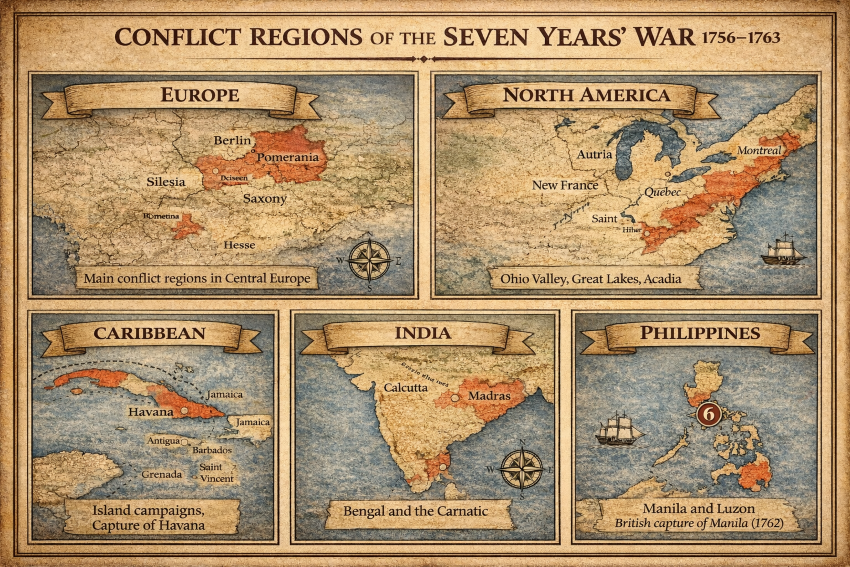
This part reconstructs how a post-1748 settlement that left major disputes unresolved escalated—through colonial clashes, maritime seizures short of declared war, and a rapid reconfiguration of European alliances—into a general war in 1756.
Milestone timeline of escalation (1748–1756)
- 1748 (Treaty of Aix-la-Chapelle): Ends the War of the Austrian Succession but leaves colonial rivalry unresolved and confirms Prussian control of Silesia, keeping the Austro–Prussian dispute live.
- 1752–1754: Relations deteriorate in North America amid competing claims and fort-building in the Ohio Valley.
- 28 May 1754 (Jumonville Glen): A skirmish in the Ohio Valley becomes an early armed clash in what contemporaries later treated as the opening of the North American war.
- 3 July 1754 (Fort Necessity): British colonial forces surrender; armed conflict in North America continues without a formal Anglo-French declaration of war.
- 8 June 1755 (Atlantic seizures/Action involving Alcide and Lys): Royal Navy operations intercept French shipping even though war is not formally declared; such actions contribute to escalation.
- 16 June 1755 (Fort Beauséjour): British capture of the fort at Chignecto; it becomes linked to subsequent population removals in Acadia.
- 9 July 1755 (Braddock’s defeat/Monongahela): A major British defeat intensifies the North American contest.
- 30 Sept 1755: Britain negotiates a subsidy arrangement with Russia (including troop maintenance levels), while also exploring a separate alignment with Prussia.
- 16 Jan 1756 (Convention of Westminster): Britain–Hanover and Prussia agree to resist the passage/invasion of “Germany” by a foreign power; this contributes to the “diplomatic revolution.”
- 1 May 1756 (First Treaty of Versailles): France and Austria conclude a defensive pact (including mutual troop contingents under specified conditions).
- Apr–May 1756 (Minorca campaign): French attack and capture of British-held Minorca helps widen hostilities in the European/Mediterranean theater.
- 17 May 1756: Britain formally declares war on France after years of armed clashes overseas.
- 29 Aug 1756 (Prussian invasion of Saxony): Prussia’s move marks the generally recognized opening of full-scale war in Europe, with contemporaries and later historians disputing the intent behind it.
1) The post-1748 bargaining problem: one peace, multiple unresolved disputes
FACTS (well-attested in standard reference works): The 1748 settlement did not remove the principal sources of rivalry. In Europe, Austria’s loss of Silesia to Prussia remained a core strategic problem for Vienna. Overseas, Anglo-French competition over North America and India remained active, and armed conflict in the North American interior began before a formal European declaration of war.
INTERPRETATION (attributed): Britannica frames Aix-la-Chapelle as a peace that “left wide grounds for discontent” and, by confirming Prussia’s conquest of Silesia, made renewed Austro–Prussian conflict likely, while also leaving colonial tensions unaddressed. This interpretation is widely shared in synthetic histories, though the degree of inevitability is debated among specialists (see Open Questions).
2) North America, 1754–1755: localized violence that internationalized
Ohio Valley clashes and the “undeclared” character of early war
FACTS:
- The Battle of Jumonville Glen occurred on 28 May 1754 in the Ohio Valley.
- The Battle of Fort Necessity occurred on 3 July 1754, ending in Washington’s surrender—an early marker of escalation.
- A major British defeat followed at the Battle of the Monongahela (Braddock’s defeat) on 9 July 1755.
INTERPRETATION (attributed): The U.S. Office of the Historian summarizes the relationship between theatres succinctly: the “French and Indian War” was the North American conflict inside a larger imperial war that Europeans came to call the Seven Years’ War. This is a framing of scale and linkage rather than an argument about any one actor’s intent.
Maritime escalation without formal war: seizures as a pathway to commitment
FACTS: Britannica describes British naval action in June 1755 (associated with Admiral Edward Boscawen’s operations) as beginning an “undeclared naval war” between Britain and France.
Royal Museums Greenwich likewise notes that, even though war was not officially declared, Boscawen had orders to attack French squadrons he met, and French ships (Alcide and Lys) were captured.
INTERPRETATION (attributed): From a bargaining perspective (modern IR lens), seizures at sea can harden positions by creating sunk costs and domestic demands for resolve; however, applying that framework here is an analytic overlay, not a direct statement of 1750s decision-makers’ motives. Confidence Medium (useful explanatory model, but not specific evidence of intent).
Acadia and population removal: a disputed-number episode that shaped wartime governance
FACTS (events and linkages): Parks Canada records the British capture of Fort Beauséjour on 16 June 1755 and situates it in the sequence that leads into “the great upheaval.”
FACTS (numbers as ranges, with why they differ):
- An Acadiensis article describes the 1755 deportation as resulting in the removal of “6000 to 7000” Acadians from the Bay of Fundy region (a figure tied to an initial phase and specific geography).
- A public-history institutional statement (Historica Canada) refers to “over 10,000” Acadians being forcibly removed over an eight-year period, reflecting a broader temporal scope and likely inclusion of multiple waves/locations.
INTERPRETATION (attributed): The divergence in figures is primarily a denominator problem: some sources count early expulsions in 1755 in Nova Scotia/Bay of Fundy; others count cumulative removals across years and regions. Confidence High that scope differences explain a substantial share of the variance; Medium on exact totals absent a dedicated demographic reconstruction.
3) Europe’s “diplomatic revolution,” 1755–1756: alliance inversion and the narrowing of exits
Why Britain sought a continental shield (Hanover) and why Austria prioritized Silesia
FACTS: Britannica explicitly notes Britain’s alliance with Prussia was undertaken partly to protect Hanover (the British dynasty’s continental possession) from a French takeover threat.
In the same synthesis, the war is described as arising out of Austria’s attempt to win back Silesia from Prussia, alongside overseas Anglo-French rivalry.
INTERPRETATION (attributed): This alignment of priorities created a “two-level” bargaining tension for Britain: protecting Hanover in Europe while contesting France overseas. Britannica’s narrative treats this as a central constraint shaping the search for a continental partner. Confidence High (well supported by diplomatic sequence in standard references).
The failed Russia track and the Convention of Westminster
FACTS: Britannica reports a preliminary 30 Sept 1755 arrangement that would have Russia maintain 55,000 men positioned to defend British interests on the continent, in exchange for subsidies (including £100,000 annually, rising to £500,000 in the event of attack).
Britain simultaneously contacted Prussia, and on 16 Jan 1756 the Convention of Westminster was signed: Britain–Hanover and Prussia agreed to respect each other’s territory and jointly resist any invasion of “Germany” by a foreign power (with specific exclusions noted by Britannica).
Britannica further notes the Russo-British arrangement then collapsed amid incompatible interpretations.
INTERPRETATION (attributed): Britannica presents Westminster as a catalytic diplomatic signal that alarmed Russia and angered France, creating conditions for closer Franco-Russian and Franco-Austrian coordination. This is less a claim of “inevitability” than a claim that perceived alignment shifts accelerated counter-alignment. Confidence High.
The First Treaty of Versailles (1756): defensive form, escalatory effects
FACTS: Britannica describes the First Treaty of Versailles (1 May 1756) as a defensive Franco-Austrian alliance with a 24,000-man support commitment under defined conditions, and notes it did not obligate Austria to join a war against Britain.
INTERPRETATION (attributed): Britannica emphasizes that both Westminster and the First Versailles treaty were formally defensive and therefore did not, in principle, force a European war—while simultaneously indicating that leading ministers (e.g., Kaunitz in the Britannica account) may have seen the 1756 alignment as a step toward broader anti-Prussian coordination. Confidence Medium–High (the distinction between treaty text and political expectation is analytically important and well grounded in the synthesis).
4) 1756 as the tipping year: Minorca, declarations, and Prussia’s move
Minorca as an early European/Mediterranean shock
FACTS: Britannica describes the French conquest of British Minorca in a campaign spanning April–May 1756, and a separate Britannica entry treats the 20 May 1756 naval battle as a notable early engagement in the European theatre.
FACTS: Britain formally declared war on France on 17 May 1756, after overseas fighting had already occurred.
INTERPRETATION (attributed): In many narratives, Minorca functions as a demonstrative event that made it harder for British governments to treat the conflict as merely colonial or “limited.” That said, it is best treated as an accelerant rather than a single cause. Confidence Medium (reasonable inference; specific cabinet-level intent would require primary minutes).
Troop concentrations and the move into Saxony (August 1756)
FACTS: Britannica reports that Austria and Russia were massing forces near Prussia and that Frederick sought assurances from Maria Theresa into August 1756 without receiving a reply he found satisfactory; on 29 Aug 1756 he led his army into Saxony, starting the European war in most periodizations.
Britannica’s “course of war” section gives an indicative scale: 70,000 Prussians crossed the Saxon frontier on 29 Aug 1756.
INTERPRETATION (explicitly disputed, with confidence ratings): Britannica itself flags that Frederick’s motive “has been much debated,” presenting two broad possibilities: (1) a preventive move to gain advantage against feared imminent Austro–Russian action; or (2) an opportunistic war of annexation. On the basis of this synthesis alone, confidence is Low–Medium on any single-motive claim; confidence High that contemporaries and historians dispute the weighting of these motives.
5) Stated aims at the brink (as expressed in aligned priorities and treaty-linked commitments)
Because “aims” can slide into inferred motives, the safest approach is to distinguish (a) widely documented strategic objectives from (b) conjectures about inner intent.
Widely documented objectives (high confidence)
- Austria: Recovery of Silesia is presented in major reference syntheses as the central European objective.
- Britain: Protect Hanover and prosecute overseas competition with France in North America and India.
- France: Maintain freedom of action to prosecute the “vital” war against Britain overseas while managing (and initially limiting) continental obligations—an expectation Britannica explicitly attributes to French assumptions around the 1756 treaty context.
- Prussia: Defend its European position against hostile coalition pressure (as a stated or implied objective in the “preventive war” reading), though assigning primacy to this aim remains disputed.
Where stated aims become hard to separate from inference (medium confidence)
- Russia: Britannica describes Russia’s troop pledges in relation to an attack on Prussia in 1756–57 diplomacy (including large-force commitments). This supports an inference that Russian policy-makers anticipated the contingency of conflict with Prussia, but the precise ranking of aims (security, influence in Poland/Baltic, alliance management) varies across scholarship. Confidence Medium.
- Company rivalry in India: Britannica notes ongoing tension between the French and British East India companies after 1748. That establishes rivalry as a structural driver, but “aims” (for Versailles or London) are harder to specify without deeper archival grounding. Confidence Medium.
What is well-established vs what is disputed (Road to War)
Well-established (high confidence)
- Post-1748 disputes over Silesia and overseas empire remained unresolved and central.
- Armed conflict in North America began by 1754 and expanded through 1755, preceding formal Anglo-French declarations.
- The alliance reversal of 1756 (Westminster; First Versailles) is a core feature of the pre-war diplomatic environment.
- Prussia’s invasion of Saxony (29 Aug 1756) is a widely used marker for the outbreak of war in Europe.
Disputed or interpretively sensitive (medium/low confidence)
- Whether Frederick’s 1756 move is best characterized as primarily preventive or primarily opportunistic (or a mixture).
- The degree to which “defensive” treaties made European war inevitable versus merely more likely.
- The most defensible aggregate numbers for Acadian removals (initial wave vs cumulative).
Key Sources Used (Part 2)
- Encyclopaedia Britannica, “Seven Years’ War” (causes; alliance logic; Hanover; Silesia; diplomatic revolution).
- Encyclopaedia Britannica, “Preliminary negotiations and hostilities in the colonies” (1750–56 diplomacy; subsidies; Westminster; First Versailles; Minorca; Saxony move; motive debate framing).
- Encyclopaedia Britannica, entries on Jumonville Glen, Fort Necessity, Monongahela, Minorca (event dating and significance summaries).
- U.S. Department of State, Office of the Historian, “French and Indian War/Seven Years’ War, 1754–63” (theatre linkage framing).
- Parks Canada, Fort Beauséjour siege history page (dated surrender and contextual sequencing).
- Royal Museums Greenwich (National Maritime Museum collections note), capture of Alcide and Lys (undeclared-war maritime escalation).
- Acadiensis (UNB journals), article noting 6,000–7,000 removed in the 1755 deportation phase (scope-specific figure).
- Historica Canada press release (public-history institutional summary), “over 10,000” removed over multi-year deportation (broader-scope figure).
- History.com (dated note on Britain’s 17 May 1756 declaration of war; used only for that discrete date).
Open Questions / Uncertainties (Part 2)
- Frederick’s intent in August 1756: How much weight to give to preventive-war logic versus opportunism varies across historians; resolving it requires close use of Prussian decision records and intelligence assessments. Confidence Low–Medium on any single-cause narrative.
- Counterfactual exits in 1755–56: Were Westminster and First Versailles stabilizing “deterrent” pacts or stepping stones to offensive plans? Treaty text is defensive; expectations may not have been. Confidence Medium.
- Escalation threshold at sea: To what extent did 1755 seizures foreclose later negotiated settlement? Evidence here is strong on actions, weaker on decision-maker beliefs without cabinet minutes. Confidence Medium.
- Acadian deportation totals: The most defensible synthesis needs careful reconciliation of regional phases, deaths in transit, and returns—beyond what short-form references provide. Confidence Medium.
- India as a “road to war” theatre: We have high-confidence evidence of company rivalry after 1748, but specifying “stated aims” for 1754–56 without deeper archival and scholarly treatment remains uncertain. Confidence Medium.