Seven Years’ War — Part 1: Pre-War System
Conflict Snapshot
- Dates (core war): 1756–1763.
Common wider framing: 1754–1763, treating the North American French and Indian War as the conflict’s early phase within a broader imperial war. - Type: Global interstate war with major imperial/colonial and company dimensions; multiple local polities and Indigenous nations participated as belligerents, allies, or autonomous actors in particular theaters.
- Principal actors (European great-power coalitions): France, Austria, Saxony, Sweden, Russia versus Prussia, Hanover, Great Britain (with later Spanish entry).
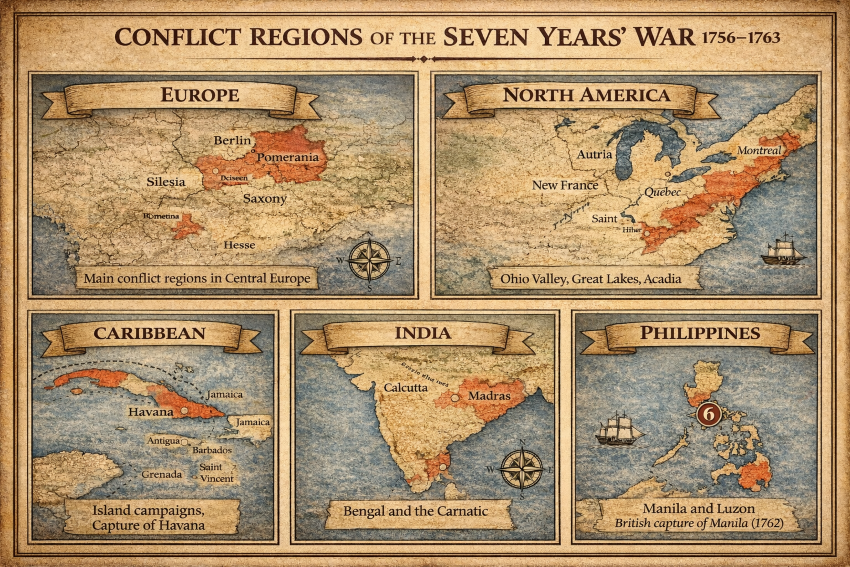
- Theaters: Continental Europe; North America; Caribbean; South Asia (especially Bengal and the Carnatic); plus episodic operations affecting West Africa and the Philippines (e.g., Manila and Havana captured in 1762).
- Outcome label (high-level, descriptive):
- Continental settlement: Peace of Hubertusburg (Feb 15, 1763) ends the German/central European conflict and confirms Prussian possession of Silesia.
- Overseas/imperial settlement: Treaty of Paris (Feb 10, 1763) ends the wider Franco-British war with territorial transfers that include France ceding Canada to Britain (among other provisions).
- Casualty ranges (why they differ):
- Central Europe: The Oxford Handbook’s introduction suggests perhaps ~1 million deaths in central Europe attributable to the war.
- Global totals: No single uncontested number is standard; published figures differ by whether they count battle deaths only, all military deaths (including disease), civilian mortality, and whether they aggregate uneven theater records. The same Oxford introduction underscores that impacts and casualty patterns were highly uneven across regions and categories.
- Displacement (why it is hard to aggregate globally):
- A widely quantified episode is the Acadian deportations: approximately 10,000 people deported between 1755 and 1763, with scholarship also citing 6,000–7,000 removed in the 1755 operation as a focal subset of a longer process.
- There is no standard global displacement total for the war; most quantified displacement is episode-specific rather than comprehensively tallied across all theaters.
- Last updated: 16 January 2026.
Timeline of dated milestones
- Oct 1748: Treaty of Aix-la-Chapelle ends the War of the Austrian Succession; colonial and commercial disputes between Britain and France remain unresolved; Prussia retains Silesia.
- 1754: French and Indian War begins in North America; later treated as the North American component of the wider Seven Years’ War.
- 1755–1763: Acadian deportations; approximately 10,000 deported (with 6,000–7,000 often cited for the 1755 operation).
- Jan 16, 1756: Convention of Westminster signed; Britain–Hanover and Prussia agree to mutual guarantees in Germany against invasion (a key element of the “diplomatic revolution”).
- May 1, 1756: First Treaty of Versailles establishes a defensive alliance between France and Austria.
- May 1, 1757: Second Treaty of Versailles forms an offensive Franco-Austrian alignment against Prussia, with extensive territorial provisions discussed in the agreement.
- June 23, 1757: Battle of Plassey in Bengal; a British East India Company victory that Britannica describes as pivotal for the Company’s transformation into a political-military power in India.
- Sept 13, 1759: Battle of Quebec; decisive British victory in the North American theater.
- Jan 5, 1762: Peter III succeeds in Russia; Britannica notes he reversed policy by making peace with Prussia and withdrawing Russia from the war.
- Jan 2, 1762: Britain declares war on Spain; Spain enters the war, and Britain captures Havana and Manila later in 1762 (Britannica summary).
- Feb 10, 1763: Treaty of Paris signed (primary text; also summarized by U.S. State Department).
- Feb 15, 1763: Treaty/Peace of Hubertusburg signed between Austria, Prussia, and Saxony, ending the continental settlement.
Pre-War System
1) The post-1748 settlement and the problem of “unfinished business”
A useful starting point is what the 1748 settlement did not resolve. Britannica’s treatments of the War of the Austrian Succession and the Treaty of Aix-la-Chapelle emphasize two structural legacies: Prussia’s retention of Silesia and the fact that Britain–France colonial and commercial disputes were not settled in a way that would support durable peace.
Fact pattern (pre-war system):
- Central Europe: The confirmation of Prussian control over Silesia left an obvious locus for future contestation between Prussia and the Habsburg Monarchy.
- Overseas empires: Britain and France remained strategic competitors across Atlantic and Indian Ocean spaces; the State Department’s summary explicitly frames the North American war as part of a larger imperial contest between Britain and France.
Interpretation (attributed): Britannica argues that the 1748 terms, by leaving colonial rivalry unsettled, were “no basis for a lasting peace.”
This is not a claim about any single actor’s intent; it is a system-level diagnosis: peace settlements can end a war while leaving stakes and security dilemmas intact.
2) The diplomatic architecture of mid-18th-century Europe
The European “pre-war system” was a multipolar order in which security depended heavily on alliances, subsidies, and the management of smaller German states and electorates as strategic corridors.
Britannica identifies the Convention of Westminster (Jan 16, 1756) and the First Treaty of Versailles (May 1, 1756) as constituent elements of the “diplomatic revolution.” These were explicitly defensive instruments in form, and Britannica notes they did not make European war “inevitable” in a mechanical sense.
Key structural features of the alliance system:
- Britain–Hanover as a continental constraint: Britain’s dynastic and strategic interests in Hanover made German security a recurrent British concern, and the Westminster Convention’s guarantees were framed in terms of resisting invasion of “Germany.”
- Austria’s coalition-building: The Franco-Austrian turn in 1756 and the escalation to an offensive alignment in 1757 were coalition instruments to change the balance against Prussia.
- Russia’s participation and volatility: The Russian withdrawal in 1762 under Peter III is a reminder that coalition warfare depended on court politics and succession in addition to battlefield outcomes.
Interpretations (attributed, with confidence):
- Britannica’s narrative suggests that Kaunitz could view the Austro-French agreement as a step toward aligning France within an anti-Prussian offensive system.
Confidence: Medium. This is interpretive (about strategic reading) but grounded in diplomatic history and consistent with the shift from defensive to offensive treaty forms in 1756–57.
3) Imperial competition: why “Europe” and “overseas” remained coupled
A defining feature of the Seven Years’ War is that European diplomacy and overseas rivalry were not independent tracks. The State Department’s framing of the French and Indian War as a North American conflict in a larger imperial war highlights how competition over territory and influence in North America was entangled with European alignments.
The Oxford Handbook’s introduction explicitly frames the war as “interconnected but often very separate series of events,” organized around three major conflicts: an American war (France–Britain), a South Asian war (France–Britain), and a European war centered on Prussia against a coalition. This formulation is important for your series because it implies a system where:
- Strategic resources (money, ships, troops, supplies) were allocated across theaters;
- Success in one theater could shape bargaining leverage in another;
- Yet local dynamics (alliances with Indigenous nations; Indian regional politics; German state structures) could drive outcomes independently of European intentions.
4) Institutions and constraints: fiscal capacity, credit, and mobilization
Historians commonly analyze 18th-century great-power rivalry through the lens of the fiscal-military state: a state capable of sustaining large-scale warfare through taxation and fiscal innovation (including borrowing and public credit). Oxford Bibliographies summarizes this as a capacity to sustain warfare via taxation and fiscal innovation, and the Oxford fiscal-military state project foregrounds John Brewer’s thesis that sustained war required the effective “mobilisation of wealth.”
The Oxford Handbook’s “Resources” chapter argues that the relative ability of belligerents—especially Britain and Prussia—to mobilize and deploy resources contributed significantly to outcomes. Importantly, this is not a single-variable explanation; it frames mobilization as a key constraint within which strategy operated.
Constraints that shaped pre-war planning (fact-anchored):
- Distance and time: War-making across the Atlantic and to South Asia imposed long delays and high logistical costs; this structurally advantaged actors with stronger naval and credit systems (a common analytic in the literature, and consistent with the Oxford “Resources” framing).
- Disease and non-combat mortality: The Oxford introduction notes Britain lost relatively few men in battle compared with disease losses (citing Erica Charters’ work).
- Uneven civilian exposure: The same Oxford introduction emphasizes that casualty patterns and impacts were highly uneven—central Europe seeing civilian mortality “of a different order” and even a cited estimate of Prussian population decline (400,000) in one interpretation within the scholarship.
5) The role of chartered companies and local polities
The pre-war system was not purely a matter of European ministries. In South Asia, the British East India Company operated as a military and political actor. Britannica’s treatment of the Battle of Plassey dates the engagement (June 23, 1757) and describes it as a crucial victory that marked the Company’s transformation from mercantile presence into political-military power in India.
In North America, the State Department’s summary emphasizes imperial competition and the colonial consequences of wartime fiscal burdens, while the quantified displacement example of Acadians underscores how some populations became objects of strategic administration within imperial security policies.
Interpretation (attributed): The Oxford Handbook’s introduction emphasizes that “other peoples” beyond European elites—including Indigenous Americans and West Africans—were integral participants or were caught up in war processes.
Confidence: High that this is a well-established scholarly orientation; the specific causal weight of any single group’s agency varies by theater and must be handled case-by-case.
6) Why termination terms mattered to the pre-war system
Because the series aims to be system-oriented, it is worth noting that the pre-war stakes are visible in how the war ended:
- The Treaty of Paris text includes France’s cession of Canada to Britain, a major imperial reallocation.
- The Peace/Treaty of Hubertusburg confirmed Prussia’s possession of Silesia, meaning the “Silesian question” was settled in Prussia’s favor at the treaty level even though rivalries persisted.
This matters for Part 1 because it clarifies that the pre-war system featured two interacting contests:
- A continental security contest (Silesia, German states, coalition balance).
- An imperial contest (North America, Caribbean, South Asia), with settlement terms that redistributed territorial and commercial position.
What is well-established vs what is disputed
Well-established
- The core war is conventionally dated 1756–1763, with the North American phase commonly dated 1754–1763 and treated as part of the wider conflict.
- The “diplomatic revolution” is commonly anchored in the Convention of Westminster (1756) and the Treaty of Versailles (1756) (with a second Versailles treaty in 1757).
- The war consisted of interconnected conflicts in Europe, the Americas, and South Asia, rather than a single uniform campaign.
- The termination involved two linked settlements: Treaty of Paris (Feb 10, 1763) and Hubertusburg (Feb 15, 1763).
Disputed or method-dependent
- Total global deaths and casualties: estimates vary sharply by definitions and uneven records; even scholarly summaries emphasize uneven impacts and categories (battle vs disease; military vs civilian).
- “Start date” of the war as a global event: 1754 vs 1756 depends on whether one treats the war as an integrated imperial conflict from the Ohio Valley crisis onward or as a European war that later subsumed overseas theaters.
- Relative weight of “resources” vs “strategy” vs “local politics” in causing outcomes: the Oxford “Resources” argument foregrounds mobilization capacity, but scholarship remains plural on causal hierarchies (to be handled explicitly in Parts 2–4).
Key Sources Used
- Oxford Academic, The Oxford Handbook of the Seven Years’ War (Introduction; Resources chapter).
- Encyclopaedia Britannica: Seven Years’ War overview; Convention of Westminster context; Treaty of Versailles (1756); Second Treaty of Versailles (1757); Battle of Plassey; Battle of Quebec; Peace of Hubertusburg; Peter III biography; key facts on Spain’s entry.
- U.S. Department of State, Office of the Historian: French and Indian War/Seven Years’ War; Treaty of Paris milestone.
- Avalon Project (Yale Law School): Treaty of Paris (1763) primary text.
- The Canadian Encyclopedia and Acadiensis scholarship on Acadian deportations (quantified episode displacement).
- Oxford (project + bibliography) on the fiscal-military state concept.
Open Questions / Uncertainties
- Global casualty totals: What range is most defensible for total deaths across all theaters once definitions (battle vs disease; civilian vs military) are made explicit?
- Comparability across theaters: How should the series standardize comparisons between central European demographic loss and colonial theater losses where records and categories differ?
- Alliance causality vs contingency: How much explanatory weight should be assigned to the 1756–57 treaty realignments versus longer-running rivalries (Silesia; colonial competition) in explaining escalation?
- Company-state dynamics: To what extent do South Asian outcomes reflect Company capacity and local coalition-making rather than “European state” strategy? (This will require tighter sourcing beyond the overview-level reference accounts.)
- Displacement accounting: Beyond the Acadian case, what other wartime population movements can be quantified with high confidence, and how should uncertainty be reported?