Part 1 — Pre-War System (Thirty Years’ War, 1618–1648)
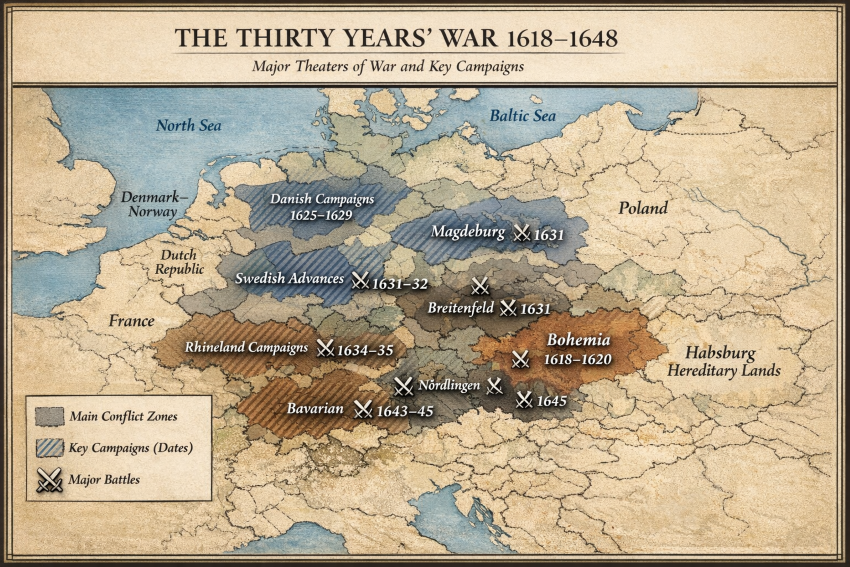
Conflict Snapshot
- Dates: Commonly dated 1618–1648 (with the Westphalian settlements signed 24 Oct 1648, after negotiations beginning 1644).
- Type (classification): A connected cluster of wars combining internal conflict within the Holy Roman Empire (including rebellions and civil-war dynamics) with major interstate interventions (notably Spain, Denmark-Norway, Sweden, France, the Dutch Republic).
- Primary arenas (“theater”): Central Europe (many campaigns in German lands; major activity also tied to the Spanish Netherlands and the Dutch-Spanish war context).
- Core political actors (high level):
- Imperial side (variable coalitions): the Holy Roman Emperor (House of Habsburg) with shifting support among Catholic and some Lutheran princes and Catholic League forces.
- Anti-imperial coalitions (variable): Bohemian and other estate coalitions at different stages; later coalitions involving Sweden and German allies, and later still France as a principal belligerent.
- Outcome label: Negotiated settlement associated with the Peace/Treaties of Westphalia (1648); also included a Spanish–Dutch settlement within the Westphalian framework.
- Casualties (range) and why they differ:
- Estimated total deaths: often given as ~4 to 12 million (with estimates attributing a large share to disease and famine rather than direct combat). The range reflects sparse and uneven records, differing geographic scopes, and differing methods for separating war effects from epidemic and subsistence crises.
- Combat deaths: sometimes estimated around ~450,000 (likewise method-dependent).
- Displacement: Contemporary accounts and later syntheses describe large-scale flight/refuge (often toward towns), but no single credible aggregate total exists; evidence is local and episodic.
- Last updated: 2026-01-15
Timeline (8–15 dated milestones)
(Notes: some dates vary by Julian vs Gregorian usage in contemporary sources; major dates below follow common modern references.)
- 1609: Letter of Majesty issued for Bohemia, expanding legally recognized religious rights for certain estates and communities (key pre-war legal reference point).
- 23 May 1618: Defenestration of Prague (Bohemian revolt trigger episode in many narratives).
- 28 Aug 1619: Ferdinand II elected Holy Roman Emperor (with external and internal support).
- 8 Nov 1620: Battle of White Mountain near Prague; decisive early defeat for the Bohemian rebel army in most conventional periodizations.
- 1625: Denmark-Norway intervenes (often framed as the “Danish phase” in older periodizations).
- 26 Aug 1626: Battle of Lutter; major Danish defeat in the campaign sequence.
- 28 Mar 1629 (date disputed in some references): Edict of Restitution issued, ordering restoration of ecclesiastical properties secularized since 1552 (a major institutional-religious shock).
- 1629: Peace of Lübeck ends Denmark-Norway’s intervention.
- June 1630: Swedish landing in Germany (often treated as the opening of the Swedish intervention).
- 17 Sept 1631: Battle of Breitenfeld; first major Protestant victory in many military summaries.
- 5–6 Sept 1634: Battle of Nördlingen; major Habsburg victory; widely linked to the next diplomatic turn.
- 30 May 1635: Peace of Prague between the Emperor and Saxony (transforming the war’s internal/external balance in many accounts).
- From 1644: Westphalian peace congress negotiations at Münster and Osnabrück.
- 30 Jan 1648: Spanish–Dutch treaty (within the broader Westphalian settlement complex).
- 24 Oct 1648: Treaties commonly grouped as the Peace of Westphalia concluded.
The Pre-War System (Actors, Institutions, Stakes, Constraints)
1) The Holy Roman Empire as a constitutional order (baseline institutions)
Factual baseline
- The Holy Roman Empire was not a centralized nation-state; authoritative summaries describe it (especially after the mid-16th century) as a loose federation of princes, both secular and ecclesiastical, under Habsburg “presidency.”
- The Emperor was formally chosen by prince-electors, a structure anchored historically by the Golden Bull (1356) and the established list of electors (including the king of Bohemia among the seven).
- The Empire’s political landscape included a hierarchy of territorial rulers (electors, princes, ecclesiastical rulers), and also imperial cities with direct relationship to imperial authority in legal theory.
Interpretations (attributed)
- A common interpretive frame in reference syntheses is that the Empire’s legal and institutional pluralism created multiple veto points, making rapid, uniform settlement of religious and constitutional disputes difficult. This is not a “single cause,” but a structural constraint: disputes could persist because parties could appeal to competing jurisdictions and privileges.
- Some modern scholarship (as reflected in historiographical review) emphasizes that the Empire retained meaningful capacity for adaptation, pushing back against older depictions of it as merely “a shell.” (This is a historiographical claim about how the Empire functioned, not a direct measurement.)
2) The confessional settlement: legal security and unresolved questions
Factual baseline
- The Peace of Augsburg (1555) created a legal framework intended to reduce confessional conflict between Catholics and Lutherans, including the principle commonly summarized as cuius regio, eius religio—the territorial ruler’s authority to set the confession of subjects within the legally recognized options.
- A key structural problem before 1618 was that Augsburg’s recognized confessions did not cleanly map onto the Empire’s evolving religious landscape (notably around the status of the Reformed/Calvinist tradition).
- In Bohemia, the Letter of Majesty (1609) became a central legal reference point for religious rights and estate privileges; later summaries describe Ferdinand (as successor in Habsburg lands) as reducing these liberties, contributing to political confrontation.
Interpretations (attributed, with confidence)
- Confessional-security interpretation (Medium–High confidence as an explanatory theme): Britannica’s narrative history of Europe explicitly characterizes pre-1618 politics as shaped by fear of confessional eradication, portraying alliance-building as driven by perceived existential religious threat.
- Legal-constitutional interpretation (Medium confidence): Another recurring scholarly frame treats confessional conflict as inseparable from constitutional disputes—who had the right to enforce religious policy, adjudicate property claims, and define the boundaries of estate privilege. This interpretation emphasizes institutions and law more than theology alone.
- Caution on motives: It is common to see claims that Ferdinand II sought to “force Catholicism” broadly; such statements appear in secondary commentary, but motives and intent vary by author and genre. Where used, they should be treated as interpretive unless tied to specific documented proclamations and enforcement actions in context.
3) Polarization mechanisms: leagues, alignments, and credibility problems
Factual baseline
- In the early 1600s, confessional and political tensions contributed to organized alignments such as the Protestant Union (1608) and the Catholic League (1609), which became important scaffolding for later coalitions.
- Pre-1618 flashpoints included controversies such as the Donauwörth incident, which authoritative histories treat as a marker of escalating confessional confrontation in the Empire.
- Another stressor was the Jülich-Cleves succession crisis (1609), cited in European histories as evidence of how dynastic disputes could take on confessional and international dimensions.
Interpretations (attributed)
- One way to read the pre-war system is as a credible-commitment problem: legal settlements existed (Augsburg; Bohemian guarantees), but parties disagreed over interpretation, enforcement, and exceptions—making promises hard to trust when power shifted. This is consistent with how reference histories connect legal frameworks to recurring crises, without implying a single planned “road to war.”
4) The wider European system: dynastic linkage and parallel wars
Factual baseline
- The Thirty Years’ War is frequently described as “a series of wars fought by various nations for various reasons,” including religious, dynastic, territorial, and commercial rivalries—a formulation that signals multi-causality and shifting coalitions.
- The conflict’s “Europeanization” occurred in an environment where the Spanish–Dutch war resumed in 1621 after the Twelve Years’ Truce period, and the Spanish-Dutch settlement was later integrated into the Westphalian settlement complex.
- Later phases are often described as transforming from primarily imperial-estate conflict into a war in which the Emperor confronted foreign powers more directly (a shift explicitly noted in European narrative histories).
Interpretations (attributed, with confidence)
- “War system” interpretation (High confidence as description, lower as singular explanation): Many syntheses treat 1618–1648 not as one continuous bilateral war but as a connected conflict system: an initial imperial-estate crisis that became entangled with external rivals’ security concerns and opportunity structures. This reading is strongly supported by how authoritative summaries describe the war’s multi-actor, multi-reason character.
5) Material constraints: military entrepreneurship, finance, and civilian vulnerability
Factual baseline
- Period commentary (including ICRC historical synthesis) describes warfare involving a mixture of regular forces, mercenary troops, private armies, and irregular groups, with major “human toll” effects driven by supply, plunder, disease, and famine.
- The same synthesis emphasizes the evidentiary problem: surviving records are often local authority/church registers and scattered witness accounts, limiting confidence in aggregate numbers and making some claims (especially about civilian deaths and displacement) heavily method-dependent.
Interpretations (attributed)
- A common analytical view is that early modern military mobilization created structural incentives for requisition and plunder when centralized fiscal capacity was limited; this does not require assuming “wanton” intent as a motive, only acknowledging the logistics described in period syntheses (e.g., “military entrepreneurship” and self-funding through contributions).
What is well-established vs what is disputed
Well-established (high confidence)
- The conflict is conventionally dated 1618–1648 and ended via the Westphalian settlements negotiated from 1644 and concluded in 1648, including a Spanish–Dutch component.
- The Holy Roman Empire’s political order involved elective monarchy via prince-electors and a plural landscape of princes, ecclesiastical rulers, and cities, limiting uniform centralized control.
- The Peace of Augsburg (1555) established a legal confessional framework that shaped politics and conflict escalation; later settlements expanded toleration frameworks.
- Major intervention milestones (e.g., Denmark 1625, Sweden 1630, Peace of Prague 1635) are stable in mainstream chronologies.
Disputed or method-dependent (medium to low confidence)
- Total deaths and their attribution (combat vs famine/disease; geographic weighting; counterfactual baselines).
- Aggregate displacement levels (substantial locally, but not meaningfully enumerable for the entire war with existing evidence).
- The relative primacy of confessional vs constitutional vs dynastic explanations (most credible accounts treat the causes as multiple and interacting, not singular).
- Calendar and dating issues for specific events and edicts (e.g., different dates cited for the Edict of Restitution).
Key Sources Used
- Encyclopaedia Britannica, “Thirty Years’ War” (overview framing of multi-cause, multi-actor war).
- Encyclopaedia Britannica, “Peace of Westphalia” (negotiations from 1644; treaties and parties; Spanish–Dutch treaty date).
- Encyclopaedia Britannica, Holy Roman Empire / electors / Golden Bull (institutional structure and electors).
- Encyclopaedia Britannica, key event entries (Breitenfeld; Nördlingen; Edict of Restitution; Peace of Prague; Lutter; Lübeck; Gustavus Adolphus in Germany).
- Encyclopaedia Britannica, Netherlands / Eighty Years’ War (resumption in 1621; 1648 settlement linkage).
- German History in Documents and Images (GHDI), Letter of Majesty (1609) (primary-document context).
- ICRC Humanitarian Law & Policy Blog, “The Thirty Years’ War: The first modern war?” (casualty range; record limitations; displacement discussion).
- Oxford Reference (contextual corroboration for treaty chronology and phase framing).
Open Questions / Uncertainties (for this series)
- How should “the” war be partitioned analytically? Older “phase” schemes (Bohemian/Danish/Swedish/French) are convenient but can obscure continuities and parallel theaters. (Confidence: Medium)
- What is the most defensible mortality range when separating direct violence from famine/disease and when accounting for regional variance? (Confidence: Medium-Low for precision; High that indirect mortality dominates many areas)
- What is the best “unit of analysis” for agency—emperors and kings, imperial institutions, territorial estates, or military-fiscal entrepreneurs? Different historiographies weigh these differently. (Confidence: Medium)
- Dating and legal status questions (calendar differences; when edicts were issued vs promulgated; what contemporaries recognized as binding). (Confidence: Medium)
- Pre-1618 causation weighting: confessional security fears vs constitutional-legal disputes vs dynastic-geopolitical rivalry—credible accounts emphasize interaction, but the relative weights remain debated. (Confidence: Medium)