Part 5 — Aftermath (short/long run, stakeholder winners/losers on both sides, what remains disputed)
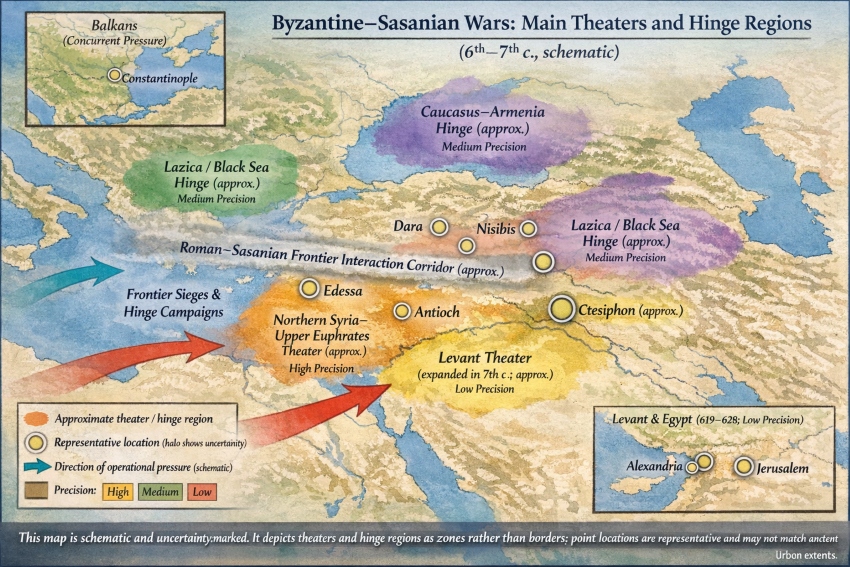
1) Immediate aftermath of the last war (628–c. 630): “restoration” amid administrative shock
Fact (settlement shape): High-quality reference synthesis describes the post-628 settlement as a rollback of Sasanian wartime gains and a rapid move toward peace after Khosrow II’s overthrow.
Fact (Persian political discontinuity): The same Iranica dossier emphasizes that the end of fighting coincided with, and was followed by, unusually rapid turnover in the Sasanian center. Khosrow II was imprisoned and executed in February 628 (as dated in the Chronicon Paschale tradition cited by Iranica), followed by Kawād II’s brief rule and then Ardašīr III’s accession as a child, with real power described as concentrated among magnates and regents.
Fact (plague claim, explicitly attributed): The Ardašīr III entry reports a “plague of 628” and—citing older scholarship—offers a very large figure for mortality in Iraq. Because this is mediated through later narrative/19th-century historiography and is difficult to corroborate quantitatively, it is best treated as evidence for perceived severity rather than a stable demographic statistic. Confidence: Low–Medium for the specific fraction; High that epidemic disease was part of the 628 crisis narrative.
Interpretation (bounded): From an administrative perspective, the “peace dividend” for both empires was constrained by the fact that reintegration (reoccupation, garrisoning, tax restoration, and local legitimacy) had to occur in a landscape already disrupted by decades of campaigning. Confidence: Medium (mechanism is plausible; local variation is large and unevenly documented).
2) Stakeholders and distributions of gain/loss (short run)
A) Byzantine/Eastern Roman stakeholders
Who plausibly “won” in the short run (descriptive, not moral):
- Imperial center (Constantinople) and the Heraclian regime: The settlement narrative in Byzantine-source tradition strongly emphasizes restoration—of provinces and symbolic items—consistent with a regime-strengthening outcome in the near term.
- Military commanders positioned for renewed influence: A war that ends with a major reversal often elevates officers credited with success; however, the record is uneven and later narratives can amplify heroization. Confidence: Medium (pattern common; specifics vary).
Who plausibly “lost” in the short run:
- Frontier and recently occupied populations (Syria, Palestine, Mesopotamia, Armenia): even where sovereignty was restored, the near-term effects often included disrupted property regimes, arrears in taxation, garrison burdens, and unresolved confessional tensions. Kaegi’s framing of the subsequent decades highlights how rapidly these provinces became contested again.
- Fiscal system: Haldon’s broad account of the 7th century treats this period as one of major transformation of state apparatus (military, civil, fiscal), implying that “restoration” did not mean a return to pre-603 administrative normality.
B) Sasanian stakeholders
Who plausibly “won” (short run):
- Elite factions that removed Khosrow II: Iranica presents the coup as led by elements of the military and magnate elite who feared retaliation and acted to replace him, suggesting short-term empowerment of court factions.
- Provincial powerholders: Ardašīr III’s entry depicts effective authority as slipping from the crown to great nobles and regents, consistent with increased autonomy at the periphery.
Who plausibly “lost” (short run):
- Central monarchy and succession stability: The cluster of short reigns and disputed accessions (Ardašīr III; Šahrwarāz; Bōrān; Āzarmīgduxt) signals systemic succession stress. Iranica explicitly confirms these rulers and their brief tenures, including coin evidence.
- Core revenue base: For the later Arab wars (which follow quickly), Iranica’s article on the Arab conquest of Iran notes that Iraq was the apex of Sasanian administration and provided roughly one-third of annual tax revenues—an explicit indicator of how catastrophic the loss of the Iraqi core would be once it occurred.
3) Medium-run aftermath (630s–650s): rapid transition to a new strategic order
Fact (regional turning): High-quality survey treatment dates the “initial Arab conquests” in staged waves: Palestine and Syria (634–636); Persian Mesopotamia (636–640); Egypt (641–643); and Iran (642–652).
Fact (macro outcome): A Cambridge overview chapter characterizes the Roman–Persian struggle as having reached a standstill, after which a new power rapidly displaced Byzantium from long-held provinces and destroyed the Persian kingdom.
Fact (Sasanian end-date conventions): Iranica dates the Sasanian dynasty broadly to 224–650 CE, while other standard conventions place the last king Yazdegerd III’s reign in 632–651 (as reflected in Iranica’s references to Yazdegerd III in related entries). The safest phrasing is “650/651” for the dynasty’s end.
Interpretations (competing, attributed) about why the post-628 order collapsed so fast:
- War exhaustion and structural strain (Byzantine and Persian): Haldon’s framing of the 7th century as a period of deep transformation implies that the state’s institutions were under exceptional pressure. This line is widely used to contextualize rapid territorial losses after 634. Confidence: Medium–High for “strain mattered”; Low for treating it as sufficient on its own.
- Sasanian political fragmentation as a primary driver: Iranica entries emphasize weak kingship and magnate dominance after 628; this provides a direct institutional channel for reduced mobilization capacity and inconsistent command. Confidence: High that fragmentation occurred; Medium on the degree to which it alone explains battlefield outcomes.
- Byzantine strategic and local-administrative failures (and collaboration dynamics): Kaegi’s study explicitly sets out to explain why Byzantium failed to contain emergent Islam and highlights policy mistakes and the problem of local collaboration. Confidence: Medium (scholarly argument; case-specific evidentiary base varies by province).
Neutral synthesis: The best-supported position, given the diversity of sources, is that the post-628 collapse of the prior equilibrium was multi-causal: (a) Persian regime instability and (b) Roman fiscal-military overstretch interacted with (c) the operational and political effectiveness of Arab armies and their emergent state structures. Confidence: Medium (broadly consistent across reputable syntheses; precise weighting remains debated).
4) Long-run aftermath: a reshaped eastern Mediterranean and Iranian plateau
A) Byzantine trajectory (7th century and beyond)
Fact (transformation thesis): Cambridge’s description of Haldon’s book emphasizes that the period c. 610–717 saw major developments and systemic change in Byzantine society, culture, and the state, consistent with a “post-war transformation” framing rather than a simple recovery.
Interpretation (attributed): Haldon’s work is commonly used to frame how the Byzantine state reconfigured its military, fiscal, and administrative apparatus in response to massive territorial contraction. Confidence: Medium–High for “reconfiguration occurred”; Medium for the exact causal attribution to the Persian war versus the subsequent Arab wars (they overlap).
B) Iranian trajectory after the Sasanians
Fact (political endpoint): The Sasanian dynasty’s terminal decades are characterized in Iranica by succession turmoil and, soon after, incorporation into the expanding Islamic polity (as treated in Iranica’s Arab conquest of Iran study and adjacent entries).
Fact (economic-administrative implications, evidence-based): Morony’s Iranica article states that the fall of Iraq was exceptionally consequential because it contained the capital and a substantial share of tax revenue—an explicit argument about why the conquest of that region was strategically decisive.
Interpretive note: Many later institutional continuities (administrative practices, elite integration) are discussed in broader scholarship, but the specifics are beyond what we can responsibly claim here without expanding the source base beyond the current pack. Confidence: Low for detailed continuity claims in this Part 5 as written; High that political sovereignty shifted.
5) What remains disputed about the aftermath
- Causal primacy: Did the 603–628 war “cause” later losses, or mainly “condition” them? Competing scholarly frameworks (strain vs policy/coalition failures vs new adversary effectiveness) differ. Confidence: Medium.
- Magnitude of demographic shock (plague, famine, displacement): The Ardašīr III entry includes a very large mortality claim for Iraq in 628; modern historians dispute demographic magnitudes in late antiquity, and local documentation is patchy. Confidence: Low–Medium on numbers; Medium–High on widespread distress.
- Speed and completeness of “restoration” (628–634): How far Byzantine administration and garrisons were fully re-established before the Arab campaigns is debated and may vary by province. Confidence: Medium.
- Local alignment and collaboration: Kaegi foregrounds collaboration as a problem; other approaches stress coercion, opportunism, or administrative breakdown. The evidence is heterogeneous (letters, chronicles, archaeology). Confidence: Medium.
- Sasanian “interregnum” structure and chronology: Even with coin evidence, sequence and duration of some reigns remain debated in detail; Iranica reflects these uncertainties in its entries. Confidence: Medium.
- Economic capacity and fiscal resilience: We have explicit claims about Iraq’s fiscal centrality, but broader quantitative reconstruction (tax receipts, army sizes) remains limited. Confidence: High on Iraq’s importance; Low–Medium on empire-wide quantification.
Key Sources Used
- John F. Haldon, Byzantium in the Seventh Century (Cambridge University Press book description and framing for systemic transformation).
- Walter E. Kaegi, Byzantium and the Early Islamic Conquests (Cambridge University Press; explanatory focus on Byzantine failure to contain early Islamic expansion).
- Encyclopaedia Iranica: Kawād II, Ardašīr III, Bōrān, Āzarmīgduxt, Sasanian Dynasty (succession crisis; coin evidence; dynasty dating).
- Encyclopaedia Iranica: ʿArab ii. Arab conquest of Iran (strategic and fiscal implications of Iraq’s fall; administrative context).
- Oxford Academic (OUP), “The Middle East in the Seventh Century: Arab Conquests” (dated conquest sequence by theater).
- Cambridge Core chapter, “The Arab conquests” (macro characterization of the new strategic order).
Open Questions / Uncertainties
- Mechanisms of vulnerability: Which concrete mechanisms best connect 603–628 war strain to defeats after 634—fiscal insolvency, manpower limits, command fragmentation, or provincial legitimacy loss?
- Province-by-province reconstruction (628–636): What can be recovered about reoccupation, taxation, and garrisoning in Syria and Palestine before the Arab campaigns?
- Sasanian center vs provinces: How did magnate autonomy after 628 affect the ability to field coherent armies and sustain frontier defense?
- Demography: How should we responsibly use plague and mortality claims in the absence of stable quantitative datasets for late antique Iraq and Syria?
- Comparative weight of collaboration: Under what conditions did local elites materially facilitate conquest, and where is “collaboration” largely a retrospective narrative frame?