Part 2 — Road to War (trigger sequences, bargaining failures, mobilization, stated aims)
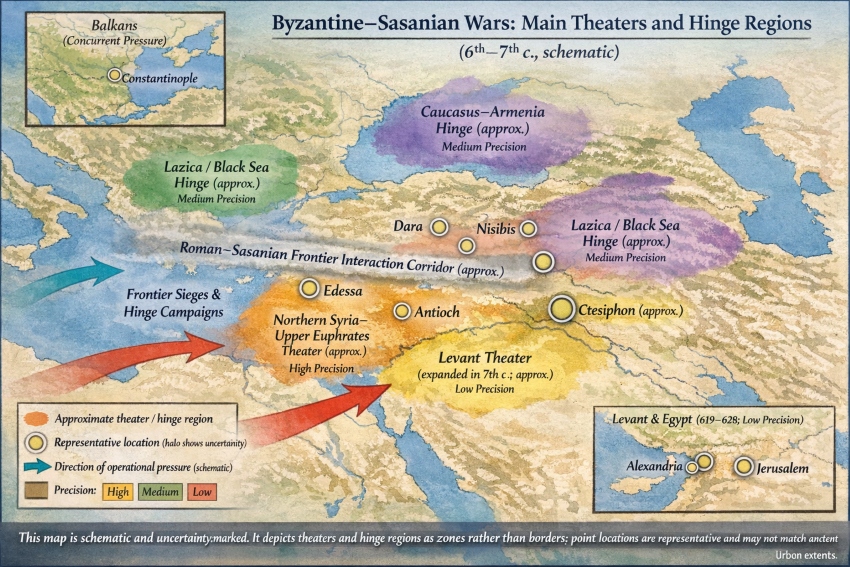
Orientation: why “road to war” is best treated as a repeating cycle
Fact: Between 502 and 628, Roman–Sasanian relations repeatedly shifted between formal peace agreements and renewed campaigning. The best-attested pattern is that treaties tried to “engineer” stability by regulating frontier fortifications, payments/subsidies, trade rules, and buffer/client regions (especially the Caucasus and the Arab federate zones).
Interpretation (attributed): Encyclopaedia Iranica’s synthesis frames several resumptions of war as arising when client disputes (notably among Arab vassals) and Caucasus/Armenia questions interacted with broader imperial competition. This is a structural reading rather than a contemporaneous “single-cause” claim. Confidence: Medium (pattern is clear; causal weighting varies by episode).
A short trigger timeline for Part 2 (select escalation points)
- 502 — Kavād I’s renewed request for funds (to meet Hephthalite obligations) is refused; Persian forces attack Roman Armenia and besiege Amida.
- 526–532 — Ongoing fighting in the Caucasus and Mesopotamian frontier; “eternal peace” is concluded in 532, including financial and frontier/fortress arrangements.
- 540 — Khosrow I breaks the 532 settlement; war is linked (in contemporary narrative framing) to disputes among Arab foederati/vassals; Antioch is captured.
- 562 — “Fifty years of peace” treaty: mutual relinquishment of gains; Byzantine annual payments framed as supporting Caucasus defense.
- 572 — Justin II halts payments and conflict resumes; some narratives assign principal responsibility to Justin II, while other chronographic traditions differ.
- 590–591 — Khosrow II appeals to Maurice after a usurpation; Maurice provides aid in return for territorial concessions, after which relations temporarily stabilize.
- 602–603 — Phocas’ coup and the killing of Maurice is followed by Khosrow II declaring war “ostensibly” to avenge Maurice; Persian forces mobilize for the 603 campaigning season.
The bargaining problems that kept returning
1) Payments/subsidies as “price of peace,” and why they were unstable
Fact: Multiple settlements explicitly connected peace to payments framed as financing defense costs (especially in the Caucasus). Iranica summarizes the 562 treaty as including a Byzantine annual payment “for defense of the Caucasus,” and reports that Justin II stopped this payment roughly a decade later.
Fact: The 532 “eternal peace” is recorded in modern synthesis as confirming the territorial status quo in exchange for a large payment (Iranica’s Justinian I entry gives 11,000 pounds of gold) and includes additional administrative provisions (e.g., relocating the dux Mesopotamiae’s seat away from Dara).
Interpretation (attributed): Iranica’s narrative implies that payments were politically contestable and therefore vulnerable to interruption when court politics shifted. Confidence: Medium (supported by repeated breakdowns; internal deliberations are not directly observable at scale).
2) Buffer regions (Caucasus/Armenia/Lazica/Iberia) as recurring “deal-breakers”
Fact: The 532 settlement (as summarized in Iranica) temporarily stabilized disputes over Lazica and Iberia, with Byzantium’s possession of Lazica affirmed while recognizing Sasanian control over Iberia.
Fact: Iranica describes the post-540 conflict as continuing intermittently for roughly two decades, “mainly in Lazica … and in Armenia.”
Interpretation: A cautious, evidence-consistent way to state the mechanism is that buffer regions created repeated bargaining dilemmas because they were neither fully “internal” nor fully “external,” and local elites could switch alignment. Confidence: Medium (mechanism plausible; local motivations differ case by case).
3) Arab federates/clients: “incident” triggers that could expand fast
Fact: Iranica explicitly links the 540 renewal of war to quarrels among Arab vassals/foederati (“war became unavoidable”), while also noting broader background claims circulating in Procopius about the balance of power.
Fact: The Justinian I entry emphasizes the operational role of allied Arab tribes and describes how Roman and Sasanian aligned Arab groups operated with some autonomy.
Interpretation: Client conflicts are best treated as “spark-capable” rather than sufficient causes: they provided immediate casus belli language and frontier operational openings, but escalations still required imperial-level mobilization decisions. Confidence: High (matches the evidence structure: incidents are visible; decision-making is inferred).
Major escalations as “case files”: triggers, bargaining failure, mobilization, stated aims
A) 502–506: Kavād I, finances, and the Amida campaign
Facts (trigger sequence):
- Iranica reports that by 502 Kavād I again requested money from Anastasius I “so the king could pay what he owed the Hephthalites,” that Anastasius refused, and that Kavād responded with attacks in Roman Armenia and a siege of Amida.
Stated aims (attributed):
- In the Iranica presentation, the request is framed as a funding need tied to eastern obligations; the refusal is framed as immediate context for the outbreak.
Interpretations and confidence:
- Interpretation: “Revenue stress + refusal + opportunistic frontier strike” is a plausible causal chain, but we should not treat it as exclusive; other longstanding frontier disputes (Nisibis, Armenia) existed. Confidence: Medium (directly supported for the request/refusal; broader motives remain inferential).
B) 526–532: grinding frontier war and the 532 “eternal peace”
Facts (trigger sequence and bargaining):
- The Justinian I entry states that when Justinian assumed sole rule in 527, Byzantium and Persia were already at war; it then summarizes key campaigns and notes that peace in 532 suited both powers (including Justinian after the Nika uprising of January 532).
- Iranica describes the 532 agreement as “unlimited peace,” with Dara remaining in Byzantine hands (though with administrative changes) and Byzantine financing for Caucasus defense.
Stated aims (attributed):
- The surviving narrative record (as summarized by Iranica) presents the peace as mutually advantageous consolidation rather than a decisive victory settlement.
Interpretations and confidence:
- Interpretation: This is a classic late antique bargaining outcome: war exhaustion plus domestic constraints makes a costly but stabilizing treaty attractive. Confidence: High for “mutual advantage” as a description of the settlement’s function; Low for precise internal deliberations beyond what sources say.
C) 540 and after: the breakdown of the “eternal peace”
Facts (trigger sequence and mobilization):
- Iranica reports that in 539 an Ostrogothic embassy sought to encourage Sasanian involvement, and that Khosrow I broke the peace with a campaign begun in spring 540, described as undertaken “under the pretext of conflicts among Arab foederati.”
- Iranica also states that (once war resumed) Khosrow “swept through Syria,” capturing Antioch and extracting ransoms.
Stated aims (attributed):
- The explicit “pretext” language underscores the evidentiary point: the main narrative source tradition does not give a single, uncontested programmatic aim, but does preserve casus belli rhetoric about federate disputes.
Interpretations and confidence:
- Iranica also relays a Procopian line that Khosrow feared further growth of Justinian’s power. That is a source-attributed interpretation, not an established “motive fact.” Confidence: Low–Medium (plausible; strongly filtered through Procopius’ rhetorical agenda).
D) 562 to 572: peace architecture and its failure
Facts:
- Iranica summarizes the 562 treaty as requiring both sides to relinquish gains and seek negotiation in future disputes; it includes clauses on religion and a Byzantine annual payment in gold tied to Caucasus defense.
- Iranica reports that Justin II stopped this payment and that hostilities resumed, with Armenia and Mesopotamia repeatedly affected by campaigning.
- The Justinian I article (PDF) notes that Menander and Theophylact Simocatta assign principal responsibility to Justin II for breaking the peace, while Theophanes disagrees—an explicit reminder that even “who broke the peace” is not unanimously transmitted.
Stated aims (attributed):
- Here the safest formulation is institutional: peace depended on compliance with its payment and frontier rules; cessation of payments and renewed insurgency/rebellion dynamics (Persarmenia is explicitly mentioned by Iranica) correlate with resumption of war.
Interpretations and confidence:
- Interpretation: The episode illustrates how “treaty payments” could be politically reframed as intolerable tribute or as legitimate shared-defense funding depending on court factions and frontier conditions. Confidence: Medium (consistent with the pattern; specific court debates are largely unrecoverable).
E) 590–591 to 602–603: from alliance to the last great war
Facts (trigger sequence):
- Iranica reports that in 590 Khosrow II appealed to Maurice after a usurpation; Maurice provided financial and military aid in return for territorial concessions, and a cordial relationship followed—until Phocas murdered Maurice and his family, after which Khosrow declared war in 603, “ostensibly to avenge his benefactor.”
- The Khosrow II entry adds operational detail: Persian forces were mobilized north and south of the Taurus for the 603 campaign; Khosrow besieged Dara, coordinated with Narses, and staged a ceremony placing Theodosius under his protection. It also describes a temporary pause for recruiting (606) to secure numerical superiority.
- Howard-Johnston’s framing (as summarized on OUP’s page) dates the opening of coordinated attacks to summer 603.
Stated aims (attributed):
- The explicit stated justification in Iranica’s synthesis is vengeance/legitimacy after Maurice’s killing (“ostensibly to avenge his benefactor”).
- The Khosrow II entry also treats continued commitment to Theodosius as stable and notes (as conjecture) that territorial cessions may have been demanded as quid pro quo—this is explicitly labeled conjecture, so it should be treated as low-confidence.
Interpretations and confidence (competing explanations):
- Legitimacy/avenging Maurice (as transmitted by Theophylact and reflected in Iranica’s synthesis). Confidence: Medium–High as a public rationale; it appears repeatedly in the tradition.
- Territorial opportunity amid Roman political division (supported indirectly by the Khosrow II entry’s emphasis on Roman internal divisions and the momentum of Persian advances; still an inference about intent). Confidence: Medium (opportunity is observable; motive ranking is not).
- Client-system reconfiguration (Khosrow II entry notes abolition of the Lakhmid monarchy as part of a prospective extension of authority—again, evidence exists for the act, but strategic intent is interpretive). Confidence: Low–Medium (act is documented; explanation is inferential).
What is well-established vs what is disputed (Part 2 focus)
Well-established
- Key war resumptions and their treaty contexts: 502, 532, 540, 562, 572, 590–591, 603.
- That late antique source traditions often preserve casus belli language (e.g., federate disputes; vengeance for Maurice) while leaving deeper “intention hierarchies” underdetermined.
- That the 603 war involved prepared mobilization and coordinated operational planning (603 season mobilization; siege of Dara; alliance/ceremony around Theodosius).
Disputed / uncertain
- “Who broke the peace” in 572: key traditions disagree (Menander/Theophylact vs Theophanes, as summarized in Iranica).
- The status and authenticity of “Theodosius” in 603–610 narratives (the tradition is complex; Iranica emphasizes sustained commitment, but the broader source criticism remains contested). Confidence: Medium.
- The relative weight of “ideology/legitimacy” vs “opportunism/territorial bargaining” in Khosrow II’s decision-making. Confidence: Low–Medium (public rhetoric is visible; private intention is not).
Key Sources Used
- Encyclopaedia Iranica, “Byzantine-Iranian Relations” (treaty structure; 532/540/562/572/603 causal framings and citations to primary texts).
- Encyclopaedia Iranica, “Justinian I” (detailed war-and-peace sequence, 526–540; 532 settlement terms; 572 responsibility dispute via Menander/Theophylact/Theophanes).
- Encyclopaedia Iranica, “Kavād I” (502 outbreak framed around the refused subvention and Hephthalite obligations).
- Encyclopaedia Iranica, “Khosrow II” (603 mobilization, Dara/Edessa operations, Theodosius ceremony; recruiting pause and Roman internal division).
- James Howard-Johnston, The Last Great War of Antiquity (periodization and 603 opening framing).
- Geoffrey Greatrex & Samuel N. C. Lieu, The Roman Eastern Frontier and the Persian Wars AD 363–628 (translated narrative sources with commentary; used as a control for dating and source triangulation).
- Procopius, History of the Wars (principal near-contemporary narrative for 6th-century causation language and campaign framing).
Open Questions / Uncertainties
- Causal weighting per war: Can we distinguish “frontier incident escalation” from “strategic choice” without over-reading Procopius and later chroniclers?
- Treaty compliance mechanics: What enforcement mechanisms (if any) existed beyond reputation, retaliation, and hostage/prisoner exchange—and how did they function in practice?
- Theodosius problem: What minimum evidentiary threshold should define “likely genuine claimant” versus “usable figurehead,” given divergent traditions and later compilation?
- Role of federates: When sources cite Arab foederati as “pretext,” how often is that retrospective rationalization versus a genuine proximate trigger?
- Internal politics as drivers: Which turning points (e.g., 572; 602) show the strongest linkage between regime change and frontier war resumption, and where is that linkage overstated?